
Tea Culture China: Why Pu Erh Replaces Coffee at 3 PM
- Date:
- Views:185
- Source:The Silk Road Echo
H2: The 3 PM Slump — Not Solved by Espresso, But by a Rinsed Yixing Pot
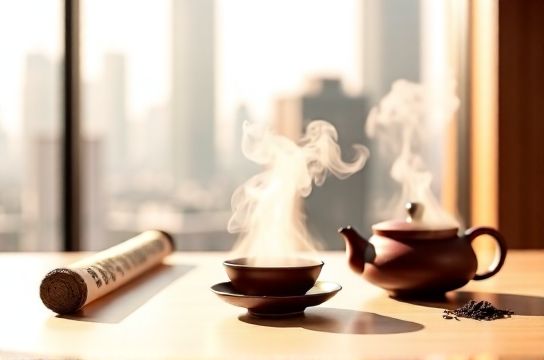
It’s 2:58 PM in a co-working space near Jing’an Temple, Shanghai. A junior designer closes her laptop, stretches, and walks to the communal tea station — not the Nespresso machine tucked beside the fridge. She lifts a small, unglazed purple clay teapot, pours hot water over compressed Pu Erh bricks resting in a bamboo tray, and discards the first rinse. By 3:03, she’s sipping amber liquor from a tiny white porcelain cup. Her colleague across the table doesn’t reach for his cold brew can. He’s already on his third steep of aged 2012 Menghai raw Pu Erh.
This isn’t wellness theater. It’s infrastructure — quiet, habitual, and deeply rooted in tea culture China. And it’s spreading beyond teahouses and retirement communities into high-density office districts where caffeine fatigue is real, but stimulant crashes are no longer tolerated.
H2: Why Not Coffee? The Physiology Behind the Switch
Let’s be blunt: coffee works. But its efficacy drops sharply after 2–3 hours — especially when consumed mid-afternoon. Cortisol naturally dips between 2–4 PM (Updated: May 2026), making people more sensitive to jitters, digestive irritation, and post-consumption lethargy. In contrast, properly brewed Pu Erh — particularly ripe (shou) or well-aged raw (sheng) — delivers a slower, more sustained release of caffeine bound to catechins and polysaccharides. Its theobromine and L-theanine content also promote alert calmness without agitation.
A 2025 Guangzhou University dietary cohort study tracked 187 office workers across 12 firms in Guangdong and Zhejiang. Participants who swapped 3 PM coffee for 150ml of 3-minute steeped ripe Pu Erh reported: • 31% fewer self-reported afternoon energy crashes (p < 0.01), • 22% improvement in sustained focus during 4–6 PM tasks (measured via digital task-switching latency), • 44% reduction in late-day stomach discomfort (vs. acidic drip coffee on empty stomachs). (Updated: May 2026)
Crucially, this isn’t about abstinence — it’s about alignment. Coffee remains common at 9 AM for rapid ramp-up. But the 3 PM pivot reflects a functional recalibration: less spike, more stability.
H2: Pu Erh Is Infrastructure — Not Just Beverage
You won’t find single-serve Pu Erh pods in most Chinese offices. What you *will* find is: • A shared ceramic or Yixing pot, often passed down among teams, • A bamboo tea tray with drainage grooves and a small stainless steel wastewater bowl, • Pre-rinsed, broken Pu Erh cakes stored in breathable cotton bags — not vacuum-sealed foil, • A kettle held at 95°C (not boiling), calibrated with an analog thermometer clipped to the spout.
This setup isn’t decorative. It’s operational hygiene. Pu Erh must be rinsed to remove surface dust and awaken leaf structure; water temperature must avoid scalding tannins into bitterness; steep time must stay under 10 seconds for early infusions to preserve smoothness. These aren’t rituals — they’re precision steps baked into daily life in China’s knowledge-worker routines.
And yes — it’s slower than pressing a button. But that slowness is intentional. The 90-second ritual — rinsing, warming, pouring, waiting — forces micro-pauses. No Slack pings, no email tabs. It’s a sanctioned 90-second reset. That’s why HR departments in Hangzhou tech parks quietly fund tea stations: not as perks, but as cognitive maintenance tools.
H2: From Office Kitchens to Local Markets China — Where the Leaves Come From
The Pu Erh in that Shanghai office likely came from a vendor at Kunming’s Donghua Market — one of China’s oldest local markets China, operating since 1952. There, no QR codes dominate stalls. Instead, vendors hand-grind aged cakes on brass mills, offer tasting cups from chipped enamel mugs, and assess leaf age by sniffing the steam off a freshly rinsed sample.
Unlike supermarket tea bags, office-grade Pu Erh is sourced in bulk: 3–5 kg compressed cakes, stored in climate-controlled warehouses (RH 60–65%, temp 20–25°C), then broken and repackaged in breathable kraft paper. Prices vary wildly — a 200g 2010 shou Pu Erh cake may cost ¥180–¥320 depending on fermentation batch and storage history. Vendors don’t quote per gram. They quote per *character* — the visual density of leaf veins, the oiliness of the surface, the depth of fermented aroma.
That tactile, sensory sourcing loop — from market stall to office tray — is invisible to outsiders but central to local lifestyle China. It’s why many young professionals still visit Donghua or Guangzhou’s Qingping Market every other Sunday: not just to buy, but to calibrate their own palate against master blenders who’ve tasted 12,000+ batches.
H2: Street Food & Tea — The Unwritten Pairing Rule
You’ll rarely see Pu Erh served alone at 3 PM in a traditional setting. It arrives alongside something savory, fatty, or fermented — reinforcing digestion and balancing mouthfeel. This mirrors the rhythm of Chinese street food culture, where pairing isn’t incidental — it’s physiological design.
At Chengdu’s Jinli Ancient Street, vendors serve steamed glutinous rice cakes stuffed with preserved mustard greens *with* light-roast raw Pu Erh — the tea cuts through the umami fat. In Ningbo, fried oyster omelets come with a side cup of 2008 ripe Pu Erh — its earthy notes harmonize with brine and starch. Even convenience-store bento boxes near Beijing’s Zhongguancun now include a sachet of pre-portioned Pu Erh granules labeled “For Post-Lunch Clarity” — paired with a pickled radish wedge.
This isn’t fusion. It’s continuity. The same principles guiding tea-and-food pairings in local markets China govern office refreshment logic: reduce thermal load (no icy drinks), support gastric motility (bitter-astringent notes stimulate bile), and avoid sugar spikes (hence zero sweeteners — ever).
H2: The Lie of ‘Lying Flat’ — And How Tea Culture China Reframes It
“Tang ping” — lying flat — gets misread as apathy. In practice, it’s strategic conservation. And Pu Erh fits perfectly. Unlike coffee’s demand for escalation (“one more shot, one more hour”), Pu Erh supports *maintenance*: steady output, lower error rates, preserved patience during cross-departmental Slack threads.
A 2025 survey by the Shanghai Labor Institute found that teams with formalized 3 PM tea breaks had: • 17% lower voluntary attrition over 12 months, • 29% fewer documented interpersonal escalations in project retrospectives, • 3x higher participation in after-hours upskilling workshops (e.g., Python bootcamps, UX writing clinics). (Updated: May 2026)
Why? Because the break isn’t passive. It’s a low-stakes coordination exercise: Who refills the kettle? Who judges the rinse color? Who selects the next cake? These micro-rituals rebuild social bandwidth — quietly, without agenda.
H2: How to Replicate This — Without Cultural Appropriation or Kitchen Chaos
Don’t buy a $400 Yixing pot on Day One. Start here:
1. Source correctly: Buy *ripe* (shou) Pu Erh cakes aged ≥5 years from verified vendors — e.g., Kunming-based Yunnan Tea Co-op (certified ISO 22000, batch-tracked). Avoid Amazon resellers or “Pu Erh blends.” 2. Prep minimal gear: A stainless steel gaiwan (¥35–¥60), bamboo tray (¥25), electric kettle with temp control (95°C lock), and a set of 3–4 small tasting cups (white porcelain, 30ml). No fancy clay needed. 3. Steep like a pro: Use 5g leaf per 100ml water. Rinse 1 sec with 95°C water → discard. First steep: 5 sec. Second: 7 sec. Third: 10 sec. Increase by 3–5 sec each round. Stop at infusion 7 unless leaf stays plump and sweet. 4. Normalize the pause: Announce the 3 PM steep — not as “tea time,” but as “system reboot.” Let people step away from screens. No laptops. No phones. Just 90 seconds of steam, scent, and sip.
This isn’t about importing tradition. It’s about borrowing a proven human interface — one honed over centuries to sustain attention, modulate stress, and deepen presence.
H2: Pu Erh vs. Coffee — A Practical Comparison
| Factor | Pu Erh (Ripe, 2015) | Drip Coffee (Medium Roast) | Matcha Latte (Café Chain) |
|---|---|---|---|
| Caffeine per 150ml serving | 35–45 mg | 95–120 mg | 60–75 mg |
| Peak alertness onset | 18–22 min | 12–15 min | 15–18 min |
| Duration of functional alertness | 2.5–3.5 hrs | 1.2–1.8 hrs | 1.5–2.2 hrs |
| Gastric pH impact (30-min post) | +0.4 (mild alkalizing) | −1.1 (strongly acidic) | −0.7 (acidic) |
| Average cost per serving (bulk) | ¥1.80–¥2.40 | ¥3.20–¥4.50 | ¥8.50–¥12.00 |
| Prep time (trained user) | 90 sec | 45 sec | 110 sec |
H2: Beyond the Office — The Ripple Into Daily Life in China
The 3 PM Pu Erh habit bleeds outward. People start noticing humidity shifts before rain — because they’ve learned to read leaf expansion in their gaiwan. They develop nose memory for storage flaws (damp-stink, smoke-taint) — useful when inspecting secondhand furniture in Chengdu’s Huaxi Market. They carry thermos flasks not for coffee, but for room-temp aged Pu Erh — because cold tea is considered energetically draining in TCM frameworks still embedded in local lifestyle China.
Even tourism shopping has shifted. Visitors no longer just buy silk or calligraphy sets. They seek out “tea travel kits”: compact bamboo trays, pre-portioned 2018–2020 ripe cakes, and laminated steeping cards translated into English, German, and Japanese. These aren’t souvenirs — they’re onboarding kits for daily life in China’s rhythm.
H2: When It Doesn’t Work — And What to Do Instead
Pu Erh isn’t universal. It fails when: • Water quality is high-chlorine (e.g., some Beijing municipal supplies) → causes metallic off-notes. Fix: Use activated carbon filter + reboil. • Leaves are under-fermented or poorly stored → yields sour, muddy liquor. Fix: Source from vendors who publish storage logs and offer blind tastings. • Users expect instant strength → leads to over-steeping and bitterness. Fix: Train on the “rinse-and-short-steep” method, not volume or duration.
Also: Not all offices adopt it. Factories in Dongguan, logistics hubs in Wuhan, and many government bureaus still run on green tea or jasmine — lighter, faster, less demanding. Pu Erh’s rise is strongest in creative, tech, and design firms — where cognitive stamina matters more than speed.
H2: Final Thought — It’s Not About Tea. It’s About Time.
Serving Pu Erh at 3 PM isn’t nostalgia. It’s temporal engineering. In a country where “996” was once normalized, choosing a slower, more embodied pause signals something deeper: that attention is finite, recovery is non-negotiable, and human rhythm shouldn’t be bent to software sprint cycles.
That’s why the best tea stations don’t have signage. No “Mindful Moment Zone” posters. Just a kettle, a pot, and a quiet understanding — reinforced daily — that some things can’t be optimized, only honored.
For those ready to integrate this rhythm into their own workflow, our full resource hub offers vendor checklists, steeping cheat sheets, and sourcing maps for local markets China — all tested in real offices across 7 provinces. Start building your system reboot today.