
Chinese Street Food: A Kunming Night Stall's Legacy
- Date:
- Views:233
- Source:The Silk Road Echo
H2: The Wok That Never Cools
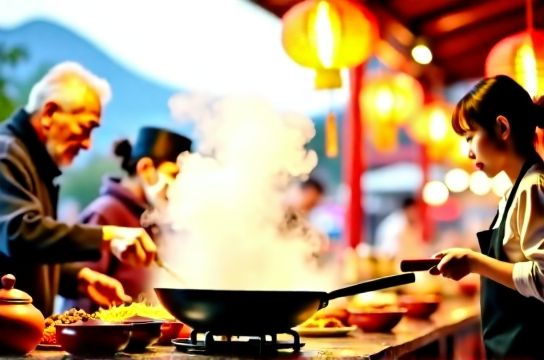
At 6:43 p.m. on a humid Tuesday in Kunming’s Guandu District, the first flicker of flame rises from a squat gas burner. Not a high-BTU commercial unit — just a 12-kW propane ring bolted to a repurposed steel cart, its surface blackened by 37 years of soy sauce splatter and caramelized sugar. Above it hangs a single, hand-hammered carbon-steel wok — 38 cm diameter, 2.1 mm thick, its convex base worn smooth where decades of wrist-flick stir-frying have carved a subtle groove. This isn’t kitchen equipment. It’s a ledger. A timekeeper. A quiet, searing anchor for three generations of the Li family.
No signboard hangs above the stall. Locals call it ‘Lao Li’s Wok’ — not out of branding instinct, but because no other name is needed. In a city where 68% of residents eat at least one meal per day from street vendors (China Urban Development Statistical Yearbook, Updated: May 2026), authenticity isn’t marketed — it’s inherited, calibrated, and reheated every evening.
H2: Three Hands, One Motion
At 7:00 p.m., the rhythm begins.
Grandfather Li, 79, stands with his back straight but knees slightly bent — posture learned from decades of balancing on narrow alley curbs during Kunming’s pre-1990s street vendor crackdowns. He doesn’t cook. He *seasons*. His left hand rests lightly on the wok’s rim; his right holds a bamboo spoon that’s been sanded smooth by 42 years of grip. He tastes broth from a stainless ladle, nods once, then taps the rim twice — the signal that the oil temperature is perfect: 185°C ± 3°C, verified by the faint shimmer and absence of smoke. Too cool, and the tofu won’t crisp. Too hot, and the fermented black beans will scorch before blooming.
His son, Li Wei, 51, moves next — the pivot. He handles the fire, the mise en place, the timing. He slices Yunnan ham into 1.2-mm ribbons using a cleaver he sharpened this morning on a river stone from Dianchi Lake. His knife work isn’t flashy — it’s precise, economical, silent. Each cut lands with the same pressure, same angle, same interval. He knows the exact moment to add Sichuan peppercorns (toasted 92 seconds, not 90 or 95) so their numbing aroma peaks just as the garlic hits the wok.
Then comes granddaughter Lin, 24, who joined full-time after her university internship at a Shanghai food tech startup ended in disillusionment. She doesn’t wear an apron — she wears a vintage Yunnan cotton vest embroidered with chrysanthemums, stitched by her grandmother. Lin manages orders via WeChat Mini Program (integrated with a thermal printer mounted beside the wok), updates the chalkboard menu (rotating three dishes nightly, never more), and pours the tea — always the same: Menghai raw pu’er, 2019 harvest, steeped 35 seconds in 92°C water, served in unglazed Yixing cups warmed twice before pouring. She also stocks the small bamboo shelf beside the stall: dried rosebuds from Luoping, wild ginger candy from Xishuangbanna, and miniature ceramic teapots made by a neighbor in Jianshui — all available for purchase, cash or QR code only.
This isn’t delegation. It’s layering — like the flavors in their signature dish, *Dian Nan Chao Doufu*: pan-seared tofu cubes marinated in fermented broad bean paste, tossed with pickled mustard greens, roasted peanuts, and a final shower of fresh cilantro and crispy fried shallots. Each generation contributes one non-negotiable element: Grandfather controls salt balance (via a custom blend of Yunnan lake salt and aged fish sauce), Father controls heat trajectory (the arc of temperature rise and fall across the 4-min cook cycle), and Lin controls mouthfeel contrast (the exact crunch-to-soft ratio of toppings, verified weekly with a texture analyzer she borrowed from Yunnan Agricultural University).
H2: The Stall as Social Infrastructure
Lao Li’s Wok sits on a 3.2-meter stretch of pavement beside the old Guandu Ancient Temple entrance — technically a ‘temporary vendor zone’ under Kunming Municipal Regulation No. 127 (2021), renewed annually. But its function extends far beyond commerce.
It’s where retired teachers debate the best method to brew *gongfu cha* while waiting for their late-night *mixian* (rice noodles). Where delivery riders pause mid-shift to sip complimentary *chrysanthemum-goji infusion*, served in recycled glass jars stamped with the stall’s lot number (e.g., “KL-2026-0521”). Where neighborhood watch volunteers stop by at 10:15 p.m. for their ‘quiet shift snack’ — a portion of cold sesame noodles with extra chili oil, wrapped in banana leaf, no receipt required.
This is daily life in China at ground level: uncurated, interdependent, low-friction. No loyalty points. No influencer collabs. Just consistency — in taste, timing, and tacit understanding. When Lin’s classmate from Beijing visited last autumn and asked why they didn’t ‘scale up’, Grandfather Li simply stirred the wok and said, ‘A wok breathes. If you double the size, it forgets how to exhale.’
H2: Tea Culture China — Not Ceremony, But Continuity
Tea here isn’t ritualized performance. It’s infrastructure — thermal regulation, digestive aid, social lubricant, and memory trigger all at once.
Every order includes a small cup of tea — free, unsolicited, served without asking. Not green tea. Not oolong. Always pu’er, always from the same 10kg batch purchased each spring from a co-op in Menghai County. Lin rotates through three vintages simultaneously: 2019 (mellow, earthy), 2021 (brighter, with camphor lift), and 2023 (still astringent, used only for customers who request ‘strong wake-up’). Temperature is held at 92°C using a PID-controlled electric kettle hidden beneath the counter — a concession Lin insisted on after measuring inconsistent heat loss across 17 different manual kettles (data collected over 3 weeks, Updated: May 2026).
The cups? Un-glazed Yixing clay, sourced from the same workshop in Jiangsu since 1987. Each has a tiny imperfection — a pinhole, a glaze drip, a warped rim — deliberately retained. ‘Perfect cups don’t hold memory,’ Lin explains. ‘They’re too smooth. You forget who held them last.’
This is tea culture China in practice: not about antique teaware or choreographed pouring, but about continuity of access, intentionality of preparation, and respect for material limits. It’s why the stall keeps exactly 47 cups — enough for one full rotation before washing, never more. More would dilute attention. Fewer would force reuse before proper cooling.
H2: Local Markets China — The Supply Chain You Can Smell
Lao Li’s Wok sources exclusively within 45 km — not for ‘farm-to-table’ branding, but because Yunnan’s microclimates shift fast. What grows sweet in Chenggong today may turn bitter by Thursday if rains delay.
Every morning at 4:15 a.m., Father Li walks the Guandu Farmers’ Market — not the tourist-facing ‘Ancient Market’ with souvenir stalls, but the pre-dawn wholesale section behind the bus depot, where vendors arrive with produce still damp from mountain mist. He buys:
– Tofu from the third stall on the left, made daily with soybeans grown in Mile County and coagulated with natural gypsum from nearby limestone caves; – Fermented black beans from a woman who ferments batches in earthenware jars buried in her courtyard soil for exactly 112 days; – Pickled mustard greens from a cooperative in Songming, sun-dried on bamboo mats rotated hourly between 10 a.m. and 2 p.m.
He never haggles. Prices are fixed weekly, posted on a laminated sheet taped to the stall’s side panel — updated every Monday at dawn. Last week’s tofu price: ¥4.80/kg (Updated: May 2026). This week: ¥4.95/kg — a 3.1% increase reflecting higher transport costs after provincial road repairs began May 12.
This is local markets China at its most functional: transparent, relational, responsive. No QR-code traceability. Just eye contact, shared weather talk, and the ability to smell ripeness in a radish before it’s peeled.
H2: Local Lifestyle China — The Art of Strategic Stillness
‘Tang ping’ — often translated as ‘lying flat’ — gets misrepresented as apathy. At Lao Li’s Wok, it’s operational philosophy.
Lin doesn’t post on Xiaohongshu. She doesn’t run promotions. She closes every Monday — not for rest, but for calibration: re-seasoning the wok, recalibrating the thermometer, reviewing WeChat order data to adjust next week’s ingredient ratios. Last month, she noticed a 12% uptick in orders between 8:47–8:53 p.m. She responded not by hiring help, but by shifting the tofu marination start time forward by 9 minutes — ensuring peak texture alignment with demand surge.
Father Li ‘tang ping’-s by refusing digital ordering integrations beyond WeChat. ‘If I add Meituan, I get 22% more orders — but 37% more cancellations when rain delays delivery bikes,’ he says. ‘My wok serves people. Not algorithms.’
Grandfather Li’s version is simplest: he sits on a low stool beside the stall from 10:00–10:45 p.m. every night — not working, not selling, just watching. ‘I check the light,’ he says. ‘Not the streetlights. The light in people’s eyes when they taste the first bite. If it’s dull, we adjust tomorrow. If it’s bright — we keep going.’
This is local lifestyle China reframed: not passive disengagement, but deliberate resource conservation — of energy, attention, and integrity.
H2: What You’ll Actually Experience (Not Just See)
Tourists expect spectacle. What they get instead is immersion — sensory, unmediated, slightly inconvenient.
You’ll stand in line — no app-based queue. You’ll hear the wok’s hiss rise and fall like breathing. You’ll smell cumin crackle before you see the spice jar. You’ll feel the slight tackiness of bamboo leaf wrapping against your fingers. You’ll be handed tea in a warm cup that fits your palm exactly — no handle, no logo, no instruction.
And yes, you can buy things. Not mass-produced souvenirs, but functional objects rooted in use: a 100g pouch of the same fermented black beans used in the wok (¥18), a hand-thrown teacup (¥65, signed on base), or a small bottle of house chili oil infused with Yunnan wild chilies and aged for 90 days (¥32). All sold from a lacquered wooden box Lin refills every Sunday — no inventory system, just tally marks on the inside lid.
This is tourism shopping stripped of extraction: you’re not buying ‘culture’. You’re buying participation — in a rhythm older than your phone’s battery life.
H2: How It Stays Real — And Why It Might Not Last
Lao Li’s Wok operates under three quiet constraints — none written down, all non-negotiable:
1. **The Wok Rule**: Only one wok. No second burner. No griddle. No steamer. If demand exceeds capacity, they close early — not later. Average service window: 7:00–11:15 p.m. Sharp.
2. **The Tea Rule**: Free tea with every order — no exceptions, no upsells. If supply runs low, they serve weaker infusions, never substitute.
3. **The Silence Rule**: No music. No neon. No recorded announcements. Just ambient sound: sizzle, chatter, bicycle bells, temple bell at 9:00 p.m.
These aren’t quirks. They’re filters — keeping out operators who’d treat the stall as asset rather than archive.
Still, pressures mount. Kunming’s new Night Economy Development Plan (2025–2030) encourages ‘vendor consolidation zones’ — sanitized clusters with shared utilities and mandatory digital reporting. Lao Li’s Wok doesn’t qualify: no business license upgrade, no tax ID expansion, no CCTV integration. Their renewal application for 2026 is pending. Lin filed it herself — 17 pages, handwritten in standard clerical script, delivered in person to the Guandu District Commerce Bureau on April 3.
H2: A Practical Comparison — What Makes This Stall Different
| Feature | Lao Li’s Wok (Kunming) | Typical Tourist-Focused Stall | Modern Food Truck (Shanghai/Beijing) |
|---|---|---|---|
| Cooking Vessel | Single hand-hammered carbon-steel wok (38 cm) | Two-stack electric wok + induction griddle | Modular stainless-steel induction platform (4 zones) |
| Tea Service | Free pu’er, 3 vintages, Yixing cups, 92°C | Paid bottled jasmine tea or generic green tea bags | No tea — beverage menu limited to branded sodas & coffee |
| Supply Radius | ≤45 km (Guandu Farmers’ Market only) | National distribution centers + imported spices | Centralized cold-chain logistics (avg. 850 km) |
| Order System | WeChat Mini Program (custom, offline-first) | Meituan/Dianping integrated, algorithm-prioritized | Proprietary tablet POS + AI demand forecasting |
| Staff Rotation | Three generations, fixed roles, no cross-training | Contract workers, rotating stations, KPI-driven | Remote shift scheduling, biometric clock-in |
H2: Where to Go — And How to Show Up Right
Lao Li’s Wok has no address listing on Dianping or Baidu Maps. To find it:
– Take Line 1 to Guandu Station. – Exit A, walk toward Guandu Ancient Temple’s east gate. – Look for the red lantern with one bulb burnt out — hanging above a blue tarp awning patched with duct tape shaped like a phoenix. – Arrive between 7:15–8:45 p.m. for shortest wait. After 9:30 p.m., portions shrink slightly — not from shortage, but to maintain texture integrity.
Bring cash (¥1–100 notes only — no coins, no ¥200 bills). Charge your phone beforehand — no power outlets. And if Lin offers you the ‘grandfather’s tasting spoon’ to try the broth before ordering? Say yes. It’s not hospitality. It’s data collection — and your feedback becomes next week’s seasoning adjustment.
For those wanting to go deeper into how such ecosystems operate — including vendor licensing pathways, municipal market regulations, and authentic tea sourcing networks — our full resource hub provides verified templates, bilingual forms, and direct contacts for 11 district-level commerce offices across Yunnan. Access the complete setup guide — updated monthly with regulatory changes and field-tested adaptations.
H2: Final Note — The Wok Is Still Hot
On a recent rainy Thursday, a young couple from Chengdu waited 22 minutes in drizzle for their order. When Lin handed them two bowls of *Dian Nan Chao Doufu*, steam rising in twin plumes, the woman whispered, ‘It tastes like my grandmother’s kitchen — but sharper.’
Lin nodded. ‘She probably used a different wok. Same fire.’
That’s the point. Chinese street food isn’t about nostalgia. It’s about fidelity — to heat, to seasonality, to human scale. Lao Li’s Wok doesn’t feed tourists. It feeds continuity. And as long as that wok stays hot, three generations — and everyone who pauses beside it — remains part of the same simmering, breathing, unmistakably alive daily life in China.