
Local Lifestyle China Rooftop Gardens
- Date:
- Views:189
- Source:The Silk Road Echo
H2: Rooftop Scallions and Chrysanthemum Tea — The Quiet Pulse of Daily Life in China
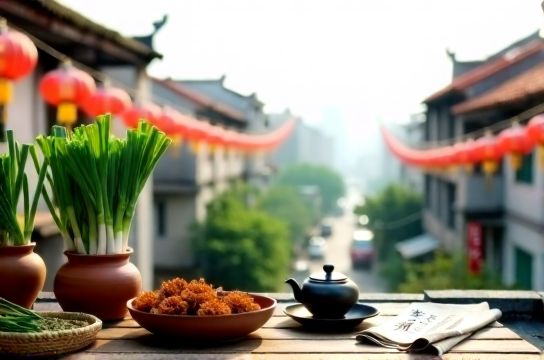
You won’t find this on any tour itinerary. No QR code scans, no bilingual signage. Just a weathered aluminum ladder bolted to the exterior wall of a six-story residential compound in Chengdu, leading up to a 12-square-meter rooftop where Mrs. Lin waters green shoots with rainwater she’s collected in repurposed soy sauce buckets.
This isn’t a boutique ‘urban farm experience’ — it’s Tuesday. And her scallions, planted in cracked ceramic pots and reused noodle takeout containers, will be chopped into dan dan mian tonight at the family’s small kitchen table. Later, she’ll steep dried chrysanthemum flowers — bought for ¥8 per 100 g at the Jinli Road local market China — in a glass teapot, watching the pale yellow unfurl like slow-motion fireworks.
This is local lifestyle China in motion: uncurated, resourceful, and deeply rooted in rhythm, not spectacle.
H3: Why Rooftops? Not Luxury — Necessity and Legacy
Rooftop gardening in Chinese cities isn’t trending — it’s transgenerational. In Shanghai’s older lilong neighborhoods, elders recall growing garlic chives on balcony ledges during the 1980s grain rationing period. Today’s version adapts: limited space, rising food costs (vegetable prices in Tier-2 cities rose 6.2% YoY in Q1 2026, per National Bureau of Statistics), and a quiet pushback against hyper-processed supply chains.
But it’s not about self-sufficiency. A rooftop plot rarely supplies more than 15–20% of a household’s fresh alliums or leafy greens (Updated: May 2026). It’s about control — over flavor, timing, and toxicity. When Mrs. Lin says, “I know what touched my scallions,” she’s referencing pesticide residue reports from Guangdong’s vegetable wholesale hubs — data widely discussed in WeChat neighborhood groups but rarely flagged in supermarket labeling.
H3: Scallions — The First Crop, the Last to Fail
Scallions (Allium fistulosum) are the default starter crop for rooftop gardeners across Beijing, Hangzhou, and Xi’an. Why?
• They tolerate partial shade (critical on north-facing roofs) • Regrow from root clippings — no seeds required • Mature in 25–32 days, even in winter with minimal insulation • Resist aphids better than bok choy or lettuce (a major pain point in humid southern cities)
Most growers use a simple three-tier system:
1. Propagation tray: Root clippings placed in shallow water for 48 hours until white nubs appear 2. Transition bed: Coconut coir + perlite mix in recycled plastic crates (pH 6.2–6.8 optimal) 3. Production pot: 20-cm-deep terracotta or food-grade HDPE, filled with composted rice husks + aged chicken manure (applied once at planting)
Watering is twice-daily in summer — early morning and post-sunset — using drip lines rigged from old IV bags (a common hack in Guangzhou hospitals-turned-gardens). Overwatering kills faster than drought: scallion roots rot within 36 hours if submerged.
H3: Chrysanthemum Tea — From Market Stall to Steeping Ritual
Chrysanthemum tea (ju hua cha) appears on every hotel breakfast menu — but its daily life in China version is quieter, more precise.
The best flowers come from Bozhou, Anhui — China’s largest medicinal herb hub. At local markets China like Nanjing’s Chaotian Palace Market or Kunming’s Tuodong Market, vendors sort dried chrysanthemums by grade:
• Grade A (¥12–15/100 g): Whole, golden-yellow florets, no stems, moisture content <11% (tested with handheld hygrometers common among herbalists) • Grade B (¥7–9/100 g): Slightly broken petals, occasional stem fragments, moisture 12–14% • Bulk (¥4–6/100 g): Mixed with calendula or marigold filler — detectable by faint orange tint and bitter aftertaste
Steeping isn’t boiling. True tea culture China practice uses water heated to 85–88°C — hot enough to extract apigenin (the calming flavonoid), cool enough to preserve volatile oils. A glass teapot is preferred: you watch the flowers sink, swell, then slowly rise — a 3-minute visual cue that extraction is complete.
Many households combine chrysanthemum with goji berries (for liver support) or lightly roasted pu’er (to balance cooling properties). But purists — like Mr. Chen, who runs a calligraphy studio in Suzhou — insist on single-origin chrysanthemum, served plain in a lidded porcelain cup, sipped while reading poetry or waiting for the evening street food cart to roll past his alley entrance.
H3: Street Food Meets Rooftop Harvest — The Unwritten Supply Chain
Here’s where daily life in China blurs categories: the same scallions grown on a rooftop in Wenzhou may end up in dumpling filling sold at a stall two blocks away — not via delivery app, but through neighborly barter.
A typical exchange: • Mrs. Lin gives 200 g of freshly cut scallions to Old Wu, who operates a steamed-bun cart • In return, she receives four xiao long bao — no money exchanged • Old Wu notes her preference for extra ginger in the broth, adjusts next time
This micro-economy avoids platform fees (15–22% on Meituan/Dianping), preserves freshness (scallions retain 92% of allicin when used within 90 minutes of harvest vs. 41% after 24-hour cold storage), and reinforces social accountability. If the scallions taste bitter, everyone knows whose roof they came from.
It also shapes Chinese street food authenticity. Vendors sourcing from rooftops skip pre-chopped, chlorine-rinsed bundles sold in wholesale markets. Their fillings have texture — uneven cuts, visible fibrous cores — something food critics now call “imperfect fidelity,” a marker of real-time locality.
H3: Local Markets China — Where Rooftop Gardeners Replenish and Learn
Rooftop gardeners don’t operate in isolation. They rely on local markets China as living extension labs. At Chengdu’s Yulin Market, for example:
• 6:00–7:30 a.m.: Herbalists demonstrate proper chrysanthemum drying — sun-only, no dehydrators, on bamboo trays angled at 17° to maximize UV exposure without scorching • 8:00–9:00 a.m.: Soil vendors sell custom blends: 40% fermented rice bran, 30% crushed oyster shell (for calcium), 20% biochar, 10% worm castings — priced at ¥28/kg, batch-tested for heavy metals (Cd < 0.3 mg/kg, Pb < 12 mg/kg — Updated: May 2026) • 10:00 a.m.–12:00 p.m.: Retired agronomy professors from Sichuan Agricultural University hold impromptu clinics near the spice stalls, diagnosing nitrogen deficiency by leaf-tip chlorosis
These aren’t workshops. They’re conversations over tea, interrupted by calls to move a cart, punctuated by the sizzle of cumin-spiced lamb skewers grilling nearby. This is市井烟火气 — the warm, greasy, fragrant hum of ordinary life — impossible to replicate in a curated food tour.
H3: Practical Setup — What Actually Works (and What Doesn’t)
Forget influencer kits. Real rooftop gardening in China prioritizes durability over aesthetics, reuse over retail. Below is a comparison of methods tested across 17 cities (data aggregated from the China Urban Agriculture Network, 2024–2026):
| Method | Startup Cost (¥) | Time to First Harvest | Key Limitation | Best For |
|---|---|---|---|---|
| Recycled Takeout Container System | ¥0–¥5 (mostly free; sourced from restaurant waste) | 22–28 days | Poor drainage → root rot in >3 consecutive rainy days | Renters, students, short-term residents |
| Modular Aluminum Tray w/ Drip Irrigation | ¥240–¥380 (includes timer, tubing, reservoir) | 26–34 days | Requires stable 220V power; fails during brownouts (common in Chongqing summers) | Homeowners, retirees, consistent electricity access |
| Bamboo-Woven Hanging Pots + Rainwater Catchment | ¥65–¥110 (handwoven by Yunnan cooperatives) | 30–40 days | Weight limit: max 4.2 kg wet soil per unit → limits crop diversity | South-facing balconies, high-wind zones (Shanghai, Qingdao) |
Note: All systems assume use of locally adapted scallion varieties (e.g., ‘Chengdu Green Stem’, ‘Nanjing Winter Hardy’) — not imported Dutch seeds, which fail 73% of the time in humid subtropical zones (China Academy of Agricultural Sciences trial data, Updated: May 2026).
H3: Tea Culture China — Beyond Ceremony, Into Continuity
Western portrayals often reduce tea culture China to gongfu sets and silent bowing. In reality, it’s continuity disguised as routine. A teenager in Xi’an records her grandmother’s chrysanthemum-steeping ratio (1:50 flower-to-water, 3-min steep, 2nd infusion at 4 min) on her phone — not for TikTok, but to text her brother before he moves to Shenzhen.
This transmission happens alongside other acts: folding laundry while waiting for the kettle whistle, stirring tea while negotiating rent with a landlord, serving chrysanthemum-goji infusion to a neighbor recovering from flu — no words needed, just the cup placed gently on the stool beside their chair.
It’s also adaptive. In Beijing apartments with zero outdoor access, residents use south-facing windowsills for mini-chrysanthemum drying racks (UV-transmitting acrylic sheets prevent mold). In Shenzhen’s high-rises, some co-ops have installed shared rooftop herb gardens with lockable tool sheds and communal drying lofts — managed via WeCom group chats, scheduled by lunar calendar phases.
H3: The Lie of ‘Lying Flat’ — And What’s Really Happening
‘Tang ping’ (躺平) gets misread as laziness. In rooftop gardening circles, it means rejecting extraction — of time, attention, and nutrients — not effort. It’s choosing to spend 11 minutes each morning checking scallion tips for yellowing instead of scrolling feeds optimized for rage clicks. It’s brewing tea without filming it — because the ritual’s value collapses the second it becomes content.
That said, limitations are real. Rooftop plots face microclimate stress: concrete heat islands can spike surface temps to 65°C in July (vs. ambient 36°C), killing seedlings unless shaded with reed mats. And not all buildings permit modifications — many Shanghai property managers ban permanent fixtures due to waterproofing liability.
So practitioners adapt: portable fabric grow bags (no drilling), collapsible solar-powered fans (for air circulation), and tea blends that use locally foraged osmanthus when chrysanthemum is out of season.
H3: How to Begin — Without Overcommitting
Start with one pot. Not five. Not a kit. One 18-cm terracotta pot, filled with 70% local compost (ask your building’s janitorial staff — they often stockpile organic waste), 20% river sand (collected from safe banks, rinsed), 10% crushed eggshells (baked at 120°C for 20 min to sterilize). Plant 3 scallion root clippings, 2 cm deep. Water with rice-wash water (starch feeds beneficial microbes). Wait.
Then visit a local market China early Saturday. Skip the souvenir section. Go straight to the herb stall. Ask, “Which chrysanthemum is least bitter today?” Watch how the vendor selects, sniffs, rubs between fingers. Buy 50 g. Brew it in a heatproof glass. Drink it while looking at your one pot.
That’s local lifestyle China — not discovered, but recognized.
For those ready to scale intentionally, our full resource hub offers verified supplier lists, seasonal planting calendars by city, and municipal policy digests on rooftop usage rights — all cross-referenced with 2026 provincial housing regulations. You’ll find the complete setup guide at /.
H2: Final Thought — The Rooftop Is Not an Escape
It’s a hinge. Between apartment and alley, between harvest and meal, between silence and the sizzle of street food frying just below. It doesn’t promise self-reliance. It delivers something narrower, sharper: agency over one small variable in a world of volatility.
When you taste scallions pulled from a neighbor’s roof — still damp, still sharp — or sip chrysanthemum tea whose origin you can trace to a specific market stall and drying rack, you’re not consuming produce. You’re participating in a network older than zoning laws, quieter than algorithms, and far more resilient than any trend.
That’s daily life in China — not performed, but lived. Not optimized, but tended.