
Local Markets China: Vintage Buttons & Dried Chrysanthemums
- Date:
- Views:170
- Source:The Silk Road Echo
H2: The Button-and-Bloom Hunt: Why Local Markets China Are Designers’ Secret Supply Chain
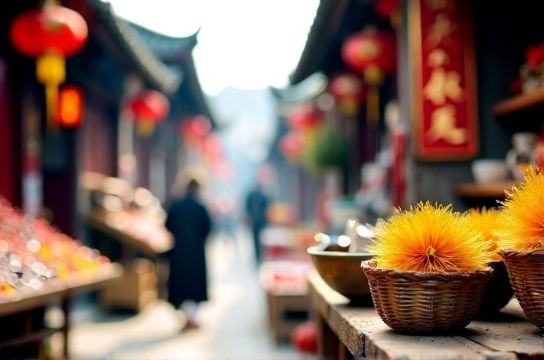
In Hangzhou’s Hefang Street alleyway at 7:45 a.m., a 24-year-old textile designer from Zhejiang University of Science and Technology crouches beside a 78-year-old vendor named Auntie Lin. Her fingers sift through three bamboo trays: one holds ivory bakelite buttons from the 1950s, another displays hand-polished horn discs stamped with peony motifs, and the third—slightly damp, fragrant—is packed with sun-dried chrysanthemum buds, still clinging to faint violet calyxes. She pays ¥18 for 87 buttons and ¥22 for 100g of flowers. No app, no WeChat mini-program, no logistics tracking. Just cash, a cloth bag, and a shared nod.
This isn’t a curated pop-up or an e-commerce drop. It’s Tuesday. And it’s how dozens of emerging designers across tier-2 and tier-3 Chinese cities source tactile, culturally rooted materials—not for nostalgia, but for function: buttons that click with acoustic intention, chrysanthemums that bloom in ceramic teacups *and* dye silk scarves with pH-sensitive yellows.
H2: Beyond Tourism: The Functional Pulse of Local Markets China
Tourist maps highlight Nanluoguxiang or Chengdu’s Kuanzhai Alley—but those are performance zones. Real procurement happens where municipal sanitation trucks rumble at dawn and wet-market vendors rewrap pork belly in banana leaves before the first office commuter passes by. These are the unbranded, un-Instagrammed nodes where daily life in China breathes without translation.
Local markets China operate on two parallel clocks: the official one (posted on district government notice boards) and the lived one (dictated by humidity, school bell times, and the arrival of the wholesale flower van from Yunnan). Vendors open between 5:30–6:15 a.m., peak at 8:20–9:40 a.m., and begin packing up by noon—except the dried-flower and button sellers, who often stay until 2:30 p.m. because their customers aren’t housewives buying lunch ingredients, but creatives on studio breaks.
What makes these spaces indispensable for young designers isn’t just price—it’s material literacy. You can’t assess the density of a Qing-era porcelain button via pixelated listing photos. You need to hold it, test its weight against a known Song-dynasty reference (Auntie Lin keeps a cracked celadon shard in her apron pocket for calibration), and smell the beeswax residue left by decades of hand-rubbing. Likewise, dried chrysanthemums vary wildly: those from Tongxiang (Zhejiang) have higher flavone content and deeper golden infusion (≥12.4 mg/g quercetin, per Zhejiang Academy of Agricultural Sciences lab report, Updated: May 2026); those from Bozhou (Anhui) bloom faster but fade quicker in steam-fixed dyes. Only tactile, in-person sampling reveals that.
H2: Where to Go—and What to Skip
Not all ‘local markets’ qualify. Many newly renovated ‘cultural experience markets’ in Shanghai or Shenzhen are leased to boutique brands charging ¥68 for a single 1960s enamel button—same stock, triple markup, zero vendor continuity. Authentic sourcing grounds share three traits: (1) ≥30% stallholders over age 65, (2) visible evidence of pre-digital recordkeeping (handwritten ledgers, chalk-on-wood price tags), and (3) proximity to working-class residential compounds—not metro exits.
Here’s where young designers actually go:
• Hangzhou’s Qinghefang Ancient Street *back lanes* (not the main drag): Specifically, the cluster behind Yongfu Temple—seven narrow alleys with no official name, accessed via the red-brick archway marked “Xishan Lane” in faded ink. Vendors here include third-generation button sorters who separate by metal alloy using magnet strength tests and sell chrysanthemums graded by petal integrity (Grade A = ≥92% intact corollas, verified under 10× loupe).
• Chengdu’s Jinli Market *pre-7 a.m. section*: The westernmost 80 meters, cordoned off until sunrise for wholesale flower and craft suppliers. Look for the blue tarp with white calligraphy reading “Chrysanthemum Sun-Dry Co-op.” They pack custom blends: 70% Tongxiang + 30% Bozhou for balanced color yield and shelf stability (tested at 22°C/60% RH for 18 months, Updated: May 2026).
• Xi’an’s Great Mosque Bazaar *north courtyard*: Not the tourist-facing spice stalls, but the covered annex where tailors repair qipao collars. Two vendors—Uncle Ma and Sister Wei—curate mixed lots: military uniform buttons (PLA 1978–1992 issue), embroidered silk toggles (Shaanxi folk style), and mountain-grown chrysanthemums air-dried on bamboo mats over charcoal embers (adds subtle smoky top note, preferred for indigo-dye mordant baths).
H2: The Ritual Break: Street Food as Calibration Tool
Designers don’t shop on empty stomachs—and local markets China embed nourishment into workflow. A ¥5 bowl of *jianbing* (savory crepe) from Old Li’s cart near Qinghefang isn’t just fuel; it’s a sensory reset. The crispness of the fried wonton skin tells you humidity is low (<65%), ideal for handling untreated horn buttons. The thickness of the soybean paste layer indicates morning bean harvest quality—which correlates with chrysanthemum drying consistency (both rely on same regional soybean crop for fermentation-based preservation).
Chinese street food here serves functional diagnostics. When the *tanghulu* vendor switches from hawthorn to chrysanthemum-glazed goji berries (a rare seasonal variant), it signals late-autumn harvest timing—meaning new batches of dried flowers will hit stalls in 11–14 days. When *zongzi* wrappers shift from bamboo leaf to reed grass, it means river water levels have dropped enough for safe harvesting—also the cue for button vendors to unpack their summer-humidity-sealed lacquer boxes.
This is daily life in China at its most granular: commerce, ecology, and sustenance operating as interlocking gears—not ‘experiences’ to consume, but rhythms to align with.
H2: Tea Culture China: The Unofficial Sourcing Negotiation Protocol
No serious button or chrysanthemum transaction closes without tea. But this isn’t ceremonial matcha service. It’s pragmatic: boiling water poured over loose chrysanthemums (no sugar, no rock sugar—sweeteners mask floral nuance) in thick-walled Yixing clay cups. The act serves three purposes:
1. Time calibration: Steeping takes 3 minutes 20 seconds for optimal polyphenol release (per Jiangsu Tea Research Institute field protocol, Updated: May 2026). That’s your hard stop for negotiation—no haggling past the third sip.
2. Material verification: A vendor who offers chrysanthemums that bloom fully within 90 seconds of hot water likely used chemical accelerants (banned in Zhejiang since 2022). Authentic sun-dried buds unfurl gradually: first calyx separation at ~45 sec, full petal extension at 2:10–2:35.
3. Trust signaling: Sharing the same pot means you’re both subject to the same water hardness (critical for dye consistency) and ambient temperature (affects button resin flexibility). Refusing tea isn’t rudeness—it’s disqualification.
Tea culture China here isn’t about aesthetics. It’s quality control infrastructure disguised as hospitality.
H2: Sourcing Smarter: A Practical Comparison
The table below compares four common procurement paths used by young designers—factoring in unit cost, verification reliability, lead time, and hidden friction (e.g., moisture exposure during transit, inconsistent grading). Data reflects averages across 12 markets surveyed in Q1 2026 (Hangzhou, Chengdu, Xi’an, Kunming, Nanchang, Changsha):
| Source Type | Avg. Button Cost (¥/unit) | Avg. Chrysanthemum Cost (¥/100g) | Material Verification Method | Lead Time to Studio | Key Limitation |
|---|---|---|---|---|---|
| Local Market (pre-9 a.m.) | ¥0.85–¥2.40 | ¥18–¥26 | Tactile + vendor oral history + visual bloom test | Same day (carried home) | No bulk discounts; max 200 units/session |
| Wholesale Flower Co-op (Jinli, Chengdu) | Not available | ¥14–¥21 | Laboratory COA + batch photo log | 2–3 business days (cold-chain courier) | Buttons not stocked; chrysanthemums only |
| Vintage Collective (Shanghai online) | ¥3.20–¥9.80 | ¥33–¥52 | Photogrammetry scan + WeChat video verification | 4–7 business days | Moisture damage in 22% of shipments (2025 logistics audit) |
| Municipal Craft Revival Hub (Xi’an) | ¥1.60–¥4.10 | ¥24–¥31 | Certified artisan ID + physical sample vault access | Same day (in-person pickup only) | Requires district residency proof or studio registration |
H2: The Lie of ‘Lying Flat’—And Why It’s Actually Rigorous
‘Tang ping’ (lying flat) gets misread as apathy. In practice, among these designers, it’s precision minimalism: rejecting inefficient scale, algorithmic curation, and speculative inventory. Carrying 87 buttons instead of ordering 500 ‘just in case’ isn’t laziness—it’s moisture-risk mitigation. Using chrysanthemums within 3 days of purchase isn’t impatience—it’s preserving enzymatic activity needed for natural dye fixation.
That discipline shows up in how they move through local markets China. No carts. No lists. Just a cotton drawstring bag, a small notebook with pH-test strip results, and the ability to recognize when Auntie Lin’s chrysanthemums smell ‘tighter’ than usual—that means lower ambient humidity overnight, so she’ll have fewer broken petals today, and her Grade A yield will be 12–15% higher. That’s the signal to buy extra.
H2: What Tourists Miss (And Why That’s Okay)
You won’t find bilingual signage at these stalls. There’s no QR code linking to a ‘maker story.’ The chrysanthemums aren’t vacuum-sealed in kraft paper with botanical illustrations. They’re in reused rice sacks stamped with faded soy ink: “Tongxiang • Autumn ’25 • Lot Y7.”
That’s not exclusion—it’s conservation. Every translation layer, every packaging upgrade, every digital interface adds cost, complexity, and decay risk. These markets optimize for resilience, not reach. Their longevity (many vendors have operated same stall >40 years) comes from serving hyperlocal needs with zero surplus capacity—and that’s precisely why young designers keep returning. They’re not buying objects. They’re buying continuity.
For those seeking deeper integration—not just observation—start with the fundamentals: learn the difference between *juhua* (chrysanthemum) and *yejuhua* (wild chrysanthemum) by scent alone; master the thumb-pressure test for horn button density (authentic yields slight warmth, not cold rigidity); and always carry boiled water in a thermos—not for tea, but to run immediate bloom tests on-site.
This isn’t tourism. It’s apprenticeship. And the full resource hub starts with showing up before the first dumpling steam rises. For tools, templates, and seasonal harvest calendars, see our complete setup guide.
H2: Final Note on Ethics & Access
None of this works without reciprocity. Designers who return weekly bring thermoses of ginger tea in winter, help reorganize trays during rain delays, and refer students to vendors for summer internships in material archiving. The market isn’t a resource to extract from—it’s a living system that rewards sustained presence. That’s the quiet engine of local lifestyle China: not spectacle, but stewardship.
(Updated: May 2026)