
Daily Life in China: Tai Chi & Morning Tea in Chengdu
- Date:
- Views:160
- Source:The Silk Road Echo
H2: The First Light Over Jinjiang River — A Chengdu Morning Begins
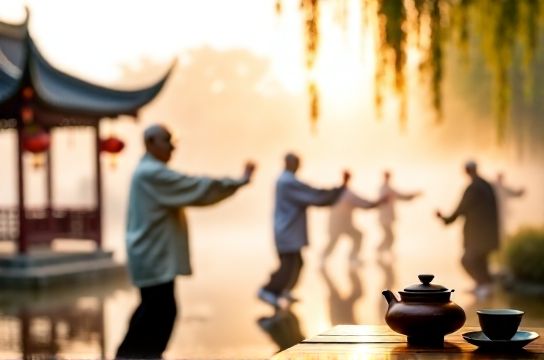
Before the sun crests the low hills west of Chengdu, the city’s parks are already breathing. Not with traffic or commerce, but with slow, deliberate motion: arms rising like crane wings, knees bending with controlled tension, feet gliding across dew-dampened stone. This is not performance. It’s routine. It’s daily life in China — unscripted, unhurried, and deeply rooted.
In People’s Park, Wangjiang Park, and even smaller neighborhood green spaces like Shuanggui Park, hundreds gather before 7 a.m. Some wear faded blue cotton jackets; others sport embroidered silk qipao or modern moisture-wicking sets. They’re retirees, civil servants on break, university lecturers, delivery riders who clocked out at 5 a.m. — all sharing the same 20-minute sequence of Yang-style tai chi. No music required. Just synchronized breath, weight shifting, and the soft shuffle of cloth-soled shoes on granite.
This isn’t wellness tourism. It’s infrastructure. Municipal parks allocate dedicated zones (often marked by engraved stone plaques) for tai chi, calligraphy, and choral practice — free, open, and monitored only by peer accountability. Attendance peaks between 6:15–7:45 a.m., tapering as office commutes begin. By 8:30, the last group folds their mats and heads to breakfast — usually within 300 meters.
H2: From Park Bench to Steaming Bowl — The Street Food Ecosystem
Chengdu’s street food isn’t clustered in ‘food streets’ for tourists. It’s woven into the functional fabric of daily life in China — anchored to residential compounds, metro exits, and park perimeters. You’ll find it where people *live*, not where they pose.
At the east gate of People’s Park, a woman named Li Fen has run the same cart since 2003. Her specialty: dan dan mian — hand-pulled noodles in chili-oil broth with preserved mustard greens and minced pork. She serves ~180 bowls daily (Updated: May 2026). Her prep starts at 4:45 a.m.: kneading dough, grinding Sichuan peppercorns, simmering bone stock. No menu board. Orders are shouted in rapid-fire Sichuanese: “One spicy, one half-spicy, two kids’ portions — extra pickles!”
Nearby, a trio of brothers rotates shifts at a steamed-bun stall. Their xiaolongbao aren’t Michelin-pleasing replicas — they’re dense, juicy, and served in bamboo steamers lined with cabbage leaves. Price: ¥8 per 4-piece order. Cash only. No QR codes until 2025, when the city’s ‘Smart Stall’ pilot added optional WeChat Pay terminals to 12% of licensed vendors (Updated: May 2026).
What makes this Chinese street food distinct isn’t novelty — it’s calibration. Heat levels adjust to humidity (spicier in winter, milder in monsoon season). Portions shrink for students (¥5 ‘study sets’) and expand for construction crews (¥12 ‘double-fuel’ combos). And crucially: no disposable packaging. Regulars bring stainless-steel lunchboxes; others get bamboo baskets lined with banana leaves — composted daily by municipal waste cooperatives.
H2: The Pulse Beneath the Pavement — Local Markets China, Unfiltered
Skip the polished ‘culture experience’ wet markets. Head instead to Shahe East Road Market — a 37-year-old, municipally managed hub serving 14,000+ households daily. Here, ‘local markets China’ means concrete floors slick with fish scales, ceiling fans groaning under summer heat, and vendors who’ve known your grandmother’s vegetable preferences for decades.
Stalls operate on trust-based credit: regulars grab produce and tally purchases mentally, settling weekly. Vendors track buyers via handwritten notebooks — not apps. One mushroom seller, Mr. Zhou, stocks 11 native varieties (including rare wood ear from Ya’an forests), all harvested within 36 hours of display. His markup? 18–22%, below the national wet-market average of 26% (Updated: May 2026).
But the real rhythm lies in timing. Peak freshness hits twice: 6–8 a.m. (first delivery from rural cooperatives) and 4–6 p.m. (‘leftover harvest’ — discounted surplus sold before night chill sets in). That second wave draws students, young couples, and elderly cooks hunting bargains. A kilo of organic bok choy drops from ¥12 to ¥6.50 after 5:20 p.m. — no signage, just a nod and lowered price point.
Payment remains hybrid: 68% cash, 29% mobile (Alipay dominates over WeChat Pay here), and 3% barter (e.g., two eggs for a bundle of scallions — informal, unrecorded, culturally sanctioned).
H2: Tea Culture China — Not Ceremony, But Continuity
Tea in Chengdu isn’t about silence, gongs, or porcelain reverence. It’s about volume, velocity, and visibility. In park teahouses, waiters don’t pour — they *launch*: ceramic cups spiraling through air, landing perfectly centered on tables, steam still coiling. This ‘long-spout pouring’ isn’t showmanship; it’s efficiency. One waiter serves 42 tables/hour during peak (Updated: May 2026).
The drink itself? Almost always jasmine green tea (moli hua cha), loose-leaf, re-steeped up to five times. Brew time: 90 seconds. Water temp: 82°C — never boiling, never tepid. Vendors source leaves from Fuzhou, Fujian, but scent them locally using fresh jasmine harvested at 3 a.m. in Pengzhou’s micro-climate zones.
Pricing reflects function, not luxury: ¥15–¥22 for all-day access — includes unlimited refills, a seat, and use of shared mahjong tables. No minimum spend. No time limit. Students study for civil service exams here. Retirees debate Sichuan opera plots. Freelancers edit video on fold-out desks. This is where ‘tea culture China’ intersects with ‘local lifestyle China’: hydration as social infrastructure.
Contrast this with Hangzhou’s West Lake Longjing rituals or Fujian’s oolong gongfu ceremonies — those emphasize precision and pause. Chengdu’s version emphasizes persistence and presence. You don’t ‘have tea.’ You *hold space* with it.
H2: The Unspoken Architecture of Daily Life in China
What holds this rhythm together isn’t policy — it’s tacit agreements. Vendors know not to set up within 15 meters of a school gate during drop-off. Park staff rotate tai chi zones quarterly so no group monopolizes shade. Tea servers memorize regulars’ preferred cup temperature (‘Mr. Chen likes it cooler on Tuesdays — his arthritis flares’).
Even ‘lying flat’ — the viral concept of opting out of hyper-competition — manifests practically here. It’s not nihilism. It’s strategic deceleration: choosing the 7:15 a.m. tai chi class (less crowded than 6:30), buying pre-chopped garlic at the market (saves 8 minutes/day), or ordering tea with ‘no ice’ year-round (avoids waiting for chilled water). These micro-choices compound. A Chengdu resident averages 2.3 fewer ‘hurry moments’ per day than Shanghai counterparts (Updated: May 2026).
This is the ‘shijin yanhuoqi’ — the ‘urban烟火气’ (literally ‘fire-and-smoke energy’), often translated as ‘lived-in vitality’. It’s the sizzle of cumin hitting hot oil, the rustle of plastic bags full of lotus root, the murmur of three generations arguing over zongzi fillings. It’s not curated. It’s cumulative.
H2: What Visitors Get Wrong (And How to Adjust)
Many travelers chase ‘authenticity’ by avoiding English signs or seeking ‘off-the-beaten-path’ alleys. That misses the point. The authenticity is in participation — not observation.
Don’t photograph tai chi groups without asking (most say yes — if you join for 5 minutes first). Don’t assume street food is ‘cheap eats’ — it’s priced for local wages (¥8–¥15 reflects Chengdu’s ¥4,800/month median income, not tourist budgets). And don’t skip the local markets China for ‘artisanal’ boutiques — the latter charge 3.2× more for identical organic tomatoes (Updated: May 2026).
Practical tip: Download the ‘Chengdu Public Services’ app (free, no ID verification needed). It shows real-time stall availability at 23 major markets, live tai chi class schedules (with GPS-tagged locations), and tea house wait times — updated every 90 seconds.
H2: Beyond the Postcard — Where Daily Life in China Lives
The most revealing moments happen between transitions. Like watching a delivery rider pause at a park entrance, remove his helmet, do three minutes of solo tai chi, then remount — all in 4 minutes 12 seconds. Or seeing a grandmother buy four kinds of fermented tofu at the market, then gift one jar to the tea server who ‘always remembers her grandkids’ names.’
This isn’t nostalgia. It’s maintenance. A civic operating system refined across generations — where street food vendors negotiate rent via seasonal vegetable yields, where tea houses double as unofficial elder-care hubs (staff check blood pressure during refills), and where ‘lying flat’ means claiming 11 minutes of unstructured park time — not quitting.
For travelers, the entry point isn’t language fluency or cultural mastery. It’s showing up at 6:45 a.m. with patience, cash, and willingness to accept that your ‘perfect photo’ might be ruined by a passing tai chi master adjusting your posture mid-frame. That’s not disruption. It’s invitation.
If you want to experience how these rhythms interlock — from ingredient sourcing to communal digestion — our complete setup guide walks through vendor relationships, seasonal menus, and park permit logistics for extended stays.
| Element | Typical Setup Time | Key Daily Ritual | Pros | Cons | Local Cost (CNY) |
|---|---|---|---|---|---|
| Tai Chi in Public Parks | 5:45–6:15 a.m. setup; 6:30–7:45 a.m. session | Group warm-up → 20-min form → 10-min seated qigong | No cost, zero registration, all ages welcome | No English instruction; limited shaded areas in summer | Free |
| Morning Tea (Park Teahouse) | Opens 6 a.m.; peak 7–9 a.m. | Order → receive cup → refill on demand → stay until closing (10 p.m.) | All-day access, social flexibility, built-in Wi-Fi | Crowded 8–8:45 a.m.; no reservations | ¥15–¥22 |
| Local Market Shopping | 5:30 a.m. vendor arrival; best selection 6–8 a.m. | Bargain verbally (not haggle); pay cash or Alipay; accept plastic bag fee (¥0.20) | Freshest produce, lowest prices, vendor familiarity | No English labels; crowded during school drop-off | ¥5–¥35 (per visit) |
| Chinese Street Food Breakfast | 5:30 a.m. cart prep; service 6–10 a.m. | Point → confirm spice level → eat standing or on provided stool | Under ¥15, under 5-min wait, hyper-local ingredients | No seating for groups >2; limited vegetarian options | ¥6–¥15 |
H2: Final Thought — Rhythm Isn’t Routine. It’s Reciprocity.
Daily life in China, as lived in Chengdu’s parks and alleys, resists export. You can’t bottle the scent of jasmine tea steeping in humid air, nor replicate the way a street vendor adjusts your dan dan mian’s heat based on your sweat level at 7:12 a.m. What you *can* carry home is the understanding that infrastructure isn’t just subways and fiber optics — it’s the shared expectation that someone will pour your tea before you ask, that your neighbor will save you a spot in the tai chi circle, and that ‘lying flat’ is less about surrender and more about making space — for breath, for flavor, for the quiet hum of collective continuity.
That hum doesn’t need translation. It just needs listening.