
Chinese Street Food Night Markets Where Students Eat Dump...
- Date:
- Views:176
- Source:The Silk Road Echo
H2: The Steam Rises at 7:15 PM — Not on a Schedule, But on Hunger
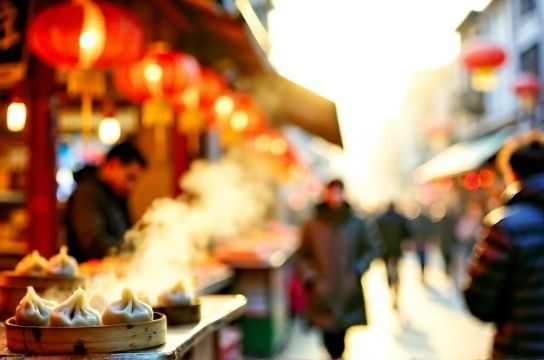
It’s not magic. It’s physics: water hitting hot oil, dough puffing under steam, charcoal glowing beneath skewers. At 7:15 p.m. sharp — no clock needed, just the collective lurch of university students pouring out of lecture halls — the alley beside Nanjing University’s Xianlin Campus begins to hum. By 7:22, the first xiao long bao stall has unrolled its plastic tarp. By 7:28, three undergrads from Philosophy and Economics are already debating Zhuangzi’s butterfly dream over shared chive-and-egg dumplings, chopsticks hovering mid-air.
This isn’t a curated ‘cultural experience’. It’s daily life in China — unscripted, affordable, sensory-dense, and deeply social. And it happens nightly, not in theme-park alleys or Instagram-lit food courts, but in working-class neighborhoods where rent is ¥2,800/month (Updated: May 2026), where vendors have known the same customers since their freshman year, and where a ¥5 cup of chrysanthemum-goji tea functions as both palate cleanser and dialectic lubricant.
H2: Why Night Markets Are the Unofficial Third Campus
Universities in China don’t operate in silos. They’re embedded — sometimes literally adjacent — to residential blocks and commercial corridors. This proximity creates what sociologists call ‘low-friction civic overlap’: students, retirees, delivery riders, and shop owners share sidewalks, stools, and conversational bandwidth.
Take the Wudaokou Night Market in Beijing. It sits between Tsinghua and Peking Universities, but its core clientele isn’t tourists snapping photos of stinky tofu. It’s grad students rehearsing thesis defenses over skewered lamb; postdocs splitting a ¥12 pot of aged pu’er; and 68-year-old Auntie Lin, who’s run her jianbing cart for 23 years and corrects grammar in students’ Mandarin essays while folding scallions into batter.
These markets aren’t ‘markets’ in the Western retail sense. They’re infrastructure — informal, adaptive, and governed by tacit norms: no loud speakers before 8 p.m., no blocking fire exits with stacked stools, and if you order three servings of spicy wonton soup, you get a free slice of preserved ginger.
H2: Dumplings as Dialogue Anchors
Dumplings — especially boiled (shui jiao) and pan-fried (guo tie) — dominate because they’re portable, scalable, and culturally neutral. A meat-and-cabbage jiao says nothing about your politics. A mushroom-and-tofu version says nothing about your GPA. But the act of sharing them? That’s where philosophy leaks in.
At Chengdu’s Jinli Night Market, students from Sichuan University gather weekly at ‘Lao Ma’s Dumpling Corner’, a stall with two stools, one steamer, and a chalkboard listing today’s fillings and tonight’s ‘topic’. Last Tuesday: “Is ‘lying flat’ (tang ping) an ethical response to structural pressure — or just surrender?”
No facilitator. No agenda. Just dumplings arriving in batches of ten, each round prompting a new angle. One student cites Daoist wu wei; another counters with Confucian duty; a third pulls out data from the 2025 Youth Employment Survey (Updated: May 2026): 64% of recent grads accepted roles paying ≤¥6,200/month, down 9% YoY. The conversation doesn’t resolve. It sustains — like the broth in the dumpling pot, constantly replenished.
This isn’t performative intellectualism. It’s cognitive calisthenics — low-stakes, high-engagement, fueled by carbs and caffeine-free herbal infusions.
H2: Tea Culture China — Not Ceremony, But Continuity
Forget gong fu cha sets displayed behind glass. In these markets, tea culture China means something quieter: the ritual of refilling your thermos from Auntie Mei’s stainless-steel urn of chrysanthemum-hawthorn brew (¥2 refills, unlimited); the way baristas at ‘Tea & Tension’ — a student-run stall near Fudan — time steeping intervals to match exam cycles (light jasmine for pre-midterms, roasted oolong for post-finals); or how the scent of aged shou pu’er drifting from a wholesale wholesaler’s backroom becomes ambient white noise for debate.
Tea here isn’t about aesthetics. It’s about continuity — of conversation, of community, of bodily rhythm. A cup cools in 12 minutes. That’s roughly how long it takes to reframe an argument. A second cup warms hands in winter, steadies nerves before presentations, and provides plausible deniability when someone asks, “Are you *still* talking about Heidegger?”
Unlike coffee shops that optimize for solo laptop work, these tea spaces optimize for adjacency: narrow tables, shared armrests, stools pulled close. You overhear more than you intend — and that’s the point.
H2: Local Markets China — Where Transactions Have Texture
Don’t confuse these with ‘tourist markets’. Local markets China are transactional ecosystems with layered economies:
– Primary layer: food (70% of stall count) – Secondary: essentials (phone chargers, hair ties, reusable chopstick kits) – Tertiary: micro-services (ID photo booths, handwritten calligraphy name seals, battery swaps for e-bikes)
What makes them resilient is their refusal to specialize. A vendor selling candied hawthorn might also fix your WeChat Pay QR code display issue. Another who grills squid may hold weekend ‘classical poetry recitation hours’ — free, no sign-up, just show up with your favorite Li Bai quatrain.
Pricing reflects real-world constraints. A plate of dan dan noodles averages ¥14–¥18 (Updated: May 2026), calibrated against average part-time wages (¥28/hour for tutoring, ¥22/hour for campus lab assistants). There’s no ‘tourist markup’ because there are no designated ‘tourist zones’ — just overlapping rhythms of study, work, rest, and snack.
H2: The Real Cost of ‘Lying Flat’ — And Why It Still Fits in a Night Market
‘Tang ping’ — lying flat — gets misrepresented as laziness. In context, it’s strategic recalibration. Students aren’t rejecting ambition; they’re rejecting burnout masquerading as meritocracy. And night markets accommodate that recalibration physically and philosophically.
You can sit for 90 minutes over one bowl of wonton soup and two cups of tea — no pressure to order again, no expectation to leave. Vendors know this. Auntie Lin won’t rush you. She’ll top up your tea, ask how your thesis is going, and slide over a free piece of preserved ginger — ‘for digestion *and* clarity.’
That slowness isn’t inefficiency. It’s infrastructure for reflection. While Shanghai’s Lujiazui financial district runs on millisecond trades, the Wudaokou night market operates on ‘dumpling cycles’ — 10 minutes per batch, 30 minutes per deep conversation, 2 hours per full mental reset.
H2: How to Navigate Without Being ‘That Tourist’
If you’re visiting, skip the ‘night market food tours’ that herd groups past 12 stalls in 47 minutes. Instead:
– Go on a Wednesday or Thursday — weekends attract crowds; weekdays reveal routine. – Bring cash (¥5–¥100 notes). Most vendors still don’t accept digital payments for sub-¥15 transactions (Updated: May 2026). – Order one thing, eat it fully, then decide your next move. Don’t ‘sample’ — participate. – Ask ‘what’s fresh today?’ not ‘what’s popular?’. The answer tells you about supply chains, weather, and seasonality — not algorithms. – If invited to join a table, accept. Even if you don’t speak fluent Mandarin, pointing at the dumpling plate and saying ‘zhe ge hao chi’ (this is delicious) opens doors.
And never photograph someone without asking — not out of politeness alone, but because many vendors are migrants from rural provinces and guard privacy fiercely. A nod and a thumbs-up after eating? That’s currency enough.
H2: What Actually Works — And What Doesn’t
Not all night markets deliver the same texture. Some have been ‘upgraded’ into sanitized food parks with uniform lighting, fixed seating, and mandatory WeChat check-ins. These lack the friction — and therefore the authenticity — of organic growth.
The best ones retain visible evidence of adaptation: patched tarps, hand-painted signs overprinted with new prices, extension cords snaking across pavement, and the faint smell of rain on hot concrete.
To help distinguish, here’s a practical comparison of operational traits across three representative models:
| Feature | Organic Night Market (e.g., Wudaokou) | Rebranded ‘Cultural Plaza’ (e.g., Xi’an Muslim Quarter Renovation Phase II) | Mall-Integrated Night Market (e.g., Chengdu Isetan Basement) |
|---|---|---|---|
| Vendor Tenure Avg. | 7.2 years (Updated: May 2026) | 2.1 years (Updated: May 2026) | 0.8 years (Updated: May 2026) |
| Payment Methods | Cash dominant; ~30% Alipay/WeChat for ≥¥20 | 100% digital; QR codes mandatory | 100% digital + UnionPay terminals |
| Seating Style | Mix of foldable stools, repurposed crates, sidewalk ledges | Fixed wooden benches, spaced 1.2m apart | Modular banquettes, reservation app required |
| Student Presence (Peak Hours) | 68% of crowd (Updated: May 2026) | 22% (mostly photo ops) | 14% (mostly mall employees on break) |
| Tea Availability | 3+ independent tea stalls; bulk herbs sold by weight | 1 branded tea kiosk; pre-packaged sachets only | None — coffee-only beverage program |
H2: Beyond the Bite — What These Spaces Preserve
They preserve linguistic elasticity: students code-switch between Sichuanese slang, academic Mandarin, and English terms like ‘ontology’ or ‘algorithmic bias’ — all within one dumpling-sopping sentence.
They preserve intergenerational scaffolding: retirees critique student arguments not to win, but to model rigor; students help vendors troubleshoot QR code scanners or draft bilingual menu cards.
They preserve economic realism: no one pretends ¥15 buys a ‘gourmet experience’. It buys warmth, speed, flavor, and the right to linger without performance.
Most importantly, they preserve the idea that public space doesn’t need a purpose — it just needs presence. You don’t go to ‘do’ something. You go to *be* somewhere where being is enough.
H2: Final Note — This Isn’t Nostalgia. It’s Maintenance.
These markets aren’t relics. They’re actively maintained — by students who volunteer to sweep alleys after rain, by city bureaus that grant temporary vendor permits based on neighborhood petitions (not investor bids), and by vendors who rotate ‘topic nights’ based on student course syllabi.
They reflect local lifestyle China not as folklore, but as functional design: dense, adaptable, low-overhead, and stubbornly human-centered.
If you want to understand how people live — not how they’re marketed to — start where the steam rises at 7:15 p.m. Follow the scent of cumin and aged tea. Pull up a stool. Order dumplings. And when the conversation turns to whether reality is relational or absolute, just nod, take a bite, and pass the vinegar.
For those looking to replicate this ethos in other contexts — whether urban planning, community development, or even remote team culture — our full resource hub offers field-tested frameworks, vendor interview transcripts, and spatial mapping templates. You’ll find actionable insights grounded in real observation, not theory detached from broth-stained napkins.