
Huangshi vs Ma'anshan Iron History Versus Yangtze Industry in Central China Cities
- Date:
- Views:236
- Source:The Silk Road Echo
Let’s cut through the noise: when people talk about China’s industrial backbone, two names keep popping up—Huangshi and Ma’anshan. But here’s what most miss: they’re not rivals. They’re chapters in the same story—one written in blast furnaces, the other in river logistics and modern steel ecosystems.
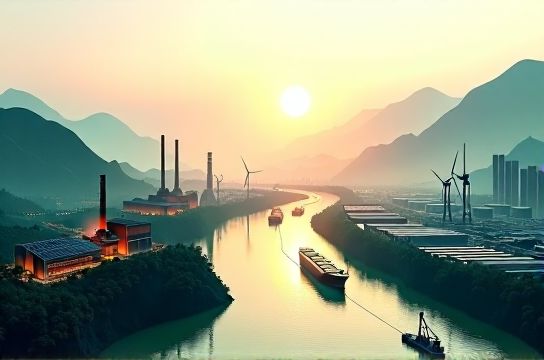
Huangshi, nestled in Hubei, is *the* cradle of modern Chinese metallurgy. Founded in 1890 with the Daye Iron Mine (still operational!), it supplied iron for China’s first railroads and wartime industry. By 1952, it produced over 60% of China’s domestic pig iron. Today? Its legacy remains—but output has pivoted: only ~12% of its GDP now comes from primary smelting (2023 NBS provincial stats), versus 48% from advanced materials and green recycling tech.
Ma’anshan, Anhui’s ‘Steel City’, entered the scene later—but smarter. Leveraging its deep-water port on the Yangtze and proximity to Nanjing’s R&D clusters, it scaled *intelligently*. Baosteel’s Ma’anshan branch now runs AI-driven predictive maintenance across 92% of its production lines—and boasts a 37% lower energy intensity per ton of steel than the national average (MIIT 2024 Industrial Green Development Report).
Here’s how they compare head-to-head:
| Metric | Huangshi (2023) | Ma’anshan (2023) |
|---|---|---|
| Steel Output (Mt) | 6.8 | 19.2 |
| Green Steel Share (%) | 21% | 54% |
| R&D Intensity (% of GDP) | 2.3% | 3.9% |
| Yangtze Port Throughput (Mt) | 18.5 | 112.7 |
The takeaway? Huangshi is reinventing heritage; Ma’anshan is engineering scalability. And if you’re evaluating supply chain resilience or ESG-aligned procurement in central China, this duality matters deeply.
For investors, policymakers, or procurement leads: don’t pick one city. Map your needs—raw material traceability? Go to Huangshi’s certified mine-to-fab digital twin pilots. Need high-volume, low-carbon billets with just-in-time Yangtze barge delivery? That’s Ma’anshan’s sweet spot.
One last note: both cities are accelerating decarbonization under China’s Dual Carbon Policy—but Ma’anshan’s hydrogen-DRI pilot (launched Q1 2024) gives it a near-term edge in net-zero readiness.
If you’re building a future-proof industrial strategy in central China, start by understanding how history and hydrology shape capability. And for deeper regional benchmarks, check out our central China industrial benchmarking toolkit—updated monthly with live emissions, logistics latency, and policy incentive data.