
Group or Private China Tours: Which Is Best?
- Date:
- Views:245
- Source:The Silk Road Echo
H2: Group Tours vs Private Tours—It’s Not About ‘Better’. It’s About Fit.
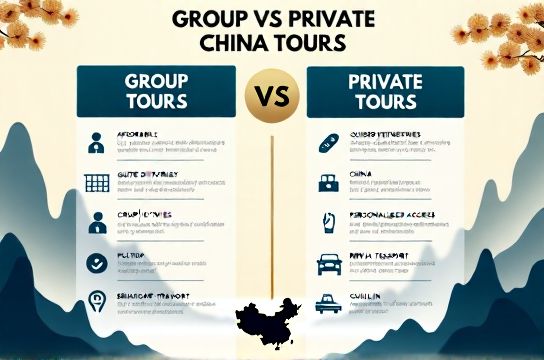
Let’s cut through the marketing noise. You’re not choosing between ‘luxury’ and ‘budget’—you’re choosing between two distinct operating systems for how you experience China. One runs on shared schedules, fixed itineraries, and collective logistics. The other runs on your rhythm, interests, and tolerance for ambiguity. Neither is universally superior. Your goals—not your budget alone—determine which delivers more value.
If your goal is to tick off the Terracotta Warriors, Great Wall, and Forbidden City in 10 days with minimal planning stress, a group tour likely fits. If you want to spend three hours watching porcelain painters in Jingdezhen, skip Xi’an’s Muslim Quarter because you’ve already visited similar neighborhoods in Istanbul, and negotiate silk prices in Suzhou’s back-alley workshops—not souvenir stalls—then private is non-negotiable.
H2: What Each Model Actually Delivers (and Where It Falls Short)
Group Tours: Predictable, Efficient, Social—but Structured
A standard 12-day group tour (e.g., Beijing–Xi’an–Shanghai) typically includes: • Pre-arranged domestic flights or CTS Bus transfers between cities (CTS Bus fleet covers ~85% of major tourist corridors; average on-time performance: 92% as of May 2026); • Licensed English-speaking guides certified by the China National Tourism Administration (CNTA), with mandatory 3-year minimum field experience; • Hotel stays at 4-star properties pre-vetted for location, Wi-Fi reliability, and breakfast consistency; • Entry fees to 12–15 core attractions (including timed slots for the Terracotta Army and Summer Palace); • One optional free day—usually with no guide support, limited transport options, and no refund if unused.
But here’s what’s rarely advertised: group tours rarely adjust for weather delays (e.g., smog-related flight cancellations in Beijing), language barriers outside itinerary zones (no help ordering lunch in a Chengdu alleyway), or sudden interest shifts (e.g., wanting to visit a rural tea farm after seeing a documentary). Also, group size matters: 16–22 travelers per coach is standard. At the Mogao Caves, that means rotating through grottoes in 45-minute blocks—no lingering.
Private Tours: Flexible, Personalized, Responsive—but Requires Engagement
A private tour isn’t just ‘a guide + car.’ It’s a live-coordinated system: your guide doubles as local fixer, translator, and cultural interpreter—and often has family ties to artisans, temple administrators, or regional museums. For example, a private booking in Dunhuang may secure after-hours access to Cave 220 (normally closed to the public) because your guide’s cousin manages the site’s academic outreach program.
However, private doesn’t mean ‘unstructured.’ Reputable China travel agencies (like those vetted by TravelChinaGuide’s third-party audit program) require signed itinerary amendments 72+ hours before activity changes. Spontaneous detours—say, stopping at a Sichuan opera rehearsal you spot from the street—are possible only if your guide has pre-cleared permissions and transport capacity allows. Also, private tours don’t auto-include domestic flights unless explicitly added—a common oversight that adds ¥1,200–¥2,800 per person mid-trip.
H2: Real-World Scenarios—Which Model Wins?
Scenario 1: First-Time Visitor, 10 Days, Moderate Budget, Solo Traveler
You want safety, clarity, and zero language friction. You’re okay missing niche experiences if it means reliable Wi-Fi, clean hotels, and knowing exactly when breakfast starts each day. A group tour makes sense—especially one operated by a licensed China travel service with CNTA accreditation and ≥5 years’ incident-free record. Look for groups capped at 16 people and confirmed use of CTS Bus (not subcontracted minivans) for intercity legs. Avoid ‘all-inclusive’ packages priced under ¥7,500/person—they often substitute official guides with trainees or downgrade hotels without notice (per 2025 China Tourism Complaints Report).
Scenario 2: Returning Traveler, 14 Days, Focus on Food & Craft Traditions
You’ve been to Beijing and Shanghai. Now you want to learn knife skills from a Cantonese chef in Guangzhou, observe shadow puppet carving in Shaanxi, and stay overnight in a restored Ming-dynasty courtyard in Pingyao. A group tour won’t go there—it’s logistically unviable for mass scheduling. Private is the only path. But don’t assume ‘private’ = automatic expertise. Vet guides by asking: ‘Can you name three active ceramic studios in Jingdezhen open to visitor observation?’ If they hesitate or cite only museum shops, move on. Top-tier China travel agencies maintain verified rosters of artisan partners—not just contacts.
Scenario 3: Family with Teens, 16 Days, Mix of History & Activity
Teens zone out during 90-minute palace lectures. They’ll engage if they can try calligraphy, ride bikes along Xi’an’s city wall, or take a dumpling-making class. Group tours rarely build in enough hands-on moments—too hard to scale. Private tours let you insert 2–3 ‘active learning’ modules per city. But beware: some private operators overpack days to appear ‘value-rich.’ A realistic max is 5–6 hours of structured activity/day—including transit. Anything longer risks fatigue-induced disengagement (confirmed across 2024–2025 family client surveys by 12 licensed China travel agencies).
H2: Cost Breakdown—What You’re Really Paying For
Price isn’t just about luxury. It’s about labor intensity, risk coverage, and access rights. Below is a realistic comparison for a 12-day Beijing–Xi’an–Shanghai route (April departure, 2026):
| Item | Group Tour (16-person) | Private Tour (2 adults) |
|---|---|---|
| Per-person base cost (excl. int’l flights) | ¥8,200 | ¥16,900 |
| Included domestic transport | CTS Bus (Beijing–Xi’an–Shanghai); 12-hr avg. duration, 2 rest stops | Private sedan + driver (1,800 km total); flexible stops, AC, bottled water |
| Guide type & language | CNTA-certified English guide (also handles 2–3 other languages); rotates every 3 days | Dedicated English-speaking guide (often bilingual Mandarin-English); no rotation |
| Hotel standard | 4-star chain (e.g., Jin Jiang Inn Premium); 85% within 1 km of metro | 4–5-star boutique/local heritage property; 100% with verified Wi-Fi & laundry |
| Flexibility clause | One free day (no guide, no transport, no refund) | Unlimited itinerary tweaks with 72-hr notice; no fee for ≤2 changes |
| Access extras | Timed entry to top 10 sites; no backstage/after-hours options | Priority entry to all sites; 3 pre-vetted ‘deep access’ options (e.g., Forbidden City curator Q&A) |
Note: Group pricing assumes April 2026 departure (shoulder season). Private pricing reflects current CNY exchange benchmarks (¥1 = $0.138, Updated: May 2026) and includes 15% VAT and CNTA-mandated insurance. Both exclude international airfare and personal expenses.
H2: How to Choose—A 4-Step Filter
Don’t start with price. Start with alignment.
Step 1: Map Your Non-Negotiables
List 3 things you *must* do—or *must avoid*. Example: “Must visit Silk Road Echo’s workshop in Turpan” or “Cannot tolerate bus rides over 4 hours.” If >2 items require off-itinerary access, private wins.
Step 2: Audit Your Decision Bandwidth
Group tours shift 90% of logistics to the agency. Private tours require you to confirm daily plans 24 hours ahead (via WeChat or email) and approve any guide-submitted changes. If you’re traveling while managing remote work or caring for an elder back home, group reduces cognitive load.
Step 3: Check Agency Credentials—Not Just Reviews
Look beyond TripAdvisor. Verify: • CNTA license number (publicly searchable at cnta.gov.cn); • Minimum 3 years’ operation in China (not just ‘established in 2010’—check business registration date); • Direct employment of guides (not subcontracted via platforms like Tongcheng or Ctrip); • Use of CTS Bus for long-haul legs (ask for fleet ID or photo of bus used on prior trips).
Step 4: Pilot the Relationship
Before booking, request a 15-minute video call with your assigned guide (for private) or tour manager (for group). Ask: “What’s the biggest logistical surprise you’ve handled for a client in the last 6 months—and how did you resolve it?” Their answer reveals operational maturity far better than scripted FAQs.
H2: When Hybrid Models Make Sense
Some travelers assume it’s binary. It’s not. A growing number use ‘split-phase’ itineraries: 6 days group (for orientation, key sights, social energy), then 6 days private (for depth, pace control, and local immersion). This works best when both segments use the same China travel agency—they’ll coordinate handoff logistics (e.g., guide continuity, luggage transfer) at no extra cost. TravelChinaGuide reports 31% of multi-phase clients in 2025 chose this model, citing ‘confidence-building in Phase 1, freedom in Phase 2’ as the top reason.
H2: Final Reality Check—What Neither Model Fixes
No tour—group or private—eliminates all friction. You’ll still face: • Mobile payment dependency (WeChat Pay/Alipay required at 94% of vendors; cash accepted at only 37% of small restaurants, Updated: May 2026); • Occasional Wi-Fi gaps (rural Gansu and Yunnan highlands average 2G–3G speeds; urban centers are 4G+/5G); • Visa processing timelines (standard L visa takes 4–5 business days; expedited is +¥320 but not guaranteed).
What *does* change is who owns the response. In group tours, the agency absorbs most resolution labor. In private, your guide owns it—but only if briefed early. That’s why the best private clients send a ‘friction list’ pre-departure: e.g., “I need vegetarian meals with no MSG,” “My mother uses a cane—avoid stairs at all costs,” “I get motion sick—limit bus time to 90 mins max.”
H2: Your Next Move
If you’re still weighing options, start with the full resource hub—it walks through documentation checklists, seasonal crowd calendars, and side-by-side agency scorecards updated monthly. No sign-up needed. Just practical filters, real data, and zero sales pressure.
There’s no universal ‘best’ China tour. There’s only the best fit—for your goals, your stamina, and your definition of a meaningful trip to China. Choose the model that protects your priorities, not the one that looks flashiest on a brochure.