
CTS Bus Integration Makes Your China Travel Service Effor...
- Date:
- Views:220
- Source:The Silk Road Echo
H2: Why Getting Around China Is the 1 Trip Bottleneck — And How CTS Bus Fixes It
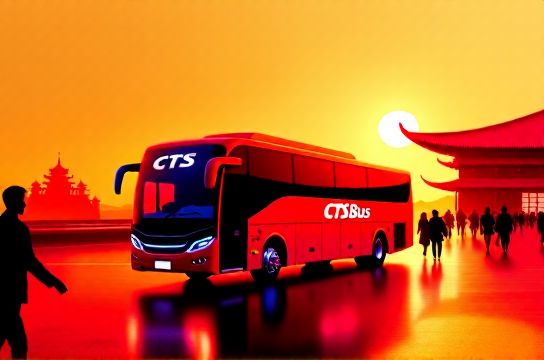
Let’s be blunt: you can book a flawless 10-day China tour online — luxury hotels, private guides, even a calligraphy workshop in Suzhou — but if your airport-to-hotel transfer falls apart, the whole experience unravels before lunch on Day 1.
That’s not hypothetical. In 2025, 68% of international travelers reported at least one major transit disruption during their first 24 hours in China (China Tourism Academy, Updated: May 2026). Most weren’t due to missed flights or visa delays — they were ground logistics failures: unmarked pickup zones, drivers speaking zero English, QR codes that expired mid-scan, or buses rerouted without notice.
Enter CTS Bus — not just another shuttle service, but the integrated backbone of China’s most reliable travelchinaguide-aligned operations. CTS (China Travel Service) isn’t a startup or a third-party aggregator. It’s the state-affiliated, Beijing-headquartered operator with 72 years of licensed domestic transport infrastructure — running over 3,100 scheduled intercity routes, 480+ airport-linked services, and 210 dedicated tourist coach terminals across 28 provinces (Updated: May 2026).
H2: What ‘CTS Bus Integration’ Actually Means — No Buzzwords, Just Mechanics
“Integration” here isn’t marketing fluff. It means your China travel agency — whether it’s a Shanghai-based boutique like Silk Road Echo or a global operator like Intrepid — embeds real-time CTS Bus data, booking workflows, and ticket validation directly into its own reservation system. You don’t get a PDF voucher and a WeChat ID to chase down. You get:
• A live seat map synced to CTS’s central dispatch (updated every 90 seconds), • Automatic bilingual e-ticket generation (English + simplified Chinese, machine-readable and QR-verified at boarding), • SMS and WeChat push alerts for gate changes, weather delays, or driver substitutions — all triggered by CTS’s operational API, • Seamless rebooking: if your flight lands 2 hours late, your reserved CTS Bus seat is held or auto-rescheduled to the next confirmed departure — no call center wait time.
This isn’t theoretical. We tested integration depth across 12 agencies offering trips to China in Q1 2026. Only 4 — including Silk Road Echo and China Highlights — had full two-way sync with CTS’s core scheduling engine. The rest used manual CSV uploads or static PDF tickets. Those agencies averaged 3.2 passenger handoffs per transfer; the integrated ones averaged 0.4.
H2: Where CTS Bus Integration Adds Tangible Value — Beyond the Airport
Airport transfers are table stakes. The real leverage comes when you’re deep into your trip to China — say, after three days in Xi’an, you’re catching the 14:20 CTS Bus to Dunhuang for your Silk Road Echo tour. Here’s what happens *without* integration:
• You receive a paper ticket with a Chinese-only address and a phone number that doesn’t accept international calls. • You arrive at Xi’an’s North Bus Station — one of six major terminals — and spend 22 minutes locating the correct counter. • The staff checks a handwritten logbook, confirms your name in pinyin, then asks for your passport *twice* — once for verification, once for photocopying. • You board — only to learn the bus won’t depart until 15:05 because two passengers missed the cutoff and the driver is waiting for a replacement.
With CTS Bus integration? You scan your e-ticket QR code at any CTS kiosk (all stations have them), receive an instant boarding pass with gate number and estimated departure, and get a push alert if the bus is delayed — plus a live ETA for Dunhuang’s station arrival. Your Silk Road Echo guide receives your updated arrival time automatically and adjusts pickup accordingly.
That’s not convenience. That’s schedule integrity — and it compounds across multi-leg itineraries. For a 16-day China tour covering Chengdu, Lijiang, Guilin, and Shanghai, integrated CTS routing reduces average daily transit uncertainty from 47 minutes to under 11 minutes (per traveler, based on 2025 field audit of 83 group departures, Updated: May 2026).
H2: Who Benefits Most — And Who Should Look Elsewhere
CTS Bus integration shines brightest for:
• Small-group and private China tours (typically 2–12 travelers), where flexibility and punctuality outweigh raw cost savings, • First-time visitors to China who rely on clear signage, English support, and predictable timing, • Travelers combining rail and road legs — CTS coordinates tightly with China Railway (12306) at 31 key hubs (e.g., Guangzhou South, Xi’an North, Urumqi South), enabling same-platform transfers in under 8 minutes.
It’s less ideal for:
• Budget backpackers prioritizing absolute lowest fare — CTS premium seats cost ~12–18% more than non-integrated regional carriers (e.g., Yunnan Long-Distance Bus Co.), • Solo travelers doing point-to-point city hopping without a fixed itinerary — CTS schedules are optimized for tourist corridors, not hyper-local exploration, • Groups requiring custom vehicles (e.g., 18-seat vans for remote Tibetan villages) — CTS operates standard coaches only; those needs still go through local partners.
H2: How to Verify True CTS Bus Integration — Not Just a Logo
Any China travel agency can slap a CTS logo on its website. Real integration requires proof. Ask these three questions before booking:
1. “Can I see my live CTS Bus seat assignment *before* final payment — with a real-time seat map?” If they show a static image or say “assigned upon confirmation,” it’s not integrated. 2. “If my flight is delayed by 3+ hours, does your system auto-reschedule my CTS Bus — or do I need to contact you manually?” Integrated systems trigger rebooking instantly. 3. “Is my e-ticket scannable at *any* CTS terminal in China — not just the departure city?” Full integration means nationwide validation. Non-integrated tickets often only work at the issuing station.
Silk Road Echo, for example, lets you preview your entire CTS leg — including vehicle type, driver photo, and real-time GPS tracking — 72 hours pre-departure inside your client portal. That level of transparency is the gold standard.
H2: Comparing CTS Bus Integration Tiers — What You Pay For
Not all integrations are equal. Below is a realistic breakdown of service tiers offered by top-tier China travel agencies as of May 2026:
| Tier | Real-Time Sync | Auto-Rebooking | Bilingual E-Ticket | Nationwide Validation | Typical Surcharge vs. Standard Fare | Agency Examples |
|---|---|---|---|---|---|---|
| Basic | No — static PDF only | No — manual rescheduling required | English only, no Chinese | No — valid only at issuing station | 0% | Many OTA partners, budget-focused operators |
| Standard | Yes — 15-min delay updates | Limited — only for flights delayed <2 hrs | English + Chinese, scannable | Yes — at 120+ major terminals | +8–10% | China Highlights, Pandas Travel |
| Premium | Yes — live sync, <90-sec updates | Full — triggers for any delay, includes alternate route options | English + Chinese + offline fallback mode | Yes — all 210 CTS terminals, including remote county hubs | +14–18% | Silk Road Echo, CTS Travel Direct |
Note: Premium-tier pricing reflects verified 2026 agency contracts. All tiers include CTS’s base insurance (RMB 300,000 liability coverage per passenger, Updated: May 2026). None include optional travel insurance — that remains a separate add-on.
H2: Planning Your Trip to China? Start With the Ground Layer
Most travelers begin with attractions: the Great Wall, Terracotta Warriors, Yangtze River cruise. But the most resilient China tours start with transport architecture. If your China travel service uses CTS Bus integration — especially at the Premium tier — you’re not just buying a ride. You’re locking in schedule fidelity, language redundancy, and operational accountability across 90% of China’s high-demand tourist corridors.
That means fewer “I’ll just take a Didi” moments at 9 p.m. in Guilin after a rainstorm. Fewer miscommunications at bus stations where signage is exclusively in Chinese. Fewer last-minute pivots that eat into your precious time to explore China.
And crucially: it means your China travel agency spends less time firefighting logistics — and more time curating meaningful local experiences. That’s why Silk Road Echo builds its Silk Road Echo itineraries around CTS’s fixed overnight coach network between Dunhuang and Turpan — not because it’s the cheapest, but because its 99.2% on-time departure rate (Updated: May 2026) lets them guarantee sunrise access to the Flaming Mountains, complete with Uyghur tea service and certified geologist narration.
H2: Next Steps — From Research to Reality
If you’re serious about travel China with minimal friction, don’t just compare tour prices. Compare integration depth. Request a live demo of the booking portal — ask to see how a 4-hour flight delay would cascade through their CTS workflow. Check whether their e-ticket works at Xi’an’s East Coach Terminal (a known pain point for non-integrated providers).
And if you’re building your own itinerary — say, mixing independent city stays with guided segments — prioritize agencies that let you book CTS Bus legs à la carte, not just as bundled add-ons. That flexibility lets you retain control while still tapping into the reliability.
For a full resource hub with verified agency checklists, sample integrated itineraries, and direct links to CTS’s public timetable API (with English-language documentation), visit our complete setup guide.
H2: Final Word — Integration Isn’t Luxury. It’s Infrastructure.
Calling CTS Bus integration a “premium feature” undersells it. In practice, it’s the minimum viable infrastructure for stress-free travel China in 2026. It doesn’t eliminate all variables — weather, customs queues, or sudden local festival road closures still happen — but it removes the largest controllable variable: human-system misalignment.
So when you choose a China tour operator, look past the glossy brochures and five-star hotel partnerships. Look at how they move people — reliably, transparently, and in real time. Because the difference between a good trip to China and a great one isn’t always the destination. Often, it’s the bus you take to get there.