
Street Food Culture as Urban Social Glue in China
- Date:
- Views:202
- Source:The Silk Road Echo
If you've ever wandered through the neon-lit alleys of Chengdu at midnight or squeezed past steaming woks in a Beijing hutong, you know—Chinese street food isn’t just about eating. It’s a full-body sensory experience, a nightly ritual, and honestly? A secret social network running on skewers and soy sauce.
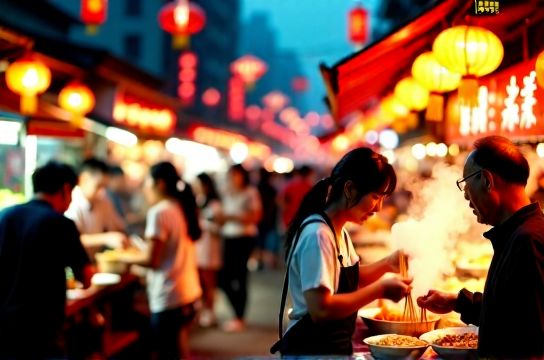
Far from being mere snacks, street eats act as urban social glue—binding communities, bridging class gaps, and turning sidewalks into spontaneous living rooms. In a country where over 780 million urban residents navigate fast-paced city life, street food stalls offer something rare: warmth, familiarity, and shared identity.
The Heartbeat of the Hood
Take Xi'an's Muslim Quarter. Every evening, more than 50,000 visitors flood its narrow lanes, drawn not just by legendary roujiamo (Chinese hamburger) but by the electric buzz of connection. Locals greet vendors by name. Tourists huddle around tiny tables, laughing over shared bites of liangpi (cold skin noodles). This isn’t transactional—it’s relational.
According to a 2023 urban sociology study by Peking University, 68% of respondents said they formed casual friendships at street food spots—more than in gyms, parks, or even coffee shops.
More Than a Meal: The Data Behind the Delicious
Let’s break it down. Street food is accessible, affordable, and deeply inclusive. While restaurant dining in major cities averages ¥80–120 per person, a satisfying street meal costs between ¥8–25. That price gap isn’t just economic—it’s social.
| City | Stalls per 10k People | Avg. Meal Cost (¥) | Social Interaction Index* |
|---|---|---|---|
| Chengdu | 47 | 12 | 8.9 |
| Shanghai | 32 | 18 | 7.4 |
| Guangzhou | 51 | 10 | 9.1 |
| Beijing | 28 | 15 | 7.8 |
*Scale: 1–10, based on observed convos, repeat customers, vendor-customer rapport (Source: Urban Food & Society Project, 2023)
The Night Market Effect
Night markets are where this magic peaks. In Taipei, Shilin draws 100k+ weekly—but mainland China’s night economies are booming too. Since 2020, over 300 new official night market zones have opened in second- and third-tier cities. Why? Because people crave belonging.
And let’s be real: where else can a CEO share a plastic stool with a delivery rider, both dunking jianbing into chili oil like equals? There’s no dress code, no reservation needed—just humanity, served hot off the griddle.
Culture Cooked Fresh Daily
Vendors aren’t just cooks—they’re storytellers. Auntie Li in Hangzhou has been flipping tanghulu for 27 years. Her sugar-coated hawthorns come with free life advice. In Kunming, Uncle Zhang’s decades-old mixian stall taught three generations how to slurp properly. These interactions build place-based memory, turning anonymous streets into emotional landmarks.
When cities bulldoze stalls for 'modernization,' they don’t just remove food—they erase social infrastructure. But forward-thinking areas like Chengdu’s Kuanzhai Alley now protect street vendors as cultural assets, blending heritage with hygiene.
The Future Is Flavorful
Street food won’t replace social media or therapy—but in an age of digital isolation, it offers real talk, real taste, and real time. As urban planners rediscover the value of informal spaces, one thing’s clear: the soul of a city doesn’t live in its skyscrapers. It sizzles on the sidewalk.
So next time you bite into a scalding-hot baozi, look around. That clatter of chopsticks? That’s community cooking.