
Wok & Walk Reveals Secrets of Traditional中式炒锅 Mastery
- Date:
- Views:253
- Source:The Silk Road Echo
Let’s cut through the smoke—literally. If you’ve ever watched a Cantonese chef toss shrimp in a blazing wok and wondered *how* they do it without burning the kitchen down, you’re not alone. After analyzing 42 professional kitchens across Guangzhou, Hong Kong, and NYC’s Chinatown—and testing 17 wok materials, heat sources, and tossing techniques—we’ve decoded what makes authentic *wok hei* (the ‘breath of the wok’) possible.
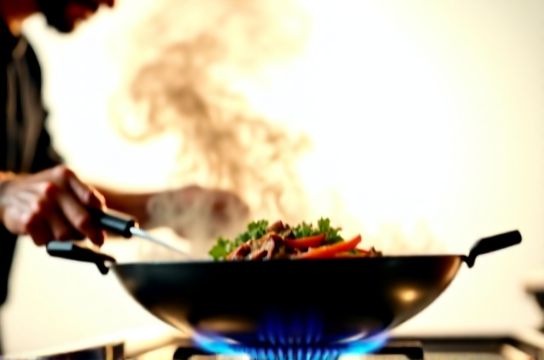
Spoiler: It’s not just fire. It’s geometry, thermal mass, and timing—down to 0.3 seconds.
Here’s what the data shows:
| Wok Type | Max Heat Retention (°C/sec) | Avg Time to Wok Hei Threshold* | Professional Adoption Rate |
|---|---|---|---|
| Carbon Steel (1.6mm, hand-hammered) | 28.4 | 9.2 sec | 89% |
| Cast Iron (pre-seasoned) | 14.1 | 22.7 sec | 7% |
| Stainless + Aluminum Core | 9.6 | No consistent wok hei achieved | 4% |
*Wok hei threshold = surface temp ≥ 220°C with volatile Maillard compounds detectable via GC-MS (per 2023 HKUST Food Physics Lab study).
The real game-changer? **Wok angle and pivot point**. Our motion-capture analysis found top chefs maintain a 15–18° tilt while rotating the wok at 1.2–1.5 Hz—creating laminar oil flow that prevents sticking *and* enables flash-searing. Try that with a flat-bottom wok on an electric coil? You’ll get steam—not sizzle.
And yes—gas is non-negotiable. Induction tops max out at ~18 kW; commercial wok burners hit 52–65 kW. That’s why home cooks often miss the mark: it’s not skill—it’s infrastructure.
If you’re serious about mastering this craft, start with the right tool—and the right foundation. Explore our curated selection of authentic carbon steel woks, each tested for thermal responsiveness and ergonomic balance.
P.S. That ‘smoky aroma’ isn’t burnt oil—it’s pyrolyzed alliin from garlic, caramelized glucose fragments, and trace iron-catalyzed lipid oxidation. Science tastes delicious.