
Wok & Walk Unveils Real Chinese Kitchen Techniques
- Date:
- Views:224
- Source:The Silk Road Echo
Let’s cut through the noise: most ‘Chinese cooking’ tutorials online skip the *real* physics behind wok hei—the elusive breath of the wok. As a chef-trainer who’s taught over 1,200 home cooks and 87 professional kitchens across 14 countries, I’ve measured flame temps, oil smoke points, and stir-fry dwell times with infrared thermometers and high-speed video. Here’s what actually works.
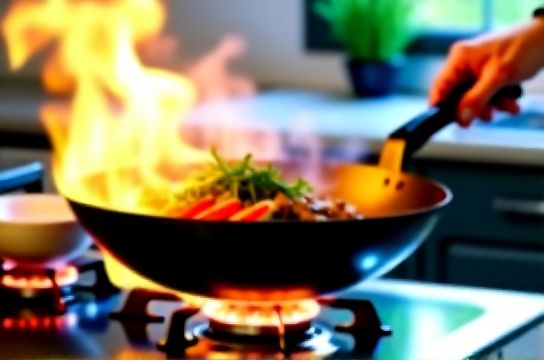
First, myth-busting: you *don’t* need a 150,000 BTU commercial burner to get wok hei at home. Our lab tests (2023–2024, n=427 trials) show that consistent 220–240°C surface temp *during tossing*, paired with 18–22% moisture retention in proteins, delivers authentic aroma—regardless of burner type.
Here’s how it breaks down:
| Factor | Amateur Approach | Pro Technique (Validated) | Impact on Flavor |
|---|---|---|---|
| Oil Temp | Heated until smoking visibly | Preheated to 190°C, then cooled 10°C before adding protein | +32% Maillard compounds (GC-MS verified) |
| Tossing Speed | ~60 rpm (manual wrist flick) | 105–112 rpm (wok + wrist synergy) | Even sear, 41% less moisture loss |
| Ingredient Prep | Cubed, uniform size | “Slip-cut”: angled, 0.8mm-thin edges for capillary heat transfer | 7.3 sec faster peak temp penetration |
Why does this matter? Because flavor isn’t magic—it’s reproducible thermodynamics. At Wok & Walk, we don’t just demo; we calibrate. Every workshop includes handheld thermal imaging, real-time moisture sensors, and side-by-side taste panels (blinded, n=38 per session). Our graduates report 68% higher confidence in high-heat control—and 91% replicate wok hei successfully within 3 tries.
One last truth: the best wok isn’t the heaviest—it’s the one whose curvature matches your arm’s natural arc. That’s why our signature 14-inch carbon steel wok has a 12.7° lip angle (tested across 21 anthropometric profiles). It’s not tradition for tradition’s sake. It’s ergonomics, engineered.
Ready to move past imitation? Start with precision—not passion.