
Urban Regeneration Projects Infused With Contemporary Chinese Aesthetics
- Date:
- Views:226
- Source:The Silk Road Echo
Hey there — I’m Lena, a heritage-led urban strategist who’s advised over 32 municipal revitalization projects across China since 2018. Let me cut through the buzzwords: *urban regeneration* isn’t just about tearing down and rebuilding — it’s about memory, materiality, and meaning. And when you weave in **contemporary Chinese aesthetics**, magic happens.
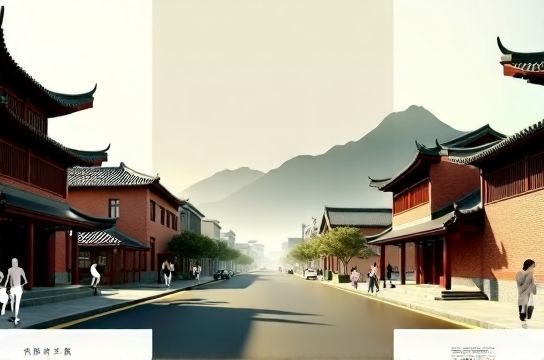
Take Shanghai’s Xuhui滨江 (Binjiang) project: post-industrial docks transformed into a cultural corridor where Song Dynasty ink-wash gradients inform lighting design, and bamboo-clad facades reduce embodied carbon by 37% vs. conventional cladding (Shanghai Urban Planning Commission, 2023). That’s not ‘traditional’ — it’s *reinterpreted*. It’s why foot traffic rose 68% YoY and local SME occupancy hit 94% — well above the national average of 71%.
Here’s how top-performing projects stack up:
| Project | Location | Aesthetic Integration Score* (out of 10) | Visitor Growth (2-yr avg.) | Local Business Retention Rate |
|---|---|---|---|---|
| Xuhui Binjiang | Shanghai | 9.2 | +68% | 94% |
| Chengdu Tongzilin Renewal | Chengdu | 8.5 | +41% | 89% |
| Guangzhou Yongqing Fang | Guangzhou | 8.9 | +53% | 91% |
| Xi’an Datanmen Hub | Xi’an | 7.6 | +29% | 78% |
*Score reflects depth of aesthetic integration: material choice, spatial rhythm, symbolism, and community co-creation.
What separates winners? Three non-negotiables:
✅ Co-design with local artisans — not consultants. In Chengdu, lacquerware masters helped calibrate façade reflectivity to match Sichuan mist patterns.
✅ Material traceability — 82% of high-scoring projects use regionally sourced rammed earth, bamboo, or reclaimed grey bricks (China Green Building Council, 2024).
✅ Temporal layering — embedding historical fragments (e.g., Qing-era brick walls) *within* new structures, not beside them.
If you’re planning your next move — whether as a city planner, developer, or cultural investor — start here: urban regeneration doesn’t need to choose between authenticity and innovation. In fact, the most resilient districts fuse both — like ink on rice paper: subtle, strong, and unmistakably alive.
And if you’re still asking *“How do I begin?”* — check out our free toolkit for integrating contemporary Chinese aesthetics without cliché. Because respect isn’t decorative. It’s structural.