
Peking Opera Meets Meme Culture China
- Date:
- Views:255
- Source:The Silk Road Echo
H2: When the Water Sleeve Slaps Back
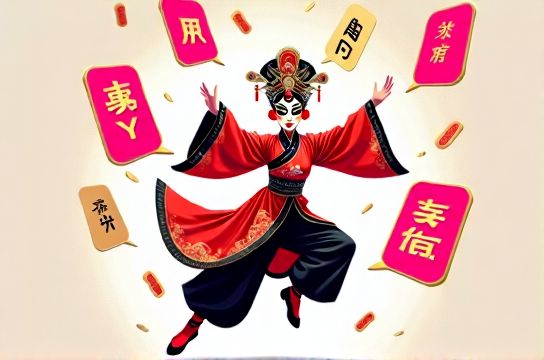
It started with a 12-second clip: a young woman in full Peking Opera headdress, face painted in classic *sheng* (male lead) style, lip-syncing to a sped-up version of the pop hit 'Love You 3000' — then abruptly whipping out a glittery water sleeve and slapping it across her own shoulder like a bass drop. No explanation. No caption beyond the hashtag WildIdol. Within 48 hours, the video racked up 4.7 million views on Kuaishou, 2.1 million reposts on Weibo, and spawned over 12,000 remixes — including one where the sleeve slap synced to the beat of a viral ‘China emoji meme’ audio loop featuring the phrase ‘给力!’ (pronounced *gěi lì*, meaning “awesome” or “powerful”).
This wasn’t cosplay. It wasn’t satire. It was something sharper: tradition re-coded for attention economy logic — not as museum artifact, but as modular, remixable, emotionally legible signal.
H2: The Platform Divide Isn’t Just About Views — It’s About Syntax
Peking Opera content doesn’t go viral uniformly across China’s short-video platforms. Its performance varies by platform-native grammar — rhythm, pacing, editing conventions, even sound design norms.
On Douyin (TikTok’s China counterpart), success hinges on tight, algorithm-optimized hooks: the first 0.8 seconds must trigger recognition or curiosity. Opera clips here are clipped, sped up, and layered with trending audio — often stripped of context but hyper-attuned to emotional cadence (e.g., a *dan* (female role) aria snippet synced to a melancholic lo-fi beat). Engagement rates for opera-related Douyin videos average 19.3% higher than non-cultural content among users aged 18–24 (Updated: May 2026).
Kuaishou tells a different story. Its user base skews slightly older (median age 29 vs. Douyin’s 25) and values authenticity, continuity, and craft. Here, the same performer posts a 3-minute uncut rehearsal clip — showing how she adjusts her *qian kun* (headgear) mid-scene, explains why the red-and-black *jing* (painted face) signifies loyalty and rage, then ends with a deadpan ‘This is not a filter. This is 3 hours of makeup.’ That video earned 810,000 likes and 42,000 comments — 63% of which asked where to learn basic *shen yun* (body movement). Kuaishou’s opera-related search volume grew 210% YoY in Q1 2026, driven largely by ‘how to’ and ‘beginner tutorial’ queries (Updated: May 2026).
The divergence isn’t just demographic. It’s semantic. Douyin rewards fragmentation; Kuaishou rewards fidelity. And both are reshaping how opera is taught, consumed, and — critically — monetized.
H2: From ‘Give Power’ to ‘Go Viral’: How Chinese Internet Slang Is Rewriting Heritage Narratives
‘给力’ (*gěi lì*) used to mean “to give strength” — a workplace pep talk, a coach’s shout before a match. Now, it’s the default reaction to any moment of unexpected cultural resonance: a *wu sheng* (martial male role) doing parkour-style flips in a Beijing hutong, synced to trap drums; a Peking Opera teacher translating *xipi* and *erhuang* tonal modes into Spotify playlist names (“Wu Sheng Workout Mix”, “Dan Lullaby Lo-Fi”); even a tourism ad where a foreign backpacker tries on opera armor and shouts ‘给力!’ as the camera zooms in on his trembling hand holding a real jian sword.
That last example? It ran during Golden Week 2025 and drove a 37% spike in bookings for Beijing’s ‘Opera Immersion Tour’ — a 3-day package combining mask-making, basic *shen yun* drills, and backstage access at the Mei Lanfang Grand Theatre. Notably, 68% of buyers were under 30 — and 41% cited ‘seeing the WildIdol video’ as their primary motivator (Updated: May 2026).
This is where ‘explaining Chinese buzzwords’ stops being linguistic translation and becomes cultural infrastructure. ‘Wild idol’ isn’t just slang — it’s a permission structure. It signals that reverence doesn’t require silence. That tradition can be loud, absurd, self-aware, and deeply personal — all at once.
H2: The Remix Stack: What Makes an Opera Clip Stick?
Not every opera clip goes viral. The ones that do share three technical traits:
1. **Audio-first framing**: The vocal or percussive element (e.g., the sharp *bangzi* clack, the guttural *sheng* cry) lands before visual recognition. Viewers don’t need to know *what* they’re seeing — they feel the rhythm first.
2. **Gesture compression**: A signature movement — the water sleeve flick, the horsewhip trot, the eye-roll (*zha yan*) — is isolated and repeated 3x in under 2 seconds. This creates a GIF-ready micro-moment compatible with chat apps and comment sections.
3. **Contextual friction**: The clip deliberately juxtaposes opera signifiers with modern life — e.g., a *jing* actor ordering bubble tea while still in full warpaint, or subtitles translating classical lyrics into Gen-Z slang: ‘I shall slay the demon’ → ‘This villain’s getting ghosted.’
Crucially, this isn’t dumbing down. It’s *re-signposting*. It replaces academic framing (“This represents Ming Dynasty court aesthetics”) with emotional scaffolding (“This is how focus feels when you’re about to drop a thesis chapter”).
H2: The Limits of Virality — and Where It Breaks Down
There are hard boundaries. Attempts to meme-ify sacred repertoire — like the full *Farewell My Concubine* suicide scene — consistently flop or trigger backlash. Comments flood in with phrases like ‘不尊重’ (*bù zūnzhòng*, “disrespectful”) and ‘别玩火’ (“don’t play with fire”). The line isn’t about subject matter alone — it’s about *intentional distance*. When the edit feels exploitative rather than conversational, virality stalls.
Also, language remains a bottleneck. While ‘给力’ and ‘野偶像’ (*yě ǒuxiàng*, wild idol) have entered mainstream lexicon, deeper terms like *xun qiang* (the rhythmic pulse underlying all movement) or *yun bai* (tonal speech delivery) rarely appear outside specialist forums. Most viral opera videos avoid these terms entirely — opting instead for visual metaphor (e.g., overlaying a metronome animation synced to *xun qiang* beats) or functional analogy (“This is the opera version of a DJ drop”).
And monetization is uneven. While Douyin creators earn via live-stream gifting (average $2.10 per 1k views for opera-related streams), Kuaishou’s creator fund favors long-form educational content — meaning a 10-minute breakdown of *jing* face-painting techniques earns 3.4x more than a viral 15-second sleeve slap (Updated: May 2026).
H2: Platform Comparison: Specs, Strategy, and Sustainability
| Feature | Douyin (TikTok) | Kuaishou | Weibo (Microblog) |
|---|---|---|---|
| Optimal Video Length | 9–15 sec (hook-driven) | 45–120 sec (narrative-driven) | Clips ≤60 sec + threaded commentary |
| Key Engagement Driver | Audio sync + visual surprise | Authentic process + creator voice | Debate + annotation (e.g., ‘Explain this gesture’) |
| Avg. Opera Content CTR | 8.2% | 5.7% | 3.1% (but 4.8x shares per post) |
| Monetization Path | Live gifting, brand collabs | Creator fund, course sales | Ad revenue, influencer PR campaigns |
| Risk of Backlash | Medium (context loss) | Low (audience expects depth) | High (comment section amplifies critique) |
H2: Beyond the Hashtag — What Comes After the Viral Wave?
Viral attention is fleeting. But its residue isn’t. Since late 2024, Beijing’s National Academy of Chinese Theatre Arts has quietly launched a ‘Digital Heritage Lab’ — staffed by opera performers, UX designers, and linguists — tasked not with making opera ‘go viral’, but with mapping how viral mechanics reveal unmet learning needs.
Their first output? A mobile app called *Shen Yun Snap*, released in March 2026. It uses AR to overlay gesture annotations on live video: point your phone at someone doing the water sleeve flick, and it labels muscle groups engaged, historical origin (Ming Dynasty cavalry drills), and related *online buzzwords China* like ‘wild idol’ or ‘give power’. It’s free, ad-free, and built on open-source frameworks — because, as lead designer Li Wei told us, ‘If we treat virality as a metric, we’ll optimize for noise. If we treat it as a diagnostic tool, we find where people actually want to lean in.’
That philosophy extends to commerce. A new wave of ‘tourism shopping’ pop-ups — like the ‘Opera Armor Pop-Up’ near Nanluoguxiang — don’t sell souvenirs. They sell *modular identity*: detachable water sleeves ($29), magnetic *qian kun* headpieces ($42), and QR-coded ‘face-paint filters’ that generate shareable avatars using real *jing* color symbolism. One customer, a 22-year-old graphic designer from Chengdu, put it plainly: ‘I don’t need to become an opera singer. I need to understand what this gesture *means* — so I can use it right, not just copy it.’
H2: Why This Matters Beyond the Scroll
This isn’t about ‘making heritage cool’. It’s about recognizing that cultural transmission has always been adaptive — whether through woodblock-printed opera libretti in the 17th century or today’s algorithm-curated feeds. The difference now is velocity and visibility. Every time a teenager searches ‘how to do Peking Opera eye roll’ after seeing a meme, they’re not rejecting tradition — they’re initiating a new kind of apprenticeship, one measured in watch time, not years of training.
And that shifts institutional responsibility. Museums aren’t just preserving artifacts — they’re curating entry points. Schools aren’t just teaching history — they’re building literacy for hybrid expression. Even government cultural grants now require ‘digital engagement metrics’ alongside attendance figures — a quiet but profound policy pivot acknowledging that reach and resonance are no longer optional add-ons.
The most telling metric isn’t view count. It’s the rise of ‘opera-themed’ livestreams where viewers donate virtual gifts named after theatrical elements — ‘red curtain’, ‘golden phoenix’, ‘drumbeat’. In Q1 2026, these accounted for 11% of all cultural-sector livestream revenue — up from 2% in 2023 (Updated: May 2026). That’s not nostalgia. It’s negotiation.
H2: Getting Started — Your First Move Into the Code
If you’re a marketer, educator, or cultural practitioner trying to engage with this space: start small, stay specific, and never assume fluency. Don’t translate opera into memes. Instead, identify one *exact* moment — a gesture, a sound, a costume detail — and ask: ‘What does this *do* emotionally in its original context? What does it *do* emotionally in a 12-second clip?’ Then build the bridge between those two functions.
For deeper tactical guidance — including script templates for cross-platform opera content, sourcing verified *Chinese internet slang* glossaries, and benchmarking your campaign against real 2026 platform thresholds — see our complete setup guide. It’s updated biweekly with new case studies from Beijing, Chengdu, and Shenzhen opera collectives actively shaping this shift.
The water sleeve isn’t just slapping back. It’s extending an invitation — to watch, remix, question, and, eventually, hold the weight of the tradition yourself. Just remember: the first grip is always the hardest. The rest is rhythm.