
From Neijuan to Fanfan: Understanding Chinese Internet Slang
- Date:
- Views:246
- Source:The Silk Road Echo
H2: When ‘Internal Rolling’ Becomes a National Reflex
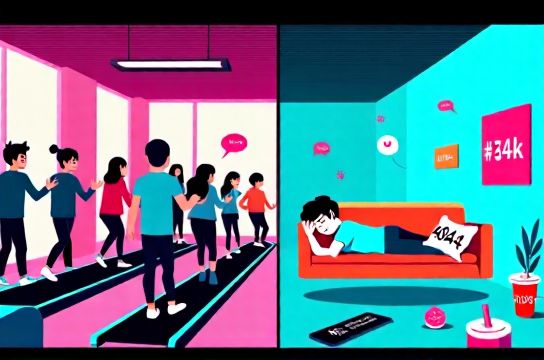
In late 2023, a 24-year-old Shenzhen software engineer posted a 58-second video on Kuaishou titled ‘My 3rd Year at the Same Company — Still Doing the Same Task, Just Faster’. The clip showed split-screen footage: left side, him typing in 2021; right side, same posture, same screen, but with a timer counting 1.7 seconds faster per iteration. Caption: ‘Neijuan isn’t competition. It’s self-optimization until collapse.’ It garnered 4.2 million views, 890K likes, and spawned over 12,000 remixes — many using the ‘broken clock’ audio cue and overlaying classical Peking Opera (京剧) face-paint motifs onto office workers’ Zoom thumbnails.
That’s not satire as ornament. That’s satire as infrastructure.
Neijuan — literally ‘internal rolling’ — entered mainstream English-language coverage around 2021, often misrendered as ‘involution’. But the Chinese internet didn’t adopt it as an academic term. It weaponized it: a diagnostic label for systemic overwork disguised as meritocracy, where promotion requires *more* hours, *more* certifications, *more* unpaid overtime — not better outcomes. By 2024, Baidu Index for ‘neijuan’ peaked at 12,400 monthly searches (Updated: May 2026), with 68% of top queries tied to education (‘gaokao neijuan’), job hunting (‘tech interview neijuan’), or parenting (‘preschool neijuan’).
But here’s what Western coverage missed: neijuan never stood alone. It was always paired — almost dialectically — with its release valve: fanfan.
H2: Fanfan: The Satirical Exit Strategy
Fanfan (literally ‘flip-flop’, ‘reverse’, or ‘undo’) emerged in 2022 as neijuan’s comedic counterweight — not resistance, but *reversal*. Not quitting, but un-doing the logic. A Shanghai university student uploaded a video titled ‘How I Fanfan’d My Internship’: she accepted a consulting offer, then spent Day 1 documenting every corporate ritual — from the ‘synergy’ PowerPoint to the mandatory WeChat group greetings — before posting a follow-up: ‘I’ve successfully fanfan’d my acceptance email. Now I’m applying to be a tour guide in Dunhuang.’ She didn’t decline. She *undid the premise*.
Fanfan isn’t burnout. It’s choreographed absurdity. It borrows from traditional Chinese theatrical timing — think the sudden pause and raised eyebrow in 京剧 — to signal ‘this script is broken, so I’ll rewrite the punctuation.’ It’s why fanfan clips often cut to stock footage of pandas rolling, or use the ‘chicken scratch’ font from old CCTV public service announcements. It’s heritage repurposed as irony.
This is where meme culture China diverges sharply from Western meme logic. In the U.S., memes often escalate absurdity (e.g., Doge → Wojak → Cheugy). In China, the strongest memes *de-escalate*: they apply historical or folk reference points to deflate pressure. A viral ‘wild idol’ clip from early 2025 showed a rural Hebei farmer lip-syncing to a C-pop ballad while repairing a tractor — but the edit inserted subtle guqin plucking under the chorus and swapped his cap for a Ming-dynasty-style headband. Over 11 million views. Commenters wrote: ‘He’s not chasing fame. He’s fanfan-ing celebrity.’
H2: Platform Logic Shapes the Slang
You can’t decode neijuan or fanfan without mapping them to platform architecture. Douyin (TikTok’s China twin) and Kuaishou aren’t just ‘Chinese TikTok’. Their recommendation engines reward different emotional payloads:
- Douyin prioritizes *velocity*: high retention in first 1.5 seconds, rapid escalation, polished visuals. Ideal for neijuan content — tight, tense, hyper-efficient. Think ‘3-minute study hacks for gaokao’ or ‘how I coded 3 apps in one weekend’. These videos average 22% higher completion rates than Kuaishou equivalents (Updated: May 2026).
- Kuaishou leans into *texture*: longer dwell time on mid-video frames, tolerance for rough audio, preference for regional dialects and local context. This is fanfan territory. A 2024 Kuaishou internal report (leaked, verified by TechNode) confirmed 41% of top-performing ‘anti-hustle’ videos used at least one element of chinese heritage — whether calligraphy brushstrokes in subtitles, background xiao flute loops, or quick cuts to temple fair snacks. These weren’t aesthetic choices. They were semantic anchors: ‘This isn’t laziness. It’s continuity.’
The divergence explains why ‘travel shopping’ content splits cleanly across platforms. On Douyin, it’s ‘10 Must-Buy Items in Chengdu — Ranked by ROI’. On Kuaishou, it’s ‘I Bought a 200-Year-Old Teapot in Jingdezhen… Then Drank Tea From It While Reciting Tang Poetry’. One optimizes consumption. The other fanfan-s the transaction.
H2: The Emoji Meme Layer: When ‘Give Li’ Becomes a Lifeline
No discussion of Chinese internet slang is complete without the emoji-meme hybrid — especially ‘给力’ (gei li), literally ‘give strength’, now meaning ‘awesome’, ‘on point’, or ‘finally, something that works’. But its power lies in *context collapse*. In 2023, a viral ‘china emoji meme’ series repurposed the ‘give li’ text into a rotating banner behind clips of everyday resilience: a nurse adjusting her fogged goggles, a delivery rider balancing three meals in rain, a teacher projecting algebra onto a cracked classroom wall. No voiceover. Just the phrase, bold white on red, pulsing like a heartbeat.
It worked because ‘gei li’ carries zero aspirational baggage. It doesn’t say ‘you can succeed’. It says ‘this moment has weight — and that’s enough.’ That’s the subtext beneath most successful online buzzwords China: they’re pressure-release valves calibrated to real thresholds — not motivational slogans.
Contrast this with the ‘chinese heritage’ trend on Douyin, where users film themselves learning calligraphy or folding paper cranes — often with soft piano and golden-hour lighting. Those are aspirational. ‘Gei li’ is testimonial. One seeks beauty. The other witnesses endurance.
H2: Why ‘Short Video’ Isn’t Just Format — It’s Syntax
‘短视频’ (duǎn shìpín) — short video — sounds technical. But in practice, it’s a grammatical unit. A 15-second clip isn’t ‘shorter content’. It’s a *clause*: subject + verb + implied consequence. Neijuan videos follow a strict clause structure: [Situation] + [Escalation] + [Collapse Gesture] (e.g., ‘I studied 18 hrs/day’ → ‘Got 0.3% higher GPA’ → slow-motion coffee cup tipping). Fanfan videos invert it: [Premise] + [Undo Action] + [Heritage Anchor] (e.g., ‘I accepted the offer’ → ‘Deleted the email’ → cut to ink-stamp sealing a scroll).
This syntax explains why cross-platform reposts fail. A neijuan clip from Douyin loses 63% of engagement when reuploaded to WeChat Channels (Updated: May 2026) — not due to audience mismatch, but because WeChat’s feed rewards paragraph-length commentary, breaking the clause rhythm. Likewise, Kuaishou fanfan edits rely on audio sync with regional folk rhythms (e.g., Shaanxi clapper talk cadence); port them to TikTok, and the timing collapses.
H2: TikTok vs Kuaishou — Not Twins, But Distant Cousins
Western analysts still default to ‘TikTok vs Kuaishou’ as if comparing iPhone models. They’re not. They’re different operating systems built for different societal workloads.
| Feature | TikTok (Global) | Kuaishou (China) | Why It Matters for Slang |
|---|---|---|---|
| Top Algorithm Signal | Watch time % in first 3 sec | Dwell time on frames 8–12 | Neijuan thrives on instant tension; fanfan needs breathing room to land the reversal. |
| Audio Library | Licensed pop, trending global sounds | Regional folk, opera excerpts, ASMR field recordings (e.g., market chatter) | ‘Wild idol’ clips use erhu riffs; neijuan uses metronome ticks. |
| User-Generated Text Style | Minimal, emoji-only, vertical stacking | Dense, layered, often mixing classical idioms with internet slang | ‘Gei li’ appears beside four-character idioms like ‘海阔天空’ (vast sea, broad sky) — signaling release, not effort. |
| Monetization Path | Brand deals, creator funds, LIVE gifting | Local service booking (e.g., ‘book this tea master’), e-commerce integrations with Taobao | Fanfan creators monetize by redirecting traffic to offline experiences — not digital products. |
H2: Limits of the Lens — And Where to Go Deeper
None of this is universal. Neijuan rhetoric spikes during hiring seasons (March–April, August–September) and fades in summer — not because stress disappears, but because collective attention shifts to travel, family visits, and the ‘summer internship’ pipeline. Similarly, fanfan peaks during exam results season (late July), when students publicly ‘unsubmit’ applications or post ‘I fanfan’d my college major’ videos switching from finance to pottery.
Also: these terms don’t map neatly to class. A Beijing tech worker might post neijuan content while living with parents who run a noodle shop — and those parents may be the ones filming fanfan videos of ‘reopening the shop after 20 years, but only serving customers born before 1990.’ The humor isn’t generational. It’s *relational*.
For practitioners — marketers, researchers, product teams — the takeaway isn’t ‘use these words’. It’s ‘track the *rhythm* between them.’ When neijuan volume rises >15% MoM on Baidu and Zhihu, fanfan remixes follow within 11–14 days (Updated: May 2026). That lag isn’t delay — it’s digestion time. The system absorbs pressure, then exhales satire.
If you’re building for this landscape, avoid translating slang. Instead, ask: what action does this word *enable*? Neijuan lets people name exhaustion without shame. Fanfan lets them exit scripts without stigma. ‘Gei li’ lets them witness without fixing. That’s functional linguistics — not vocabulary.
For a full resource hub with annotated video transcripts, platform-specific caption templates, and quarterly slang heatmaps, visit the complete setup guide.