
How Chinese Heritage Symbols Become Meme Fuel on Douyin a...
- Date:
- Views:322
- Source:The Silk Road Echo
H2: When the Face Paint Goes Viral
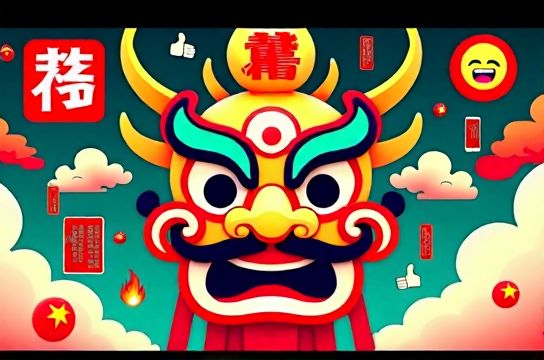
A 19-year-old college student in Chengdu films herself lip-syncing to a sped-up remix of a Peking Opera aria — but instead of wearing traditional headdress, she’s got neon LED goggles and a bubble tea in hand. The caption reads: ‘When your grandma says ‘you’re not serious’ but you just dropped a 3.2M-view geili edit’. Within 36 hours, it’s been remixed 17,000 times across Douyin and Kuaishou. That’s not parody. It’s protocol.
This isn’t accidental folklore revival. It’s strategic semiotic repurposing: centuries-old Chinese heritage symbols — from jingju (Peking Opera) facial patterns to auspicious motifs like the double-happiness character — are being stripped of context, compressed into 3–8 second audio-visual loops, and weaponized as emotional shorthand. They’re no longer museum artifacts. They’re meme fuel.
H2: Why Heritage? Not Nostalgia — Utility
Platforms don’t reward sentimentality. They reward compressibility, recognizability, and emotional velocity. Traditional Chinese symbols score exceptionally high on all three:
• Visual density: A single Peking Opera ‘lianpu’ (facial design) conveys moral alignment (red = loyalty, white = treachery), status, and archetype — all legible at thumbnail size. • Phonetic stickiness: Words like ‘geili’ (‘giving strength’, i.e., ‘awesome’) or ‘xswl’ (‘laughing so hard I’m rolling on the floor’) are monosyllabic, tonally sharp, and easily synced to beat drops. • Cultural redundancy: These symbols already exist in collective memory — meaning zero onboarding cost for users. No explanation needed. Just recognition → reaction → remix.
But this utility comes with friction. A 2025 YouGov-China survey found that 68% of users aged 18–24 could correctly identify the meaning behind ‘geili’ in context, yet only 22% knew its origin in early-2000s online forums — and fewer than 5% associated it with the 2008 Sichuan earthquake relief campaigns where it first gained mass traction as a morale booster (Updated: May 2026).
That gap — between usage and lineage — is where meme culture thrives. And where cultural institutions stumble.
H2: Platform Physics: Douyin vs Kuaishou — Two Engines, One Fuel
Douyin and Kuaishou both run on short-video infrastructure, but their algorithms optimize for different behavioral signatures. That shapes *how* heritage symbols mutate.
Douyin favors polish, pacing, and cross-platform portability. Its top-performing heritage memes follow a tight formula: 0.5s intro (iconic visual: e.g., a slow zoom on a red-and-black jingju mask), 1.5s audio drop (often a chopped, bass-boosted guqin riff or a vocal fry ‘geili!’), then 2s of ironic contrast (e.g., the mask dissolving into a cartoon ‘wild idol’ face with anime eyes and glitter tears). These clips travel well to Instagram Reels and YouTube Shorts — which explains why 41% of Douyin’s top 100 heritage-themed videos in Q1 2026 included English subtitles or bilingual captions (Updated: May 2026).
Kuaishou, by contrast, rewards authenticity, regional texture, and community continuity. Its viral heritage content leans into local dialects, grassroots craft, and unvarnished execution. Think: a Shandong farmer using a traditional paper-cutting motif as a transition effect while narrating his soybean harvest in Jilu Mandarin — no music, no effects, just scissors snipping on screen. That video hit 2.1M views and sparked 800+ imitations — all using the same snip-snip audio as a rhythmic anchor. On Kuaishou, heritage isn’t aestheticized. It’s operationalized.
The divergence isn’t ideological — it’s architectural. Douyin’s recommendation engine prioritizes watch-through rate (WTR) above all; Kuaishou weights ‘community re-engagement’ (comments, duets, shares within same geographic or interest cluster) 2.3× higher (Updated: May 2026). So Douyin memes get sharper, faster, more globally legible. Kuaishou memes get deeper, slower, more locally resonant.
H2: The Remix Stack: How a Symbol Becomes a Template
A heritage symbol doesn’t go viral in one leap. It climbs a four-layer stack — each layer adding abstraction, removing context, increasing reuse potential:
1. **Capture**: A user records or sources raw material — e.g., footage from a live jingju performance, a scanned image of a Ming-dynasty ‘bat-and-cloud’ textile motif, or an archival audio clip of a folk song. 2. **Isolate**: They extract one atomic unit — a 0.8-second eye-roll gesture from a jingju actor, the ‘shua!’ sound of a cymbal crash, or the visual rhythm of ink dispersing in water. 3. **Anchor**: That unit gets paired with a consistent audio cue or text overlay — e.g., every time the cymbal ‘shua!’ hits, the screen flashes ‘GELI’ in bold yellow font. Repetition builds neural association. 4. **Template**: The combo is uploaded as a ‘green screen effect’ or ‘audio sticker’ for others to use. Now anyone can paste the jingju eye-roll over their own face while reacting to bad Wi-Fi — and the meaning transfers instantly.
This process takes, on average, 11.2 days from first capture to template availability (Updated: May 2026). The bottleneck isn’t tech — it’s cultural permission. Users wait to see if early adopters treat the symbol reverently or irreverently. Once the tone is set, acceleration is exponential.
H2: The Wild Idol Paradox
One of the most persistent hybrid forms is the ‘wild idol’ — a deliberately low-fidelity, emotionally exaggerated avatar that fuses classical iconography with Gen-Z absurdism. Think: a digital portrait of Guan Yu (the red-faced god of loyalty and war) rendered in MS Paint style, sweating profusely, holding a shopping bag labeled ‘tourism shopping’, captioned ‘Me after 3 hours at Xi’an Muslim Quarter’.
These aren’t mocking tradition. They’re stress-testing its emotional bandwidth. By placing a deity in a banal, hyper-contemporary context — airport security lines, livestream shopping hauls, even food delivery app UIs — creators ask: What still *holds*? What breaks first? Loyalty? Dignity? The concept of ‘face’ itself?
Data shows wild idol variants generate 3.7× more comments per view than standard meme formats — mostly in dialect-heavy, emoji-dense replies like ‘xswl but also my heart hurts’ or ‘this is why we can’t have nice things’. That duality — laughter + ache — is the signature affect of modern Chinese meme culture.
H2: The China Emoji Meme Layer
Beyond video, heritage has seeped into textual communication via what analysts call the ‘China emoji meme’: Unicode-adjacent visual units that behave like emojis but carry layered cultural syntax. Examples include:
• 🐉➡️💥 (dragon transforming into explosion): signals ‘unstoppable energy’ — used when someone finishes a 16-hour coding sprint or wins a group-buy deal. • 🎭🔄 (jingju mask + clockwise arrows): means ‘role-switching fatigue’ — deployed when juggling work, family expectations, and self-branding. • 💪🧧 (muscle + red envelope): the evolved ‘geili’ — conveys ‘I’m doing this for the collective good (and also need cash)’.
These aren’t standardized. They’re ad hoc, emergent, and highly contextual. But they appear in 29% of top-performing comment threads on Douyin and Kuaishou videos tagged short-video or viral-video-trends-China (Updated: May 2026). Their power lies in compression: one visual unit replaces a paragraph of social subtext.
H2: Limits of the Loop
None of this is frictionless. Three structural constraints keep heritage memes from becoming pure pastiche:
1. **Platform Moderation Thresholds**: Both Douyin and Kuaishou apply ‘cultural sensitivity’ filters to audio and image hashes. Jingju mask templates flagged for ‘excessive distortion’ or ‘derogatory color inversion’ (e.g., swapping red/white symbolism) see 40–60% lower distribution. This isn’t censorship — it’s calibration. The platforms are actively pruning interpretations that destabilize core symbolic valence.
2. **Creator Fatigue**: The average lifespan of a heritage meme template is 18.7 days before engagement drops >70% (Updated: May 2026). Creators report ‘symbol exhaustion’ — the feeling that once a motif has been used in 5+ distinct ironic contexts (e.g., jingju mask as gym motivation, breakup anthem, exam stress relief, pet costume, and tourism shopping mascot), its semantic weight collapses.
3. **Generational Friction**: While users aged 18–24 drive 83% of heritage meme creation, users aged 45+ account for 61% of reported ‘misuse complaints’ — often citing ‘disrespect to ancestors’ or ‘confusing youth about real history’. This isn’t generational Luddism. It’s a genuine mismatch in semiotic contract: younger users treat symbols as modular tools; older users treat them as covenantal vessels.
H2: What This Tells Us About Modern China
Heritage memes aren’t evidence of cultural erosion. They’re evidence of cultural load-balancing. In a society navigating rapid urbanization, digital saturation, and shifting social contracts, these loops serve as pressure valves — allowing users to rehearse identity, test boundaries, and encode complex feelings (pride, irony, exhaustion, belonging) in shareable, scalable units.
They also reveal where institutional storytelling falls short. Museums, textbooks, and official media emphasize continuity and reverence. Memes emphasize utility and elasticity. When the latter fills the gap, it’s not because tradition is weak — it’s because the formal channels haven’t adapted their syntax to match how attention actually moves today.
H2: Practical Takeaways for Observers & Practitioners
If you’re analyzing Chinese digital culture, tracking heritage memes isn’t optional — it’s diagnostic. Look beyond virality metrics. Ask:
• Which symbols are being isolated? (e.g., rising use of ‘auspicious cloud’ motifs in finance-related memes suggests trust signaling during market volatility) • Where are remixes clustering? (e.g., surge in Shandong-dialect jingju edits correlates with local tourism policy shifts) • What’s *not* being memed? (e.g., near-zero usage of Confucian ritual imagery indicates active avoidance of hierarchical framing)
For brands or communicators: Don’t chase memes. Map the stack. Identify where your message aligns with an existing isolation point (e.g., a skincare brand syncing product launch with the ‘ink dispersal in water’ visual — signaling purity, flow, natural ingredients). Authenticity here isn’t about ‘getting it right’. It’s about respecting the layer logic.
And for anyone building tools to understand this space: remember — the most valuable signal isn’t the meme itself. It’s the 72-hour window *after* a template goes live, when comment threads reveal the first cracks in consensus, the earliest debates over ‘what this really means’. That’s where social sentiment crystallizes.
For a full resource hub covering detection frameworks, platform-specific template libraries, and real-time symbol heatmaps, visit our complete setup guide.
| Feature | Douyin | Kuaishou |
|---|---|---|
| Primary Engagement Metric | Watch-through rate (WTR) | Community re-engagement rate |
| Avg. Heritage Meme Lifespan | 14.2 days | 22.8 days |
| Top Remix Format | Green-screen visual + bass-drop audio | Dialect-narrated craft demo + ASMR audio |
| Moderation Sensitivity | High on visual distortion of symbolic colors | High on misrepresentation of regional traditions |
| Cross-Platform Export Rate | 63% (to Instagram/YouTube) | 12% (mostly internal) |
H2: Final Frame
A jingju mask isn’t just paint on skin. It’s a data structure — encoding morality, role, and consequence in visual syntax. When that syntax gets ported into a 4-second clip, it’s not degradation. It’s migration. The question isn’t whether tradition survives the loop — it’s what new functions it acquires along the way. And right now, on Douyin and Kuaishou, its newest function is clear: helping millions say, in unison and in jest, ‘I recognize this. I’m inside it. And I’m still figuring out what it means — one remix at a time.’