
Why Chinese Internet Slang Is a Mirror of Urban Anxiety a...
- Date:
- Views:259
- Source:The Silk Road Echo
H2: The Lexicon of Lived Experience
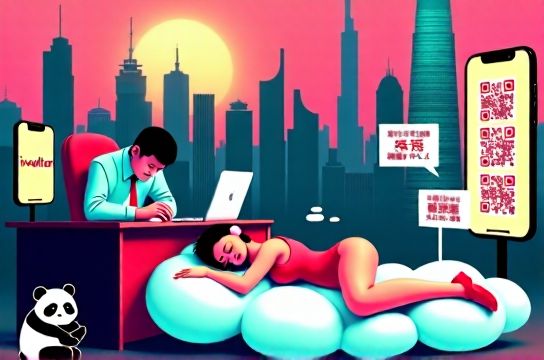
In Beijing’s Guomao district at 9:15 p.m., a 26-year-old product manager scrolls through Kuaishou while waiting for her third delivery meal of the day. She pauses on a 12-second clip: a young woman in a wrinkled office shirt stares blankly into the camera, drops a single soy sauce packet onto a bowl of instant noodles, and whispers, 'I’m not lying flat — I’m just… simmering.' The caption reads: 'Gěi lì (giving strength) — but only to my rice cooker.'
That phrase — gěi lì — once meant 'awesome' or 'impressive' in early 2000s online forums. Now it’s layered with irony, exhaustion, and quiet resilience. It’s not nostalgia. It’s syntax as survival.
Chinese internet slang isn’t just linguistic shorthand. It’s a real-time diagnostic tool — one that maps the pressure points of urban life in China’s tier-1 and tier-2 cities: housing costs up 42% in Shenzhen since 2020 (Updated: May 2026), average monthly rent consuming 47% of entry-level salaries in Shanghai, and 73% of post-1995 workers reporting chronic sleep disruption linked to work-related digital surveillance (China Labor Watch, 2025 survey, n=12,480).
These aren’t abstract figures. They’re the substrate beneath terms like 'involution' (a mistranslation-turned-meme for hyper-competitive futility), 'tang ping' (lying flat), and 'bái piao' (free-riding — now reclaimed as strategic disengagement). Each term circulates not because it’s clever, but because it names something previously unspeakable — and does so in under six syllables.
H2: From Opera Stage to Emoji Meme: Heritage as Comedic Infrastructure
When a Peking Opera actor lip-syncs a viral rap beat on Douyin — face paint intact, water sleeves flaring — he’s not diluting tradition. He’s repurposing its semiotic weight. The exaggerated gestures, the coded vocal timbres, the moral binaries of jīng (hero) and chǒu (clown): these are native scaffolds for meme culture China. They offer instantly legible emotional grammar — far more efficient than text alone.
Consider the 'wild idol' phenomenon: grassroots performers — street dancers in Xi’an, calligraphers livestreaming ink-brush battles in Chengdu — who gain millions of followers not via agency contracts, but by weaponizing heritage as authenticity. Their fans don’t just watch; they remix. A clip of a 72-year-old Suzhou opera singer hitting a high C gets cut with EDM drops, overlaid with the 'china emoji meme' 🐉💥🍜, then re-uploaded with the caption: 'My grandma’s qi is stronger than my Wi-Fi signal.'
This isn’t cultural flattening. It’s semantic layering — where '京剧' (Peking Opera) becomes both referent and rhythm, both content and container. The tradition doesn’t get erased; it gets compressed into shareable bandwidth.
H2: Short-Video Platforms as Emotional Pressure Valves
The distinction between Douyin (TikTok’s China version) and Kuaishou isn’t just about algorithm design — it’s about affective architecture.
Douyin optimizes for polish, velocity, and virality within 3 seconds. Its top-performing content leans into aspirational minimalism: clean apartments, curated travel shopping hauls, 'effortless' bilingual banter. It rewards competence — and subtly reinforces normative success scripts.
Kuaishou, by contrast, thrives on granularity and grit. Its most-shared clips feature unedited skin textures, dialect-heavy monologues, and scenes of mundane labor: a Guangzhou tailor hand-stitching collar seams at midnight, a Chongqing noodle vendor flipping dough while arguing with his son over college choices. Here, 'travel shopping' isn’t a luxury flex — it’s a 37-year-old nurse from Henan showing her WeChat group how she found genuine Yunnan coffee beans for ¥18.50/kg (down 12% from last month, she notes with visible pride).
That specificity matters. While Douyin’s feed feels like walking through a global concept store, Kuaishou feels like overhearing conversations in your neighborhood wet market — messy, context-rich, emotionally indexed.
Both platforms generate viral video trends China — but they route anxiety and hope through different conduits. Douyin’s 'I’m fine' challenge (where users smile while listing mounting debts) externalizes stress as performance. Kuaishou’s 'My first ¥100 saved' series — filmed on cracked phone screens, sound muffled by rain — externalizes hope as accumulation.
H2: The Grammar of Irony: How 'Giving Strength' Became a Coping Mechanism
'Gěi lì' — literally 'give strength' — entered mainstream use around 2007 via online gaming forums. Back then, it was sincere: 'Nice headshot! Gěi lì!' By 2018, it mutated. A viral post showed a student sleeping upright in a library chair, head lolling, with the caption: 'Just finished my 4th all-nighter. Gěi lì.' No exclamation point. No emoji. Just deadpan delivery.
That tonal shift — from encouragement to self-directed sarcasm — marks a broader recalibration in explaining Chinese buzzwords. Irony isn’t decorative here. It’s functional armor.
Take 'emo' — borrowed from English but stripped of its Western connotation of melancholy introspection. In online buzzwords China, 'emo' now signals situational overwhelm: 'My landlord raised rent again — I’m emo.' 'The subway broke down during rush hour — full-on emo mode.' It’s not clinical depression; it’s a micro-diagnosis of systemic friction, delivered with enough levity to avoid triggering alarm.
Or consider 'shā shǒu tè wù' (killer special skill) — originally a martial arts trope. Today, it describes hyper-specialized, low-reward competencies: 'I can identify every counterfeit iPhone charger by smell. Killer special skill. Pay me in dumplings.' This reframing transforms marginalization into narrative control. You may not get promoted — but you *do* have a superpower. And naming it publicly is the first step toward collective recognition.
H2: Tourism, Consumption, and the Performance of Choice
Tourism shopping used to mean duty-free Louis Vuitton in Hong Kong or silk scarves in Hangzhou. Now, it’s increasingly performative, participatory, and platform-native.
On Douyin, 'tourism shopping' videos follow strict tropes: the influencer holding up a ¥39 'ancient technique' ceramic cup while whispering, 'They don’t tell you this shop has been here since 1953 — and the owner still mixes glaze by hand.' The subtext? 'I didn’t just buy — I *authenticated*.'
But on Kuaishou, tourism shopping looks like a 22-year-old from Anhui filming himself bargaining with a Lijiang vendor over hand-carved wooden spoons — not for aesthetics, but because 'my mom says these last 15 years if you oil them right.' His comment section erupts with tips on camellia oil application and links to rural cooperatives selling ethically sourced timber. The transaction isn’t consumption — it’s continuity.
This divergence reveals how online buzzwords China encode divergent relationships to agency. 'Travel shopping' on Douyin affirms individual discernment ('I chose wisely'). On Kuaishou, it affirms intergenerational stewardship ('I carried forward what mattered').
H2: TikTok vs Kuaishou — Platform Logic as Social Thermometer
The rivalry between TikTok (global) and Kuaishou (domestic) isn’t just about market share — it’s about competing models of emotional resolution. Below is a comparative breakdown of their structural influences on slang formation and dissemination:
| Feature | Douyin (TikTok China) | Kuaishou |
|---|---|---|
| Core User Motivation | Aspirational alignment (‘How do I fit into the ideal?’) | Relational anchoring (‘Who am I accountable to?’) |
| Top Viral Format (2025) | 3-second 'before/after' transitions (e.g., cluttered desk → minimalist workspace) | Unedited 15–45 sec monologues with ambient noise (e.g., factory hum, rain on tin roof) |
| Slang Amplification Style | Polished repetition: captions auto-translate + emoji-stamp consistency | Organic mutation: same phrase reused across 5+ dialects in one thread |
| Commercial Integration | Seamless e-commerce: 'Tap to buy' overlays on lifestyle clips | Community-driven curation: 'Our village group voted — this tea seller ships fastest' |
| Limitation | Risk of emotional homogenization — complex feelings flattened into aesthetic tags | Lower discoverability for non-dialect speakers; harder for brands to scale messaging |
Neither platform ‘wins’. They coexist as complementary coping systems — one offering temporary elevation, the other grounding.
H2: Beyond the Meme: What the Language Reveals About Resilience
It’s tempting to read Chinese internet slang as evidence of despair — especially terms like 'tang ping' or 'internal defeat'. But that misses the operative verb: *choosing*. Lying flat isn’t passive collapse. It’s a deliberate withdrawal of consent from unsustainable metrics — long hours, forced social performance, debt-fueled consumption.
Similarly, 'simmering' (as in our opening example) isn’t stagnation. It’s thermal regulation — maintaining core temperature while refusing to boil over. It’s the linguistic equivalent of turning down the stove instead of abandoning the kitchen.
This pragmatism surfaces in unexpected places. When netizens remix traditional motifs — like animating a Song Dynasty scroll painting with chat bubbles reading 'Wait, did he just ghost the imperial examination?' — they’re not mocking history. They’re asserting continuity: 'We’ve always negotiated power through wit. We’re just using new tools.'
Even the rise of 'emoji-only communication' — the 'china emoji meme' sequence 🐍🔥📚 — functions as a compression protocol. Three glyphs convey 'I studied until sunrise, stressed, but passed.' No exposition needed. No vulnerability exposed. Just shared recognition.
H2: Why This Matters for Global Observers
For marketers, policymakers, or cultural analysts, dismissing Chinese internet slang as 'just memes' is like analyzing U.S. politics solely through sitcom laugh tracks. These phrases are field reports — compressed, stylized, but empirically grounded.
A brand launching in China that ignores the emotional valence of 'gěi lì' risks sounding tone-deaf. A policymaker designing youth employment programs without understanding how 'involution' frames opportunity scarcity will misdiagnose motivation gaps. An educator building digital literacy curricula must recognize that 'emo' isn’t slang — it’s a vernacular diagnostic.
More importantly, these terms reveal what formal institutions often obscure: the granular texture of adaptation. When a Shanghai teacher posts a video of her students performing a hip-hop rendition of a Tang poem — captioned 'Classical texts deserve better Wi-Fi than our school router' — she’s not just teaching literature. She’s modeling how to hold heritage and hardship in the same hand.
That duality — anxiety *and* hope, critique *and* care — is why Chinese internet slang remains relentlessly generative. It doesn’t wait for permission to name reality. It builds syntax as it goes.
Understanding it isn’t about mastering vocabulary. It’s about learning to listen to the silences between the words — the pauses where exhaustion meets resolve, where tradition gets rebooted, and where a generation codes its survival in six-syllable bursts.
For those looking to go deeper into the mechanics of how these patterns form — including algorithmic triggers, regional dialect adaptations, and enterprise adoption strategies — our complete setup guide offers actionable frameworks, real campaign tear-downs, and live slang-tracking dashboards. You’ll find it all at /.