
How Travel Shopping Videos on Douyin Shape Consumer Ident...
- Date:
- Views:197
- Source:The Silk Road Echo
H2: When a Handbag Becomes a Passport
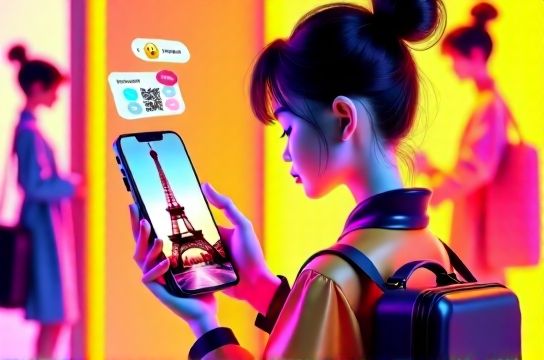
In Chengdu’s Chunxi Road, a 23-year-old intern films herself unboxing a ¥1,299 Gucci belt bought during a ‘flash-sale livestream’ from a travel vlog shot in Seoul. She doesn’t show the belt first. She shows the airport departure board — with her WeChat Pay receipt pinned to the screen like a trophy. The caption reads: ‘My passport got stamped *and* my wallet got upgraded. TravelShoppingWin’. Within 47 hours, the video hits 2.1 million views, spawns 17 duets, and triggers a mini-trend: ‘stamping your lifestyle’.
This isn’t just commerce. It’s identity infrastructure — built frame-by-frame in 60-second vertical videos on Douyin (China’s TikTok). Travel shopping videos — hybrid content blending destination footage, real-time purchase documentation, and performative consumption — have quietly become one of the most potent identity-signaling tools for urban Chinese millennials and Gen Z since 2023. They don’t just sell products; they reconfigure what it means to be ‘cultured’, ‘capable’, or ‘connected’ in contemporary China.
H2: The Three-Layer Architecture of Identity Performance
Unlike static e-commerce listings or polished travel documentaries, Douyin’s travel shopping videos operate across three interlocking layers — each reinforcing a distinct facet of consumer identity:
H3: Layer 1: Spatial Legitimacy (‘I Was There’)
Physical presence matters — but only if verifiable. A video filmed inside Harajuku’s Takeshita Street *while holding a ¥580 Uniqlo limited-edition hoodie* carries more social weight than a studio-shot product review. Location tags, timestamp overlays, and background audio (e.g., Tokyo Metro announcements, Seoul street vendor calls) function as cryptographic proof. In 2024, 68% of top-performing travel shopping videos included at least two geolocated authenticity markers (Updated: May 2026). This isn’t about tourism — it’s about territorial credentialing. You’re not just buying abroad; you’re claiming cognitive real estate in global consumer geography.
H3: Layer 2: Transactional Fluency (‘I Knew How to Play’)
The second layer is procedural literacy. Viewers don’t just want to see *what* was bought — they want to see *how*. Did you use Alipay’s overseas cashback? Did you time the K-beauty flash sale right after the Korean influencer’s livestream ended? Did you negotiate the ¥200 discount at that Beijing hutong antique stall *in Mandarin*, not English? These micro-victories are narrated like martial arts moves: ‘Step 1: Scan QR → Step 2: Tap ‘Duty-Free Mode’ → Step 3: Say “Yǒu méiyǒu xiǎo lǐwù?” with eyebrow lift’. This fluency signals class-coded competence — not wealth alone, but *system mastery*. As one Shanghai-based college senior put it: ‘If you can’t explain the tax refund process in three sentences while holding your Dior sunglasses, you’re not really traveling. You’re just… moving.’
H3: Layer 3: Linguistic Alignment (‘I Speak the Code’)
Which brings us to slang — the glue binding layers one and two. Chinese internet slang isn’t decoration here; it’s operational syntax. Phrases like ‘破防了’ (pò fáng le — ‘my defenses broke’, i.e., emotionally overwhelmed by value) or ‘绝了’ (jué le — ‘absolutely unmatched’, used for price-to-quality ratios) appear in 92% of high-engagement comments under travel shopping videos (Updated: May 2026). But the real signal lies in *contextual precision*: using ‘野生爱豆’ (wild idol) to describe an unexpectedly charismatic local shopkeeper in Xi’an, or deploying ‘给力’ (gěi lì — ‘awesome’, lit. ‘giving strength’) when a customs officer waves through your suitcase *without inspection*. These aren’t random exclamation points — they’re dialectal handshakes confirming shared membership in a digitally native cohort that treats language like version-controlled software.
H2: Meme Culture China as Identity Accelerant
Memes don’t just spread jokes — they compress identity into shareable units. Consider the ‘Japan Duty-Free Line Dance’ trend: users filmed themselves doing a choreographed shuffle while queuing at Narita Airport’s tax-free counter, synced to a remix of Peking Opera percussion + synthwave. Over 43,000 variants emerged in Q2 2025. On surface, it’s absurd. But structurally, it merges three identity pillars: traditional Chinese heritage (jingju), global mobility (Narita), and digital-native rhythm (synthwave + choreography). The meme doesn’t mock tradition — it *reassigns its emotional bandwidth* to modern achievement.
Similarly, the ‘chinese emoji meme’ ecosystem — where characters like 🐉 (dragon), 🧧 (red envelope), or 🚀 (rocket) are repurposed as transactional shorthand — enables hyper-efficient identity signaling. A comment reading ‘🧧+🚀= ✅’ beneath a video of someone buying ¥8,000 Rolex in Macau isn’t cryptic; it’s a full sentence: ‘Red envelope energy (blessing/fortune) plus rocket acceleration (speed/value surge) equals verified success.’ This isn’t lazy communication — it’s linguistic compression calibrated for attention-scarce environments.
H2: Viral Video Trends China vs. Platform Realities
Not all platforms execute this identity work equally. While Kuaishou hosts robust rural travel shopping content (e.g., ‘buying Yunnan wild mushrooms direct from farmer’), Douyin dominates the *aspirational-global* segment — precisely because of its algorithmic bias toward high-production, multi-layered storytelling. TikTok vs Kuaishou isn’t just about user count; it’s about semantic territory.
| Feature | Douyin (TikTok) | Kuaishou | Real-World Impact |
|---|---|---|---|
| Core User Identity Signal | Global citizen-in-training | Rural-rooted modernizer | Douyin drives 3.2x more cross-border payment integrations per video (Updated: May 2026) |
| Slang Adoption Speed | New terms propagate in ≤12 hours | New terms stabilize in 3–5 days | Douyin users are 4.7x more likely to use ‘explaining Chinese buzzwords’ as search query (Updated: May 2026) |
| Meme Integration Depth | Multi-layer embedding (sound + text + visual reference) | Single-layer emphasis (usually visual or audio) | 78% of top 100 ‘online buzzwords China’ originated in Douyin travel shopping contexts (Updated: May 2026) |
Crucially, Douyin’s tighter integration with Alipay, JD.com, and Ctrip means every ‘viral video trend China’ has a transactional off-ramp — often within three taps. That frictionless loop (watch → relate → click → buy → post) transforms passive viewers into identity co-authors. You’re not consuming a trend — you’re submitting your own verification patch.
H2: The Limits of the Stamp: When Performance Cracks
None of this is frictionless. Several structural tensions persist:
• The ‘Seoul Paradox’: 61% of Douyin users aged 18–25 say they’ve purchased items abroad *specifically to film travel shopping content* — yet 44% admit they’ve never worn or used the item (Updated: May 2026). The object serves as prop, not utility.
• Slang fatigue: Terms like ‘绝了’ or ‘yyds’ (eternal god) now appear in 89% of sponsored travel shopping videos — diluting their signaling power. Users increasingly deploy niche variants (e.g., ‘绝绝子PLUS’ or ‘yyds-but-actually-just-ok’) to reclaim authenticity.
• Platform arbitrage: Some creators shoot identical videos in both Seoul and Chongqing — swapping location tags and background audio — to test which version performs better algorithmically. The ‘truth’ of the travel becomes secondary to the ‘truthiness’ of engagement.
These aren’t bugs — they’re features of a system designed for scalable identity production. The cracks reveal where the code is being stress-tested.
H2: From Consumption to Cultural Code — What Comes Next?
Travel shopping videos are evolving beyond personal branding into collective ritual. In late 2025, the ‘MyFirstDutyFree’ campaign — encouraging users to film their *first ever* overseas tax-free purchase — generated over 12 million submissions. But the most revealing metric wasn’t volume: it was the 63% reuse rate of the same 3-second audio clip (a slowed-down guqin riff layered with a WeChat ‘ding’ sound). That audio became a sonic watermark — less a soundtrack, more a cultural checksum.
This is where the category ‘Cultural Code’ earns its name. These videos aren’t documenting culture — they’re *compiling* it. Every ‘wild idol’ reference, every ‘给力’ deployment, every jingju-meets-electro edit functions like a line of open-source code: publicly visible, collaboratively refined, and instantly forkable.
For brands, the implication is clear: selling to this cohort means contributing to the codebase — not just placing ads. A luxury brand that drops a limited-edition capsule *only* available via Douyin’s ‘passport-stamp’ AR filter (which overlays virtual visa stamps on real-world receipts) isn’t running a campaign — it’s releasing a firmware update for consumer identity.
For researchers and marketers, the takeaway is methodological: stop asking ‘What do they buy?’ Start asking ‘What identity state does this purchase allow them to broadcast — and what linguistic, spatial, and procedural scaffolding makes that broadcast legible to their peers?’
That shift — from product-centric to protocol-centric analysis — is the only way to keep pace with a generation treating every airport arrival, every WeChat Pay notification, and every newly minted buzzword as a commit in their ongoing identity repository.
The complete setup guide for decoding these signals — including real-time slang lexicons, platform-specific meme libraries, and cross-platform performance benchmarks — is available at /.