
Watch Flame Lit Kilns Shape Jingdezhen's Ceramic Legacy
- Date:
- Views:422
- Source:The Silk Road Echo
If you’ve ever wondered how a humble lump of clay becomes a masterpiece that sells for thousands, you need to understand one thing: the flame-lit kiln. In Jingdezhen, the porcelain capital of the world, these ancient wood-fired kilns aren’t just tools—they’re living history. As a ceramic artist and longtime observer of traditional firing techniques, I’ve seen firsthand how the dance of fire and flame shapes not just pottery, but culture.
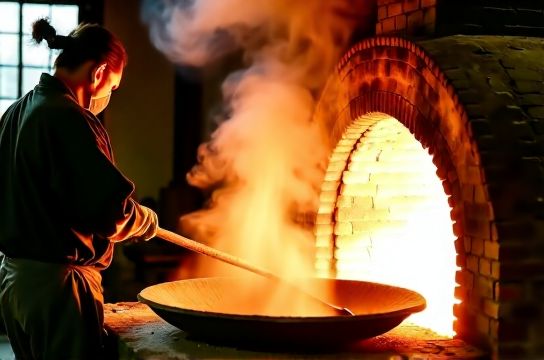
Jingdezhen has been perfecting porcelain for over 1,700 years. But it’s not the clay or the craftsmanship alone that sets it apart—it’s the dragon kilns (long in Chinese), long sloping structures built into hillsides. These kilns can stretch over 50 meters and hold up to 10,000 pieces per firing. What makes them special? The way heat travels. Unlike modern electric kilns, dragon kilns rely on natural draft and stacked chambers, creating subtle temperature gradients—up to 1,380°C at the front, cooling to 1,200°C at the back. This variation produces unique glaze effects impossible to replicate with machines.
Let’s talk numbers. A single wood-firing lasts 24–36 hours and burns roughly 8–10 tons of pine wood. That may sound inefficient, but the results speak for themselves. According to a 2022 study by the China Academy of Ceramics, wood-fired pieces from Jingdezhen fetch 3–5x higher prices than gas- or electric-fired equivalents in international auctions. Why? Collectors value the ‘kiln spirit’—ash deposits that melt into natural glazes, creating one-of-a-kind textures.
Here’s a quick comparison of common kiln types used in Jingdezhen today:
| Kiln Type | Firing Time | Temp Range (°C) | Fuel Used | Unique Output |
|---|---|---|---|---|
| Dragon Kiln (Wood) | 24–36 hrs | 1,200–1,380 | Pine wood (8–10 tons) | Natural ash glazes, 'fire marks' |
| Gas Kiln | 8–12 hrs | 1,280–1,320 | Natural gas | Consistent color, fewer surprises |
| Electric Kiln | 6–10 hrs | 1,200–1,300 | Electricity | Precise control, ideal for prototypes |
Now, you might ask: with all this time and fuel, why bother? Because perfection isn’t always about control. In fact, some of the most sought-after pieces come from ‘accidents’—a wisp of smoke here, an uneven burn there. These ‘flaws’ are celebrated as signs of authenticity. Master potter Chen Ruiqiang once told me, “A machine-made piece is like a robot singing—technically correct, but soulless.”
Tourists often visit the Guylao Kiln, one of the few still operating in the old city. Watching artisans load shelves by torchlight, then seal the kiln with mud—it’s like stepping into a ritual older than most nations. And when the kiln cools after three days? That unloading moment—called ‘opening the mountain’—feels like Christmas morning for potters.
So if you're serious about ceramics, don’t just look at the final product. Understand the fire that shaped it. Whether you're a collector, artist, or curious traveler, flame-lit kilns offer more than pottery—they offer a legacy forged in smoke and flame.