
Social Mobility in Today's Chinese Context
- Date:
- Views:300
- Source:The Silk Road Echo
In today’s fast-evolving China, social mobility isn’t just a buzzword—it’s a lived reality for millions. Whether you're climbing the corporate ladder, moving from rural villages to bustling cities, or chasing a college degree as a ticket to a better life, upward mobility is both a dream and a daily hustle.
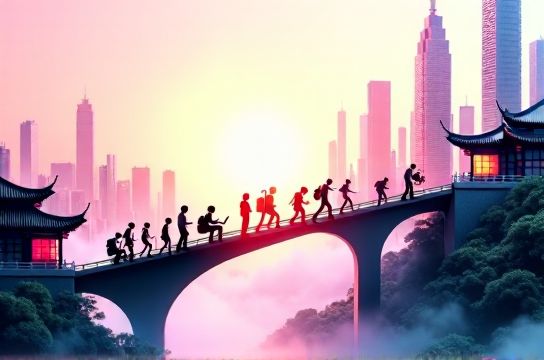
China’s rapid economic growth over the past four decades has reshaped its social fabric. According to the World Bank, China lifted over 800 million people out of poverty since the late 1970s—the largest such movement in human history. But what does social mobility really look like now, especially for the younger generation?
The Engines of Mobility
Three major forces drive social mobility in modern China: education, urbanization, and digital opportunity.
- Education: For many families, the Gaokao (national college entrance exam) remains the golden ticket. In 2023, over 12.9 million students sat for the exam. A Peking University study found that college graduates earn, on average, 67% more than their peers with only high school diplomas.
- Urban Migration: Over 300 million people have moved from rural areas to cities in the last 30 years. Migrants often start in low-wage jobs but use city access to networks, skills, and savings to improve their children’s prospects.
- Digital Platforms: E-commerce, livestreaming, and gig work are creating new ladders. A 2023 report by Alibaba showed that over 50 million people earn income through digital platforms—many from small towns or rural counties.
Mobility in Numbers: A Snapshot
To put it in perspective, here’s a breakdown of intergenerational income mobility in China compared to other countries:
| Country | Intergenerational Income Elasticity | Notes |
|---|---|---|
| China | 0.45–0.60 | Moderate stickiness; improving in urban centers |
| United States | 0.47 | Often seen as 'land of opportunity' but mobility stagnant |
| Denmark | 0.15 | High mobility due to strong welfare and education |
| India | 0.50–0.60 | Similar structural barriers to China |
(Source: OECD & World Bank, 2022)
A lower elasticity means higher mobility—so while China still has room to grow, it’s not as rigid as some assume.
The Hidden Barriers
But let’s keep it real: mobility isn’t equal across the board. The hukou (household registration) system still limits access to public services like education and healthcare for rural migrants in cities. And while tier-1 cities like Beijing and Shanghai offer opportunity, skyrocketing housing costs can slam the door shut.
For Gen Z, the pressure is real. The term “involution” (neijuan) went viral a few years back—and it stuck. It describes the exhausting grind of working harder for little gain, especially in competitive job markets. A 2023 survey by Zhaopin.com found that only 38% of young graduates feel optimistic about career advancement.
So, What’s the Outlook?
Despite challenges, pathways exist. Government initiatives like rural revitalization, vocational training expansion, and digital infrastructure rollout are slowly leveling the field. Meanwhile, self-made success stories—from village streamers selling local goods online to tech entrepreneurs in Shenzhen—show that grit and timing still matter.
In short, social mobility in China today is a mix of old-school effort and new-age opportunity. It’s not guaranteed, but for those willing to adapt, the ladder—though wobbly—is still climbable.