
Religious Beliefs in Secular Chinese Society
- Date:
- Views:256
- Source:The Silk Road Echo
In a country where the skyline is dotted with skyscrapers and ancient temples stand quietly beside bustling shopping malls, China presents a fascinating paradox: a largely secular society with deep spiritual undercurrents. While official statistics paint China as one of the most atheist nations on Earth, scratch beneath the surface and you'll find a rich tapestry of religious beliefs quietly thriving.
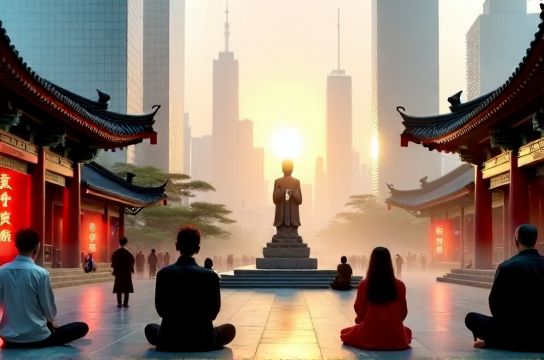
According to a 2023 Pew Research Center report, only about 10% of Chinese adults identify with an organized religion. Yet, over 60% engage in folk religious practices—lighting incense, honoring ancestors, or visiting temples during festivals. This blend of secular identity and spiritual practice defines the unique religious landscape of modern China.
The Big Three: Buddhism, Taoism, and Folk Religion
While China officially promotes atheism, especially within the Communist Party, it recognizes five religions: Buddhism, Taoism, Islam, Catholicism, and Protestantism. Among these, Buddhism and Taoism have the deepest cultural roots.
- Buddhism: Introduced from India over 2,000 years ago, it now claims around 18% of the population (approx. 250 million people).
- Taoism: Homegrown and deeply tied to Chinese philosophy, practiced by roughly 10 million formally, though millions more follow its principles informally.
- Folk Religion: Not officially recognized, yet practiced by up to 30% of the population through rituals, deity worship, and ancestor veneration.
| Religion | Estimated Followers (Millions) | Official Recognition | Key Practices |
|---|---|---|---|
| Buddhism | 250 | Yes | Meditation, temple visits, vegetarianism |
| Taoism | 10 | Yes | Qi cultivation, feng shui, ritual offerings |
| Folk Religion | 400 | No | Ancestor worship, festival rites, spirit mediumship |
| Christianity | 70 | Yes (with restrictions) | Church services, Bible study, house churches |
| Islam | 23 | Yes | Daily prayers, halal diet, Ramadan fasting |
Wait—how can folk religion have 400 million followers if it’s not recognized? Because in China, belief doesn’t always require a label. Many people say they’re ‘non-religious’ but still burn joss paper during Qingming Festival or pray at a local temple for good luck. It’s spirituality without formal affiliation—a quiet rebellion against rigid categorization.
Secularism with a Spiritual Pulse
The Chinese government maintains tight control over religious institutions, requiring all groups to register and align with state ideology. Unregistered 'house churches' and underground Buddhist sects often face crackdowns. Yet, spirituality persists—especially among older generations and rural communities.
Urban youth, meanwhile, are redefining faith. Meditation apps, mindfulness retreats, and even AI-powered fortune telling are blending ancient traditions with digital culture. A 2022 survey found that 45% of millennials consult traditional almanacs before making big decisions—proving that old habits die hard, even in a tech-driven world.
Why It Matters
Understanding religion in China isn’t just about counting temples or believers—it’s about grasping how culture, history, and policy shape personal belief. In a society that values harmony and social stability, religion often takes a backseat to family, education, and economic success. But when life gets tough? That’s when the incense comes out.
So, is China truly secular? Depends on how you define it. Officially, yes. Emotionally and culturally? Millions light a candle every day hoping for peace, prosperity, or protection. And that’s a kind of faith no statistic can fully capture.