
Inside China's 'Involution' Epidemic: How Pressure Shapes Modern Society
- Date:
- Views:311
- Source:The Silk Road Echo
You’ve probably heard the term ‘involution’ thrown around in chats about Chinese society — but what does it *really* mean? It’s not just a buzzword. In China, “neijuan” (内卷), or involution, has become the unofficial anthem of overworked students, burnt-out office workers, and anyone stuck in a never-ending race where running faster gets you nowhere.
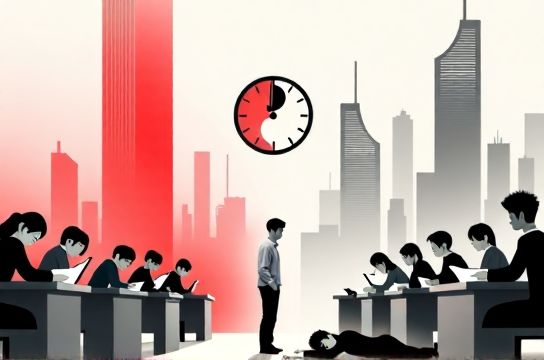
Imagine this: You stay late at the office to finish your work. Then you notice everyone else is staying even later — not because they have more to do, but just to look busy. So you stay later too. And the cycle spirals. That’s involution: exhausting effort with zero real progress. It’s like running on a treadmill that keeps speeding up, but you’re still stuck in place.
This phenomenon isn’t new, but it’s exploded in recent years across education, tech jobs, and even parenting. Students in China study 14-hour days, not because they love textbooks, but because everyone else is doing it. One kid tutors at night? Soon the whole class is cramming past midnight. The bar keeps rising, rewards stay the same, and stress skyrockets.
The roots of involution run deep. Rapid economic growth created massive opportunity — but also fierce competition. With millions chasing limited top-tier jobs, university spots, or housing in big cities, people feel forced to outwork each other just to survive. Social media doesn’t help. Platforms like WeChat Moments and Xiaohongshu are full of highlight reels — promotions, luxury trips, perfect kids — making everyone feel like they’re falling behind.
And let’s talk about the workplace. In tech hubs like Beijing and Shenzhen, the '996' culture (9 a.m. to 9 p.m., 6 days a week) is common. Employees grind endlessly, fearing that taking a break means losing their edge. But here’s the twist: all this extra work rarely leads to better results or pay. It just becomes the new normal. That’s involution in action — more input, no output gain.
Young people are pushing back. The 'lying flat' (tang ping) movement gained traction as a form of quiet resistance — choosing minimal effort, rejecting burnout, and opting out of the rat race. Others embrace 'low-desire lifestyles,' focusing on mental health over material success. While these aren’t solutions, they reflect a growing awareness: something’s broken in the system.
So, can China escape involution? Experts say it’ll take structural changes — better work-life balance policies, fairer education systems, and cultural shifts that value well-being over endless hustle. For now, though, millions continue navigating this invisible pressure cooker, trying to find meaning without melting down.
Involution isn’t just a Chinese problem — it’s a warning sign for any society obsessed with productivity at all costs. As global pressures rise, understanding neijuan might help us all step off the treadmill before it’s too late.