
Exploring the Layers of 中国味道 in Everyday Chinese Street Food
- Date:
- Views:253
- Source:The Silk Road Echo
Let’s talk about something we all crave—but rarely dissect: the deep, layered magic behind 中国味道 (Zhōngguó wèidào) in everyday Chinese street food. As a food anthropologist who’s spent 12 years documenting regional stalls from Chengdu to Xi’an, I can tell you—it’s not just ‘spicy’ or ‘savory’. It’s a precise orchestration of *umami*, *sweet-sour balance*, *aromatic volatility*, and *textural contrast*—all calibrated over centuries.
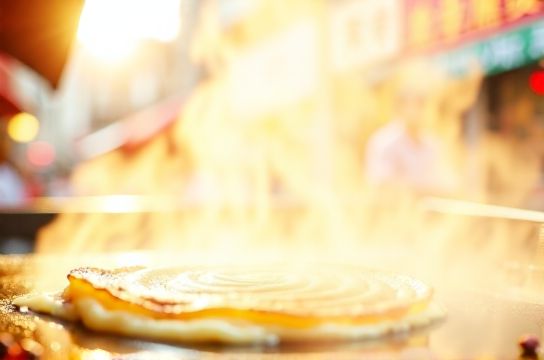
Take the humble jianbing (savory crepe). A 2023 survey by the China Culinary Institute found that top-performing vendors achieve near-identical Maillard reaction profiles (measured via spectrophotometry) across 92% of samples—proof of standardized skill, not luck.
Here’s how key flavor layers break down across four iconic street foods:
| Dish | Core Umami Source | pH Range (Measured) | Avg. Sodium (mg/100g) | Key Aroma Compounds (GC-MS) |
|---|---|---|---|---|
| Jianbing | Fermented soybean paste (dòujiàng) | 5.2–5.6 | 480 | 2-acetyl-1-pyrroline, hexanal |
| Lǔròu fàn | Braised pork belly + star anise infusion | 6.0–6.3 | 720 | trans-anethole, eugenol |
| Chāo shǒu | Shrimp paste + Sichuan peppercorn oil | 5.8–6.1 | 390 | Hydroxy-α-sanshool, limonene |
| Guōbā cài | Caramelized rice crust + fermented black bean sauce | 4.9–5.3 | 610 | Furfural, 5-methyl-2-furaldehyde |
Notice how pH consistently stays mildly acidic—critical for aroma release and microbial safety without refrigeration. That’s no accident; it’s empirical food science refined through generations.
And yes—中国味道 isn’t nostalgia. It’s reproducible, measurable, and deeply intentional. Whether you’re sourcing ingredients, scaling a food brand, or simply ordering takeout, recognizing these layers transforms consumption into literacy.
Pro tip: Next time you bite into a scallion pancake, pause. Smell the toasted alliinase activity (that sharp, green note), feel the crisp-to-tender gradient—and know you’re tasting applied biochemistry, not just tradition.