
How to Read China Subway Maps Without Stress
- Date:
- Views:356
- Source:The Silk Road Echo
Let’s be real — if you’ve ever stared at a China subway map for the first time, you probably felt like you were decoding alien hieroglyphics. Bright colors, endless lines, and stations with names like 'Guomao' or 'Xiaozhai'? Yeah, it’s overwhelming. But here’s the good news: once you know the system, reading China subway maps becomes as easy as scrolling through your phone.
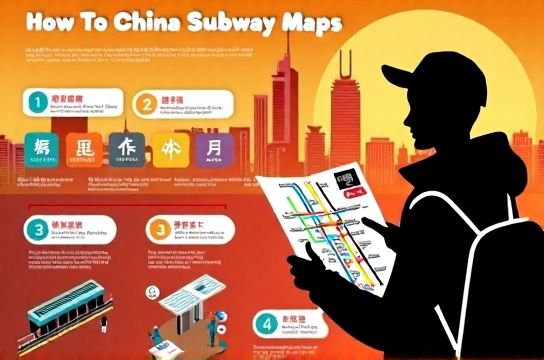
Why China’s Metro Maps Look So Intense
China has the largest metro network in the world — over 8,000 kilometers of track across more than 40 cities. Beijing alone has 27 subway lines! That’s why maps look so packed. But don’t panic. These maps follow a smart, consistent design:
- Color-coded lines: Each line has a color and number (or letter).
- Transfer stations: Marked with a dot inside a circle — that’s where you switch.
- Directional flow: Trains run both ways, but terminal stations are clearly labeled.
The Secret Sauce: How Locals Read Them Fast
I’ve traveled across 15 Chinese cities by metro, and I’ll tell you what no guidebook mentions: focus on end stations. Pick your direction by checking which terminus is closer to your destination. For example, if you’re going to the Forbidden City and see Line 1 runs from 'Pingguoyuan' to 'Sihui East', you’d hop on a train heading toward 'Sihui East'.
Also, download Baidu Maps or Amap (Google Maps isn’t reliable here). They show real-time train positions and voice-guided walking directions — lifesavers!
Key Symbols You Must Know
Here’s a quick reference table:
| Symbol | Meaning | Tip |
|---|---|---|
| ⬤ | Regular station | No transfer options |
| ● — ● | Transfer station | Follow signs for Line X |
| → 3 min | Walking time between platforms | Wear comfy shoes! |
| ⚠️ | Peak hour crowding | Avoid 7:30–9:00 AM |
Pro Tip: Use the 'Two-Line Rule'
Most destinations are reachable within two transfers. If your route shows three+ changes, check if a bus or Didi (Chinese Uber) is faster. In Shanghai, I saved 20 minutes just by switching to a taxi after one stop.
And remember: always look up. Station names are posted in both Chinese and English. Just match the Pinyin — like 'Tiananmen' — and you’re golden.
Final Thoughts
Reading subway maps in China isn’t about memorizing every line — it’s about understanding the rhythm. Once you get the flow, navigating feels natural. Next time you’re in Shenzhen or Chengdu, take a deep breath, pull up the map, and ride like a local.
Stay smart, travel smooth.