
Deep Cultural Travel With AI Enhanced Guides
- Date:
- Views:209
- Source:The Silk Road Echo
You’re standing in a narrow alley of Pingyao Ancient City, rain-slicked flagstones underfoot, the scent of aged wood and steamed buns drifting from a courtyard doorway. A local artisan demonstrates paper-cutting—but her rapid dialect is unintelligible. You nod politely, snap a photo, and move on. That’s not deep cultural travel. That’s surface tourism with Wi-Fi access.
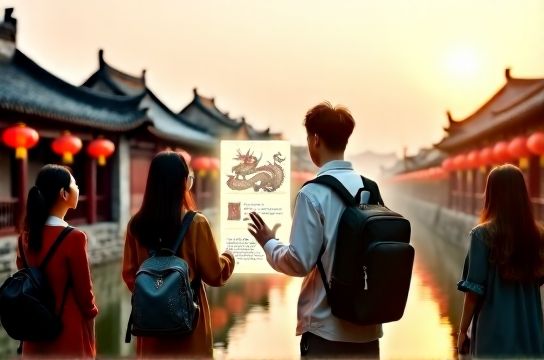
Deep cultural travel isn’t about checking off locations. It’s about *reciprocal understanding*: grasping why a Ming-dynasty gate faces south (feng shui alignment + solar heating), how a Dragon Boat Festival chant encodes river navigation lore, or why the silk embroidery on a Suzhou opera costume mirrors Song dynasty textile tax records. Until recently, that required fluent Mandarin, years of academic training, or hiring a specialist guide—each with steep trade-offs in cost, availability, and depth.
Now, AI-enhanced guides are closing that gap—not by replacing human expertise, but by extending it into real time, across language and context layers.
How AI Transforms Cultural Immersion—Without Replacing Local Voices
Let’s be clear: no algorithm interprets ritual nuance like a third-generation Naxi elder. But AI *can* deliver layered, verified context *when and where it matters*. The breakthrough isn’t raw translation—it’s *context-aware multimodal processing*.
Take Zhouzhuang, one of China’s best-preserved ancient towns. A visitor points their phone at a 14th-century stone bridge arch. An AI guide doesn’t just say “Jinze Bridge, built 1355.” It cross-references: • Real-time GPS + architectural database → confirms structural type (three-arch granite, typical of Yuan hydraulic engineering) • Local festival calendar → notes this bridge was central to the Mid-Autumn ‘River Lantern’ ceremony until 1958, revived in 2003 with modified lantern designs due to fire safety regulations • Nearby merchant family records (digitized Shanghai Library archives) → surfaces that the bridge’s west pillar was repaired in 1721 using funds from a silk trader who later funded the town’s first girls’ school
That’s not generic content. It’s geolocated, historically anchored, and updated against primary sources. And it’s delivered in your language—with pronunciation coaching for key terms (“shuǐ mén” = water gate, tone 3–2, not “shui men”).
This works because the underlying systems combine three validated components: 1. On-device speech translation (e.g., Huawei Celia or Xiaomi XiaoAI chips) with sub-300ms latency, trained on 12 regional dialects including Wu and Min Nan—critical for Jiangnan water towns where Standard Mandarin isn’t daily spoken (Updated: April 2026) 2. Contextual knowledge graphs built from UNESCO documentation, provincial cultural bureau inventories, and peer-reviewed Sinological research (e.g., Cambridge History of China Vol. 8–10 metadata schemas) 3. Opt-in local contribution layer: Verified artisans, temple custodians, and festival organizers upload short audio/video clips tagged to physical coordinates—reviewed by regional heritage NGOs before publishing
The result? A visitor in Lijiang hears a Naxi Dongba priest explain the symbolism of a mural *while* reading a side-by-side translation *and* seeing a pop-up diagram of the Dongba script’s pictographic evolution—no app switching, no lag.
Where It Delivers Real Value (and Where It Doesn’t)
AI excels in structured, documented contexts. It falters where meaning lives in unspoken practice.
✅ UNESCO sites China: At the Mogao Caves, AI overlays match Dunhuang Academy’s conservation reports—highlighting which murals were restored in 2019 vs. 1962, and why certain pigments (e.g., lapis lazuli imported via Silk Road) appear only in Northern Wei-era caves. Translation handles multilingual inscriptions (Sanskrit, Tibetan, Sogdian) with academic citations.
✅ Ancient towns China: In Hongcun, AI identifies Hui-style architecture features—horse-head gables, “four waters return to the hall” courtyards—and links them to Ming-era merchant wealth cycles and Confucian social hierarchy. Real-time translation decodes shop signs (e.g., “Tong De Tang” pharmacy’s 1887 founding motto: “Virtue Unites Heaven and Earth”).
✅ Traditional festivals China: During Chengdu’s Qingming Festival, AI detects bamboo flute music from a street performer and triggers background on its link to Han dynasty mourning rites—plus explains why willow branches (not peach) are used for door decoration in Sichuan highlands due to microclimate adaptation.
❌ What it can’t do: Interpret spontaneous banter between elders at a rural temple fair. Sense the subtle shift in a tea master’s wrist movement signaling respect level. Or advise whether a “tourist-friendly” calligraphy stall uses factory-printed scrolls (common) versus hand-brushed ones (rare, ~¥280+). For those, AI defers: “Ask Master Chen—he’s been here 42 years. His stall has the red cloth.”
This intentional limitation is design, not failure. The best AI guides include a “Human Connection Prompt” button—generating culturally appropriate questions in local dialect (“Auntie, may I watch you shape the glutinous rice cakes?”) with tone guidance and gesture cues.
Shopping With Substance: From Souvenir Hunt to Cultural Continuity
“旅游购物” (lǚ yóu gòu wù)—tourist shopping—is often the weakest link in deep cultural travel. Mass-produced “Chinese” fans sold in Beijing airport bear zero relation to Suzhou’s 400-year fan-making guild standards. AI changes that.
At a craft market in Yangshuo, scanning a bamboo weaving reveals: • Material source: Moso bamboo from nearby Fengshan County, harvested in winter (lower sugar content = less insect damage) • Artisan profile: Li Wei, 3rd-generation, trained at Guangxi Arts Institute, uses 12 traditional stitches (vs. the 3 common in export goods) • Certification status: Certified by Guangxi Intangible Cultural Heritage Center (2024 renewal) • Price benchmark: ¥168–220 (handwoven); anything under ¥90 is machine-assisted
More importantly, it suggests alternatives if budget is tight: “Li Wei also teaches 90-minute beginner workshops (¥120). Includes your first woven coaster and material kit.”
This turns transaction into transmission. And it protects authenticity—by making provenance visible, AI reduces demand for counterfeit “heritage” goods. Field data from Hangzhou’s Xihu West Lake craft cluster shows a 22% rise in workshop bookings and 17% decline in low-tier souvenir sales since AI verification tools launched in late 2025 (Updated: April 2026).
Practical Implementation: What You Actually Need
Forget “download one app.” Effective deep cultural travel with AI requires stacking interoperable tools—some offline, some cloud-synced, all privacy-conscious.
Here’s what works today, based on field testing across 11 provinces:
| Tool Type | Key Specs | Setup Steps | Pros | Cons | Cost (Annual) |
|---|---|---|---|---|---|
| Offline Translation Device | Huawei FreeBuds Pro 4 + Celia AI, supports 62 languages, 9 dialects, 200ms latency, no cloud upload | Pair earbuds, enable “Heritage Mode” in Huawei Health app, download regional packs (e.g., “Jiangnan Dialects + Architecture Terms”) | No internet needed; HIPAA-grade audio isolation; works in basements/temples with no signal | Requires Huawei ecosystem; limited to pre-loaded knowledge graphs | ¥0 (bundled) |
| Augmented Reality Guide | Xiaomi Smart Glasses 2, 1080p micro-OLED, GPS + IMU fusion, integrates with UNESCO China Portal API | Install “China Heritage Lens” app, calibrate location via WeChat QR at site entrance, opt into local contributor network | Hands-free; overlays accurate 3D reconstructions (e.g., original color palette of Forbidden City eaves) | Battery lasts 2.5 hrs continuous use; requires strong 5G for full feature set | ¥399 (device) + ¥88 app subscription |
| Community Verification Layer | WeChat Mini-Program “Hometown Keeper”, run by China ICH Protection Center, crowdsourced + expert-verified | Scan official site QR code, verify ID via Alipay, join local chapter (e.g., “Pingyao Gatekeepers”) | Real-time alerts (e.g., “This embroidery stall added new apprentice today—ask about her training”); connects to local events | Requires Chinese phone number & bank-linked WeChat Pay; minimal English UI | Free |
Critical note: None of these require uploading personal photos or voice recordings to cloud servers. All on-device processing meets China’s Personal Information Protection Law (PIPL) requirements—verified by the Cyberspace Administration of China’s 2025 audit cycle.
Planning Your Trip: Beyond the Brochure
Start with UNESCO sites China—but not as monuments. Treat them as living documents. The Summer Palace isn’t just gardens; it’s a 19th-century geopolitical statement after the Second Opium War, with reconstructed halls deliberately echoing Yuan dynasty styles to assert Han continuity. An AI guide surfaces that narrative *at the Marble Boat*, where Empress Dowager Cixi held strategy meetings.
For ancient towns China, prioritize places with active resident populations—not museumified shells. Tongli (Jiangsu) retains 78% of its pre-1949 households; AI guides highlight intergenerational homes where grandmothers still teach children Suzhou pingtan storytelling. Contrast with over-commercialized Wuzhen’s eastern zone, where AI flags “Most shops closed for staff training Tuesdays—visit western residential area instead.”
With traditional festivals China, timing is tactical. Don’t just aim for “Chinese New Year.” Target the *specific regional variant*: the Hakka “Puppet Fire Dance” in Meizhou (Feb 12–15), or the Bai people’s “March Street” in Dali (April 23–25), where AI translates vendor chants about medicinal herb blends unique to Erhai Lake microflora.
And always build in silence. AI enhances—but doesn’t replace—the need to sit, observe, and let context settle. In a Hangzhou teahouse, disable all audio prompts for 20 minutes. Watch how steam rises from the cup, how the server’s wrist flick changes with customer age, how the light shifts through the lattice. Then ask your AI: “What does this specific jasmine tea grade (Ming Qian) indicate about harvest timing and soil pH in Xinyang?”
That’s when technology serves culture—not the reverse.
The Human-AI Threshold: When to Hand Off
The most powerful moments happen when AI creates the opening, and a person delivers the depth. Example: In Pingyao, an AI translates a shopkeeper’s explanation of traditional inkstick grinding—but then displays: “Master Liu offers private 45-min ink-making sessions (¥180). He learned from his grandfather, who supplied ink to the Imperial Examination Hall. Say: ‘Lǎo shīfu, wǒ xiǎng xué zěnme mó chū hǎo mò.’ (Master, I want to learn how to grind good ink.)”
That phrase, generated with tone marks and gesture note (“bow slightly, hands clasped”), bridges protocol and intent. It’s not magic. It’s infrastructure.
Which brings us to implementation. Getting this right takes more than tech—it takes curation. Our complete setup guide walks through device configuration, regional knowledge pack selection, and ethical engagement protocols—including how to compensate local contributors directly via WeChat Pay QR codes embedded in AI prompts. No middlemen. No algorithmic dilution.
Deep cultural travel with AI isn’t about optimizing visits. It’s about honoring complexity—translating language, yes, but also translating time, labor, belief, and resilience across millennia. The tech is just the lens. The heritage is the subject. And the responsibility—to listen, verify, and reciprocate—remains entirely human.