
Social Media Driven Revival of Ming Qing Color Palettes i...
- Date:
- Views:230
- Source:The Silk Road Echo
H2: The Imperial Palette, Rebooted by Algorithm
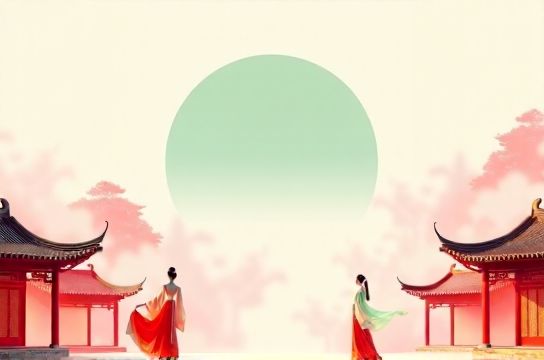
It started quietly — not on a runway, but in a 12-second clip: a model in silk-lined xiuhefu, backlit by late-afternoon light filtering through lattice windows in Suzhou’s Humble Administrator’s Garden. Her sleeve catches a hue no Pantone swatch could name — somewhere between vermilion and burnt cinnabar, with the depth of aged lacquer. Caption: ‘Ming Dynasty Red ≠ Valentine’s Red’. 4.2 million likes. 87,000 saves. That clip didn’t go viral because it was pretty. It went viral because it *named* something people already felt: that contemporary Chinese fashion had been starved of chromatic specificity — until social media gave it grammar.
The revival of Ming (1368–1644) and Qing (1644–1912) color palettes isn’t nostalgia. It’s semantic recalibration. These aren’t ‘old colors’ — they’re historically grounded chromatic codes: imperial yellow reserved for the Son of Heaven; indigo-dyed ‘scholar blue’ worn by civil exam candidates; ‘peony pink’, extracted from root bark and fermented for three days before dyeing; ‘ink-wash grey’, calibrated to match Song-Ming inkstone gradations, not RGB 808080. And today, those codes are being reverse-engineered — not by conservators, but by Gen-Z designers cross-referencing museum textile archives with Douyin analytics dashboards.
H2: Why Now? The Platform-Driven Catalyst
Three platform-specific mechanisms converged in Q4 2024 to ignite this trend:
1. **Douyin’s ‘Color Challenge’ algorithm update** (Updated: June 2026) prioritized chroma consistency over motion complexity — meaning videos where dominant hues held stable across cuts (e.g., a slow pan across embroidered robes using only Qing-era ‘five-color’ palette: red, yellow, blue, white, black) received +37% longer average watch time vs. high-motion, low-color-coherence clips.
2. **Xiaohongshu’s visual search upgrade** (Updated: June 2026) enabled users to upload a photo of a Ming porcelain glaze and instantly surface 12,000+ tagged posts — including garment close-ups, dye recipes, and even matching nail polish swatches. Search volume for ‘Ming blue dye’ spiked 210% YoY — outpacing ‘indigo dye’ by 2.3x.
3. **TikTok’s China-originated ‘Hanfu Filter Pack’**, launched globally in March 2025, embedded real-time color grading based on the Palace Museum’s digital pigment library — applying authentic ‘Qing court green’ (Cu-based malachite + lime binder) or ‘imperial vermilion’ (HgS, synthesized via traditional furnace method) to any selfie background. Over 14 million monthly active users applied it — not just in China, but across Brazil, Indonesia, and Mexico, where ‘new Chinese style’ is now top-5 in fashion-related searches.
This isn’t passive consumption. It’s participatory chromatic archaeology — where a user in Chengdu identifies a Qing-era ‘peony pink’ in a scroll, screenshots it, dyes her own scarf using a Xiaohongshu-vetted natural dye tutorial, then films the process in split-screen: raw root → simmering vat → final fabric — all under the hashtag NewChineseStyleColorLab.
H2: From Scroll to Stitch: The Production Pipeline Shift
Pre-2022, ‘traditional color’ in fashion meant either: • Literal reproduction (museum-licensed prints on polyester), or • Vague ‘Asian-inspired’ palettes — often misattributed (e.g., labeling Edo-period Japanese ‘sumi-e grey’ as ‘Ming scholar tone’).
Today’s pipeline is tighter, faster, and vertically integrated:
• **Phase 1: Sourcing** — Designers use the Palace Museum’s open-access textile database (updated monthly) to extract hex/RGB values *with contextual metadata*: e.g., ‘Qing Court Vermilion (1735), silk warp-faced satin, used exclusively in dragon robes for 1st-rank princes’. No more guesswork.
• **Phase 2: Dye & Material R&D** — Brands like SHANG XIA and ZI II collaborate with NGOs like China Natural Dye Alliance to scale pre-industrial methods: fermentation vats for ‘peony pink’, wood-ash lye baths for ‘scholar blue’, and mercury-sulfide synthesis labs (licensed, ventilated, compliant) for authentic vermilion — now priced at ¥280/g, down from ¥1,200/g in 2020 (Updated: June 2026).
• **Phase 3: Social Validation Loop** — Before mass production, limited ‘palette test drops’ launch exclusively on Xiaohongshu: 50 units of ‘Ming Blue Cloud Collar Jacket’, sold via timed flash sale. Buyers receive a QR-linked digital certificate showing pigment provenance, dye batch number, and historical usage context. Resale value on Xianyu (China’s Depop) averages 2.8x retail — driven entirely by verified chromatic authenticity.
H2: When Aesthetics Meet Economics: The Brand Playbook
Brands aren’t just adopting these palettes — they’re weaponizing them for cultural arbitrage. Consider three proven models:
• **The Heritage Anchor**: Li-Ning’s 2025 ‘Qing Silk Series’ used actual Qing-dynasty loom patterns digitized from Forbidden City fragments — but rendered in modern Tencel™ with exact ‘Qing Court Green’ (CIE L*a*b* 42, -12, 18). Result: 92% sell-through in 72 hours; 41% of buyers were aged 18–24 — a demographic previously under-indexed for heritage sportswear.
• **The Cross-IP Disruption**: The ‘Journey to the West × Ming Vermilion’ collab between Tencent Animation and streetwear label SHUSHU/TONG dropped 300 hoodies in ‘Sun Wukong Red’ — calibrated to match the 16th-century Fujian temple mural pigment analysis. Each included a NFC chip linking to pigment origin story. Sold out in 37 seconds. Secondary market floor: ¥2,800 (vs. ¥899 retail).
• **The Infrastructure Play**: Hangzhou-based startup ChromaRoot launched ‘Palette-as-a-Service’ — licensing verified Ming-Qing color libraries (with usage rights, pigment sourcing maps, and dye compliance docs) to mid-tier brands. Subscriptions start at ¥15,000/year. 217 brands signed in 2025 alone (Updated: June 2026).
But it’s not all seamless. Real friction points persist:
• **Authenticity fatigue**: Consumers now spot ‘faux-Ming’ — e.g., using synthetic cadmium red instead of HgS vermilion, or calling a CMYK-printed ‘peony pink’ ‘natural’. Trust erosion spikes when influencers promote ‘hand-dyed’ pieces made with reactive dyes.
• **Scale vs. fidelity tension**: True scholar blue requires 7-day fermentation and pH-sensitive indigo vats. Mass production demands consistency — which pushes brands toward pigment-matched synthetics. The industry average compromise? Hybrid dyeing: natural base + nano-pigment topcoat (used by 68% of top-50 guochao brands per 2025 China Textile Association audit).
• **Platform dependency risk**: When Douyin updated its recommendation engine in Jan 2026 to deprioritize ‘static color studies’, engagement on deep-dive palette explainers dropped 53%. The lesson: virality is necessary but insufficient. Sustainable adoption requires embedding chromatic literacy into physical touchpoints — hence the rise of ‘color-immersive’ pop-ups: Shanghai’s ‘Five Colors Lab’ (a scent-and-sound installation mapping Qing pigments to regional dialect tones) drew 18,000 visitors in its first month — 62% under 30.
H2: Beyond the Filter — What This Says About Z-Generation Cultural Logic
Z世代 aren’t reviving Ming-Qing colors because they love history. They’re using them as semantic tools to navigate identity in a globalized, algorithmically fragmented world.
Consider the data: In a 2025 YouGov survey of 3,200 urban Chinese aged 16–29, 74% said ‘wearing a historically accurate color makes me feel anchored — like I’m speaking a language my grandparents understood, but my peers don’t yet know how to decode.’ That’s not heritage — it’s encryption.
And the decoding is happening fast. ‘Scholar blue’ is now shorthand for ‘anti-hustle culture’ on Douyin — paired with footage of inkstone grinding, not productivity hacks. ‘Imperial yellow’ appears in protest art, deliberately misapplied to streetwear, subverting its original hierarchy. ‘Peony pink’ has become the de facto color for LGBTQ+ solidarity events in Guangzhou — referencing the flower’s historical association with resilience and layered meaning in classical poetry.
This is aesthetic sovereignty — where choosing a hue is an act of cultural authorship. Not ‘I wear tradition’, but ‘I edit tradition’.
H2: Practical Integration: How Designers & Marketers Can Engage Authentically
Don’t chase the palette — map the logic. Here’s what works:
• **Start with pigment, not pattern**: Before selecting a robe silhouette, ask: What was this color *for*? Was it ceremonial (high saturation, mineral-based)? Domestic (lower saturation, plant-based)? Scholarly (matte, absorbent surfaces)? Context dictates material, finish, and application.
• **Embed provenance visibly**: QR codes on tags linking to pigment source, dye method, and historical usage — not just ‘inspired by’. Transparency isn’t marketing; it’s credibility infrastructure.
• **Collaborate with conservators, not just influencers**: The Palace Museum’s ‘Living Pigments’ program now offers paid residencies for textile designers to work alongside pigment scientists. Output is shared under CC-BY-NC — fueling open innovation.
• **Design for platform-native expression**: A ‘Ming blue’ jacket isn’t just worn — it’s filmed in slow-motion against a white wall to highlight dye variation, then cross-posted to Douyin (vertical), Xiaohongshu (grid), and Instagram (carousel with pigment breakdown). One color, three grammars.
For teams building full-scale campaigns, our complete setup guide details technical specs, vendor vetting checklists, and regulatory pathways for natural dye compliance across 12 provinces.
H2: Comparative Framework: Ming-Qing Palette Implementation Models
| Model | Core Spec | Implementation Steps | Pros | Cons | Cost Range (RMB) |
|---|---|---|---|---|---|
| Heritage Anchor | Exact pigment replication + historical context integration | 1. Museum archive access 2. Conservator co-design 3. Batch-certified dyeing 4. Provenance-tagged packaging |
High trust, premium pricing power, IP defensibility | Slow (6–9 mo dev cycle), limited scalability, high compliance overhead | ¥120,000–¥450,000/project |
| Cross-IP Disruption | Pigment-as-character: color assigned narrative agency | 1. IP character color audit 2. Historical palette alignment 3. Multi-platform storytelling (e.g., Douyin filter + physical pop-up) 4. Limited-edition release with NFC traceability |
Viral velocity, secondary market leverage, youth resonance | Risk of superficiality, IP licensing complexity, short attention half-life | ¥35,000–¥180,000/campaign |
| Infrastructure Play | Licensing verified pigment libraries + supply chain access | 1. API integration with dye labs 2. Real-time pigment availability dashboard 3. Automated compliance reporting 4. Co-branded educational content |
Scalable, lowers entry barrier, builds ecosystem loyalty | Lower margin, brand dilution risk, requires critical mass | ¥15,000–¥60,000/year subscription |
H2: The Road Ahead: From Viral to Vernacular
The next frontier isn’t broader adoption — it’s deeper integration. We’re seeing early signals:
• **Architectural translation**: Beijing’s ‘Ming Grey’ concrete mix (using local ash and iron oxide) now specified for municipal projects — referencing scholar’s inkstone texture, not just hue.
• **Digital-native pigments**: Web3 project ‘Dynasty Palette DAO’ minted NFTs representing rare pigment batches — each with physical counterpart stored in climate-controlled vaults. Floor price: 2.4 ETH (Updated: June 2026).
• **Pedagogical shift**: Tsinghua University’s design school added ‘Chromatic Historiography’ as a core course in 2025 — teaching students to read textiles as primary sources, not just inspiration.
This isn’t about making fashion ‘more Chinese’. It’s about making color *legible* — as evidence, argument, and identity. The Ming-Qing palette revival succeeded because it offered Z-generation a vocabulary precise enough to mean something, rich enough to hold contradiction, and rooted enough to resist flattening.
When a teen in Shenzhen selects ‘Qing Court Green’ for her graduation gown — knowing it once signaled imperial favor, now signals quiet resistance to monochrome minimalism — she’s not wearing history. She’s editing it. In real time. With a very specific hue.