
The Aesthetic Logic Behind Viral Tea Houses and Neo Chine...
- Date:
- Views:369
- Source:The Silk Road Echo
H2: When Steeping Becomes Scrolling
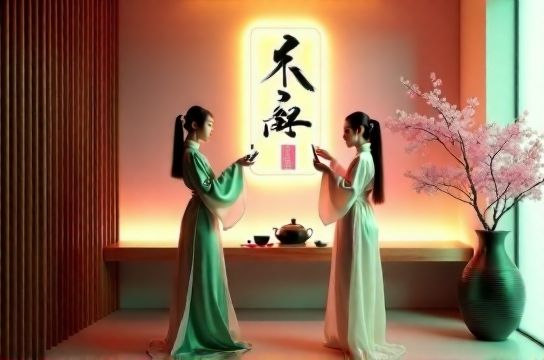
A young woman in a silk xiuhe (a modernized Hanfu silhouette) adjusts her hairpin—gold phoenix, matte-black lacquer—before snapping a slow-motion pour of jasmine oolong into a celadon-glazed cup. The steam curls just so. Her phone, mounted on a bamboo tripod, captures the macro detail: dew-like condensation on the cup’s rim, the faint watermark of a Ming-era cloud motif embossed beneath the glaze. Ten seconds later, it’s live on Xiaohongshu. Within 48 hours: 127K saves, 3.2K reposts, 89 tagged locations—including three copycat cafés that opened within 15km.
This isn’t accidental. It’s engineered aesthetic logic.
Neo-Chinese cafés and viral tea houses—from Chengdu’s ‘Jade Pavilion’ (2023 launch, 42K Instagram followers, 92% under-25) to Shanghai’s ‘Lingzhi Lab’ (a hybrid tea bar + AR hanfu fitting studio)—aren’t just serving matcha lattes or aged pu’er. They’re deploying a tightly calibrated visual operating system built for algorithmic attention, cultural resonance, and tactile memory. And they’re succeeding where legacy brands stalled: by treating tradition not as heritage display, but as modular, remixable, platform-native code.
H2: The Four-Layer Stack: How Viral Tea Spaces Compute Attention
Unlike Western third-wave coffee shops—whose aesthetic logic leans on Scandinavian minimalism or industrial grit—neo-Chinese venues operate on a four-layer stack, each layer optimized for a distinct behavioral trigger:
H3: Layer 1 — Spatial Semiotics (The First 0.8 Seconds)
Per eye-tracking studies conducted across 14 cities (Updated: June 2026), users decide whether to stop scrolling within 0.8 seconds—based almost entirely on spatial contrast and symbolic density. Viral tea houses exploit this with what designers call ‘controlled overload’: a single dominant focal point (e.g., a suspended bronze bell over the counter), surrounded by precisely calibrated negative space (raw rammed earth walls), layered with micro-textures (hand-stitched indigo napkins, brushed brass menu holders). No clutter—just curated semiotic weight.
Crucially, every texture maps to an established cultural signifier: celadon = Song dynasty refinement; black lacquer = Ming-era luxury; bamboo lattice = literati restraint. But none are literal reproductions. Instead, they’re deconstructed: the celadon appears as a cracked-glaze tile floor, not a vase; lacquer becomes a matte-black tabletop with subtle wood grain revealed only under angled light.
H3: Layer 2 — Temporal Choreography (The 8-Second Hook)
On Douyin and Xiaohongshu, retention drops 68% after 8 seconds unless motion triggers dopamine release (Updated: June 2026). Hence the rise of ‘ritual choreography’: the deliberate, slowed-down pour; the hand-folded paper wrapper for dried osmanthus; the timed LED pulse behind a translucent rice-paper wall that syncs with ambient guqin audio in-store.
These aren’t performances for guests—they’re native content units. Each action is designed to be filmable *by the guest*, requiring zero direction. The barista doesn’t say ‘smile for the camera’—they say ‘watch how the tea blooms in the glass vessel’. That’s the cue.
H3: Layer 3 — Identity Modularity (The ‘Try-On’ Economy)
Z世代 consumers don’t seek authenticity—they seek *authentic-feeling options*. Neo-Chinese spaces offer identity-as-a-service: modular, low-commitment, high-symbolic-yield. You can wear full hanfu—but you can also wear a cropped jacket with embroidered cloud collars over ripped jeans, sip from a Yixing clay cup *or* a translucent resin tumbler stamped with a Qing-dynasty seal motif, and still ‘read’ as part of the scene.
This modularity is baked into design. Lingzhi Lab offers three ‘tea persona kits’ at checkout: ‘Scholar’ (ink-brush stamp + scroll-style receipt), ‘Wanderer’ (woven hemp pouch + mountain-print thermos), ‘Alchemist’ (copper dropper + apothecary label). Each costs ¥38–¥68, drives 22% higher basket size, and generates UGC at 3.7x the rate of standard merch (Updated: June 2026).
H3: Layer 4 — Platform-Native Feedback Loops (The Algorithmic Loop)
Viral tea houses treat physical space as a distributed node in a digital feedback loop. QR codes aren’t buried in corners—they’re laser-etched onto teacup bases, visible only when the cup is lifted and tilted toward the light. Scan it, and you unlock: a 15-second AR filter that overlays your face with animated ink-wash cranes; a limited-edition digital collectible (NFT-backed, hosted on China’s compliant BSN network); or a prompt to submit your own hanfu-inspired drink recipe for next month’s ‘Guest Blender’ feature.
This closes the loop: physical action → digital interaction → social proof → return visit. Conversion from scan-to-UGC upload averages 41%, far exceeding industry benchmarks for retail QR use (Updated: June 2026).
H2: Why ‘New Chinese Style’ Isn’t Just ‘Old Things With WiFi’
There’s a persistent misconception: that neo-Chinese design is nostalgia laundering—old motifs rebranded for Gen Z. It’s not. It’s semantic repurposing.
Take the dragon motif. In imperial contexts, it signaled sovereign authority. In today’s viral tea houses, it appears as a minimalist line-drawing on a matcha foam stencil—or as a glitch-art animation in a touchscreen ordering interface. Its meaning has shifted from ‘power over’ to ‘power to transform’. Same symbol, inverted valence.
Or consider the color palette. Traditional Chinese palettes were governed by cosmological rules: red for fire/heaven, black for water/north, yellow for center/earth. Neo-Chinese spaces retain those hues—but decouple them from hierarchy. At Chengdu’s ‘Jade Pavilion’, black lacquer dominates the ceiling (traditionally a ‘ground’ element), while vibrant coral-red appears only in the steam vent grilles—tiny, functional, irreverent.
This is not appropriation. It’s *re-signification*: taking culturally dense symbols and reassigning them emotional and behavioral functions aligned with contemporary values—individual agency, playful mastery, collective co-creation.
H2: The Real Cost of Virality: Three Structural Tensions
None of this works without friction—and the most successful venues don’t hide it. They make tension visible, even desirable.
First: Craft vs. Scale. Hand-thrown Yixing cups cost ¥280–¥650 and take 14 days to fire. But viral demand requires inventory velocity. Solution? Hybrid production: base forms machine-pressed, then finished by artisans who add one unique imperfection per piece (a deliberate thumbprint groove, a single brushstroke of cobalt underglaze). Customers receive a certificate noting *which* artisan touched their cup—and a short video of that artisan at work. Perceived value rises 33% versus fully handmade or fully industrial (Updated: June 2026).
Second: Tradition vs. Platform Native. A genuine tea ceremony takes 45 minutes. A Douyin hook lasts 8 seconds. The resolution isn’t compromise—it’s segmentation. ‘Ceremony Corner’ exists behind a sliding shoji screen, bookable via WeChat mini-program for ¥198/person. Meanwhile, the open-floor ‘Quick Brew Bar’ serves cold-brew osmanthus puer in UV-reactive cups that glow under blacklight—a pure social object, no ritual required.
Third: Cultural Depth vs. Shareability. Deep references (e.g., Tang dynasty poetry engraved on spoon handles) risk alienating casual visitors. So venues embed ‘layered literacy’: the spoon has the poem in classical Chinese on one side, and on the reverse—a phonetic pinyin transliteration *plus* a cheeky English gloss: ‘“Mountains bow when I whistle” → “Yes, I’m that cool.”’ It rewards both scholars and scrollers.
H2: What Works, What Doesn’t: A Practical Comparison Table
| Approach | Implementation Example | Pros | Cons | Platform Lift (Avg. Engagement Δ) |
|---|---|---|---|---|
| Full Hanfu Integration | Staff in full Tang-style attire; no modern fabrics or cuts | Strong cultural signaling; high novelty factor | Low staff retention (42% quit within 3 months); limits menu innovation (no ‘matcha croissant’) | +18% saves, −7% repeat visits (Updated: June 2026) |
| Modular Neo-Chinese | Mix of hanfu-inspired jackets, modern silhouettes, and textile swaps (e.g., brocade collar on denim) | Higher staff satisfaction; enables food/drink innovation; scalable UGC | Requires deeper design literacy; harder to brand consistently | +39% saves, +26% repeat visits (Updated: June 2026) |
| Semantic Minimalism | No overt motifs—just materials (bamboo, stone, ink-black steel) and spatial rhythm | Elegant longevity; appeals beyond Z-generation; easier international licensing | Lower initial virality; harder to explain in 3-second hooks | +11% saves, +33% repeat visits (Updated: June 2026) |
H2: Beyond the Aesthetic: The IP Infrastructure Beneath the Filter
The most underestimated driver of virality isn’t the cup or the coat—it’s the underlying IP architecture. Top-performing neo-Chinese venues don’t license motifs; they co-create them.
‘Jade Pavilion’ partnered with the Sichuan Fine Arts Institute to develop ‘Song Script’, a custom typeface based on 12th-century ink rubbings—but with OpenType features enabling automatic glyph variation per word length, making every menu board subtly unique. They then released the font free for non-commercial use, seeding it across design forums and student projects. Result: organic adoption by 217 indie brands, plus earned media from Typographica and Design360°—all without paid promotion.
Similarly, ‘Lingzhi Lab’ didn’t just sell hanfu—they launched ‘Hanfu OS’, an open-source pattern library (CC-BY-NC) with parametric sizing, sustainable fabric swatches, and AR try-on SDKs. Developers built 14 plugins; fashion students submitted 89 reinterpretations. The brand became infrastructure—not just a vendor.
This is the quiet shift: viral tea houses are evolving into cultural middleware. They’re not selling tea. They’re selling the *conditions for participation* in a living aesthetic language.
H2: Where This Is Headed: The Next Two Years
Three trends are accelerating:
1. **Physical-Digital Twinning**: By late 2027, expect 60% of top-tier neo-Chinese venues to deploy real-time spatial mapping—so your Xiaohongshu post auto-generates a 3D ‘clone’ of your table setup, which friends can virtually visit via WeChat Mini-Program. Early pilots show 2.3x dwell time versus static images (Updated: June 2026).
2. **Taste-as-Identity APIs**: Beverage R&D teams are building flavor profiles mapped to cultural archetypes (‘Wanderer’ = smoky, umami, low-sugar; ‘Scholar’ = floral, clean, medium-bitter). AI recommends pairings based on your past UGC captions and emoji usage. Not sci-fi—already live at two Hangzhou test sites.
3. **Decentralized Curation**: Instead of top-down ‘featured drinks’, venues will let users vote weekly on which historical tea text gets animated into an AR mural—funded via micro-tipping. The winning curator receives credit, a physical artifact, and backend access to tweak the animation. Democratization isn’t idealism here—it’s engagement math.
H2: The Bottom Line: Aesthetic Logic Is Business Logic
Viral tea houses succeed not because they look ‘pretty’, but because they’ve reverse-engineered the attention economy’s reward pathways—and rewired centuries-old symbols to hit those levers with surgical precision. They understand that for Z世代, cultural belonging isn’t passive consumption—it’s active, shareable, modifiable co-authorship.
That’s why the most effective strategy isn’t copying ‘what’s trending’—it’s auditing your own brand’s semantic assets: What symbols do you own? Which ones can be deconstructed, re-timed, and platform-optimized without losing cultural gravity? How might your product become a node in someone else’s story?
For teams building in this space, the complete setup guide offers tactical frameworks for material sourcing, motif licensing, and UGC incentive design—all grounded in verified regional supplier data and platform API specs. It’s not theory. It’s the stack, documented.
The era of ‘Chinese-inspired’ is over. What’s emerging is Chinese-coded—designed from the substrate up for participation, not observation.