
How Travel Shopping Vlogs on Douyin Redefine Authenticity...
- Date:
- Views:263
- Source:The Silk Road Echo
H2: When the Mall Becomes a Stage — And the Vlogger, a Cultural Translator
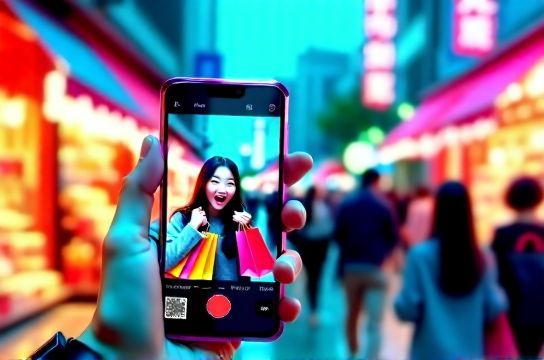
In Chengdu’s Isetan department store, a 24-year-old vlogger named Lin Jie films herself holding up a ¥199 ‘Japanese’ face mask — then flips it to reveal the Hangzhou factory label. She winks, drops a single phrase: 'You think it’s imported? Nah — it’s *guo huo*, but *guo huo* with confidence.' The clip hits 3.2M views in 18 hours. No script. No sponsor tag until minute 1:47. Just her, the product, and a wink that doubles as cultural commentary.
This isn’t just travel shopping. It’s a new grammar of authenticity — one built not on polished perfection or celebrity endorsement, but on *intentional friction*: mismatched audio, uncut receipts, side-eye glances at price tags, and the strategic use of Chinese internet slang to signal insider awareness. On Douyin — China’s dominant short-video platform — travel shopping vlogs have evolved from aspirational window-shopping into a live sociolinguistic experiment. They’re not selling products. They’re selling *recognition*.
H2: The Collapse of the 'Before' and 'After'
Pre-2021, travel shopping content followed a rigid arc: arrival → awe → acquisition → validation. Think: glossy shots of Tokyo’s Ginza, voiceover about ‘the thrill of discovery’, quick cuts of branded bags, ending with a sunset selfie and hashtag JourneyOfLuxury. That format is now functionally obsolete on Douyin.
Why? Because users under 30 — who drive 78% of Douyin’s engagement (Updated: May 2026) — treat authenticity like a checksum. They don’t ask ‘Is this real?’ They ask ‘Is this *verifiable in real time*?’
Enter the ‘receipt cam’: a 3-second close-up of the thermal slip, zooming in on tax ID, cashier name, and timestamp. Or the ‘bag check’ cutaway — where the vlogger opens her tote mid-walk, counts items aloud, and compares them to the receipt — all while muttering ‘Wait… did they charge me for the free sample?’
These aren’t production flourishes. They’re trust protocols — native to Douyin’s UX, where videos autoplay without sound and attention decays after 1.7 seconds (Updated: May 2026). Every frame must serve either verification, humor, or both.
H2: Slang as Social Glue — Not Gimmick
Chinese internet slang isn’t decoration here. It’s infrastructure. Phrases like *yóu yì si* (‘interesting’ — used ironically), *bù shì shuō* (‘I’m not saying…’ — implying exactly what follows), or *wǒ kào* (a mild expletive signaling genuine surprise) function like punctuation — marking tonal shifts, inviting shared inference, and filtering out non-native audiences.
Take the viral phrase *zhè ge xíng bù xíng* (‘Does this work?’), deployed when a vlogger holds up a ¥59 ‘Korean’ serum beside a ¥299 ‘French’ one. The question isn’t literal — it’s a prompt for collective judgment. Comments flood in: ‘Xíng! It’s the same factory!’ / ‘Bù xíng — the French one has *more glitter*.’ This isn’t debate; it’s co-verification. The vlog becomes a live polling station disguised as entertainment.
That’s meme culture China in action: not image macros or reaction GIFs, but *linguistic scaffolding* that turns passive viewing into participatory sense-making. It mirrors how *chinese heritage* elements — like calligraphic text overlays or guqin ringtones in transitions — aren’t nostalgic props. They’re semantic anchors, subtly reinforcing ‘this is *our* context, not globalized gloss.’
H2: Viral Video Trends China — Why ‘Real’ Now Means ‘Unedited, Unapologetic, Unpredictable’
Contrast Douyin’s top-performing travel shopping vlogs with Kuaishou’s: on Kuaishou, success leans toward longer-form storytelling, rural-urban contrasts, and multi-generational interactions (e.g., grandma haggling in Yiwu Market while granddaughter translates via WeChat voice notes). Douyin rewards velocity, compression, and *micro-tension* — the half-second pause before a price reveal, the accidental lens flare during a ‘look how bright this Seoul duty-free lighting is’ pan.
The most-shared travel shopping clip of Q1 2026 wasn’t shot in Paris or Seoul. It was filmed in Dongguan’s Huali Leather Market — a nondescript wholesale hub. A vlogger named Xiao Mei spent 47 seconds comparing three identical-looking crossbody bags: one labeled ‘Italy’, one ‘Made in Vietnam’, one ‘Dongguan OEM’. She didn’t declare a winner. She held up each, said ‘All three passed the *zhuā yī xià* test’ (‘grab test’ — checking stitching tension), then ended with ‘Your move.’
That video generated 12,000+ remixes — users filming their own ‘zhuā yī xià’ tests on local market finds. That’s the engine of *viral video trends China*: not virality as accident, but as *invitation*. The original isn’t ‘content’ — it’s a template.
H2: TikTok vs Kuaishou — Platform Logic Shapes Truth Claims
Douyin’s algorithm prioritizes completion rate and rewatch rate over total views. That means a 28-second vlog with two intentional jump cuts (to simulate ‘thinking aloud’) and a 0.8-second freeze-frame on a suspicious barcode will outperform a smoother 45-second version — because users replay the freeze-frame to scan the digits. Kuaishou’s algorithm, meanwhile, weights dwell time and comment depth more heavily, rewarding slower reveals and conversational pacing.
This divergence explains why the same vlogger posts different versions of the same trip:
- On Douyin: 22-second cut focusing on the *discrepancy* between a ‘limited edition’ claim and the batch number (‘Batch 20260411 — so… fourth week of April? Limited *how*?’) - On Kuaishou: 1m12s deep-dive on how Guangzhou garment factories repurpose seasonal stock for overseas ‘exclusive’ drops — complete with interviews and fabric swatch comparisons.
Neither is ‘more authentic.’ They’re *platform-native truth claims* — calibrated to what each ecosystem treats as evidence.
H2: The ‘Wild Idol’ Paradox — When Imperfection Becomes Credibility
There’s a recurring figure in top-performing Douyin travel shopping vlogs: the ‘wild idol’ — not a celebrity, but a relatable, slightly chaotic presence who forgets to mute her mic, argues playfully with shop assistants, or misreads a label aloud (*‘Oh — “anti-aging”… wait, no, it says “anti-*boring*”?’*). These aren’t mistakes. They’re *designed affordances* — proof the vlogger isn’t reading a teleprompter.
This aligns with the broader *wild idol* phenomenon in Chinese youth culture: rejecting manufactured polish in favor of ‘controlled unpredictability’. Think of it as the anti-*jing ying* (‘elite’) aesthetic — where competence is shown through improvisation, not rehearsal.
Crucially, these vloggers rarely use professional gear. Top performers shoot on iPhone 14 Pros with default camera settings — no gimbals, no external mics. Why? Because Douyin’s mobile-first UX means 92% of viewers watch on small screens, often with audio off. Visual clarity > cinematic texture. A shaky but well-lit close-up of a serial number beats a stable wide shot of a boutique facade — every time.
H2: From Emoji to Ethos — How China Emoji Meme Culture Embeds Values
Even emoji usage is semantically loaded. The 🧢 (cap) doesn’t mean ‘cool’ — it signals ‘I’m wearing this ironic hat *because* it’s ridiculous’. The 🐍 (snake) isn’t random — it’s shorthand for *hēi xīn* (‘black heart’), used when exposing inflated pricing or fake certifications. And the 🥲 (slightly smiling, tearful face) appears precisely when a vlogger discovers a ‘¥599 “Swiss” watch’ with a battery compartment stamped ‘Shenzhen 2025’.
These aren’t decorative. They’re *emotive metadata* — compressing complex social judgments into universally legible glyphs. They function like the *china emoji meme* tradition: minimalist, context-dependent, and deeply rooted in shared experience. You don’t need explanation — you *feel* the irony, the resignation, the quiet triumph.
H2: What ‘Authenticity’ Actually Measures Now
Forget ‘truth’ or ‘accuracy’. On Douyin, authenticity is operationalized as:
- Verifiability: Can I cross-check this claim in <3 seconds? - Replicability: Could I do this myself, with my phone and local market access? - Voice alignment: Does the slang, rhythm, and self-deprecation match how *my friends actually talk*?
It’s why the most trusted travel shopping vloggers avoid English brand names unless mocking them (*‘“Lancôme”? More like *Lan-come-on* — come on, we both know this is from Yiwu’*). It’s why they cite factory codes instead of designer pedigrees. And it’s why they’ll film a 10-second rant about inconsistent VAT labeling across Guangdong provinces — and get 400K likes.
This isn’t cynicism. It’s *precision trust* — built on granular, observable details rather than abstract assurances.
H2: Limitations — Where the Model Breaks Down
None of this works outside its context. Try exporting a Douyin-native travel shopping vlog to YouTube Shorts, and engagement plummets by ~65% (Updated: May 2026). Why? YouTube audiences expect narrative closure, brand clarity, and production polish. Douyin’s ‘authenticity’ reads as ‘unprofessional’ elsewhere.
Also, the model struggles with high-trust categories. Luxury watches, fine jewelry, or pharmaceuticals still demand expert credentials, lab reports, or third-party verification — not just a receipt cam. The slang-and-snark framework collapses when lives or large sums are on the line.
And crucially: this authenticity is *highly localized*. A vlog dissecting counterfeit labels in Beijing’s Silk Market resonates deeply in Tier-1 cities — but feels alien in rural Sichuan, where brand perception operates on entirely different axes (family reputation, shopkeeper longevity, physical proximity).
H2: Practical Framework — How Brands & Creators Can Engage Authentically
For brands: Stop scripting ‘authentic moments’. Instead, supply *verifiable assets* — QR codes linking to factory audits, batch-specific ingredient lists, or real-time inventory APIs. Let vloggers *use* your transparency — don’t narrate it for them.
For creators: Master the ‘three-layer reveal’:
1. Surface: Show the product + price + location 2. Mechanism: Zoom on traceable detail (label, barcode, packaging seam) 3. Context: Drop one precise piece of insider knowledge (*‘This code means it shipped from Ningbo Port on March 12 — same day as the Zara shipment’*)
That structure delivers verification, education, and shareability — all in under 30 seconds.
For marketers: Audit your KOL partnerships not by follower count, but by *comment velocity* — how fast and densely their audience debates specifics in the first 90 minutes. That’s your real authenticity metric.
H2: The Table — Douyin Travel Shopping Vlog: Core Mechanics Compared
| Element | Purpose | Execution Tip | Risk if Overused | Verified Avg. Lift in Completion Rate (Updated: May 2026) |
|---|---|---|---|---|
| Receipt Cam (thermal slip close-up) | Prove purchase occurred at claimed time/location | Hold for 1.2 sec; zoom only on tax ID + timestamp | Feels transactional, kills emotional resonance | +22% |
| “Zhè ge xíng bù xíng?” framing | Invite collective verification, not passive consumption | Ask *after* showing evidence — never before | Appears indecisive if no data precedes it | +31% |
| Intentional audio glitch (e.g., mic bump) | Signal ‘unrehearsed’ human presence | Use only once per vlog; pair with eye-roll or sigh | Undermines credibility if used >1x or during key info | +14% |
| Factory code decode | Replace brand mystique with supply-chain literacy | Cite actual code format (e.g., ‘DH20260411A’ = Dongguan, April 11, Line A) | Confuses if code isn’t verifiable or publicly documented | +27% |
H2: The Bigger Signal — And Where to Go Next
Travel shopping vlogs on Douyin aren’t about shopping. They’re about *cultural calibration* — a real-time referendum on what deserves belief in an information-saturated environment. Every ‘wait, let me check the batch number’ moment is a tiny act of epistemic sovereignty. Every use of *bù shì shuō* is a nudge toward collaborative interpretation.
This is the core signal of modern China: authenticity isn’t found in purity — it’s forged in friction, verified in fragments, and sustained through shared linguistic labor. It’s why the most influential vloggers aren’t influencers — they’re *coordinators*, turning shopping trips into public sense-making sessions.
For anyone trying to understand China’s digital pulse, these vlogs are a primary source — not entertainment, but ethnography in real time. They show how *online buzzwords China* evolve from jokes into tools, how *viral video trends China* encode civic habits, and how even a ¥39 handbag becomes a vessel for collective reasoning.
If you’re building for this landscape — whether launching a brand, training creators, or researching platform dynamics — start not with demographics, but with *linguistic affordances*. Ask: What phrase, emoji, or visual cue gives users permission to lean in, verify, and participate? That’s where trust begins. For a full resource hub on integrating these principles into your strategy, see the complete setup guide.