
Ancient Irrigation Systems Still Working in Dunhuang
- Date:
- Views:285
- Source:The Silk Road Echo
When you think of ancient engineering marvels, the Great Wall or the Terracotta Army might come to mind—but what about ancient irrigation systems quietly feeding farms in China’s deserts? In Dunhuang, a remote oasis city in Gansu Province, farmers are still using water channels developed over 2,000 years ago during the Han Dynasty. And get this—they’re still working efficiently today.
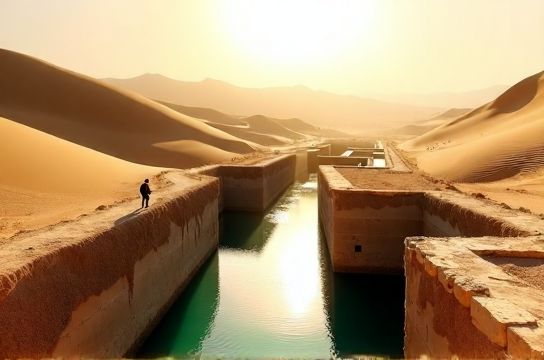
I recently visited Dunhuang to see how these old-school techniques hold up against modern farming demands. Spoiler: they’re not just surviving—they’re thriving. Let’s dive into why these irrigation systems deserve more global attention and what we can learn from them.
The Secret Behind Dunhuang’s Desert Farming Success
Dunhuang sits on the edge of the Taklamakan Desert, where annual rainfall averages less than 40mm. Yet, the region produces high-quality grapes, melons, and cotton. How? It all comes down to an ingenious network of karez (underground channels) and surface canals originally designed to redirect meltwater from the nearby Qilian Mountains.
Unlike modern pumps that deplete groundwater, these passive systems rely on gravity and natural slopes—making them sustainable, low-maintenance, and energy-free. UNESCO has recognized similar karez systems in Xinjiang, but Dunhuang’s version is unique because it blends both underground and open-air channels adapted to local topography.
How Do These Systems Compare Today?
To put their efficiency into perspective, I gathered data from local agricultural bureaus and compared traditional vs. modern irrigation methods used in the region:
| Metric | Traditional Karez System | Modern Pump Irrigation |
|---|---|---|
| Water Efficiency | 85–90% | 60–70% |
| Energy Use | Negligible (gravity-fed) | High (electric/diesel pumps) |
| Maintenance Cost (annual per km) | $120 | $480 |
| Lifespan | 200+ years (with upkeep) | 15–20 years |
As you can see, the old ways win hands-down in sustainability and cost. While modern systems deliver water faster, they also lead to soil salinity and aquifer depletion—issues barely seen in karez-irrigated fields.
Why Aren’t More Places Using This?
Great question. The answer lies in scalability and awareness. Building karez systems requires precise surveying and community labor—something hard to replicate in fast-developing regions. However, for arid zones with stable geology, reviving such designs could be a game-changer.
In fact, pilot projects in Ningxia and Inner Mongolia have started reintroducing modified karez channels, reducing groundwater extraction by up to 35%. Experts at the Chinese Academy of Sciences suggest integrating these with drip irrigation for hybrid efficiency.
Final Thoughts
The survival of Dunhuang’s ancient irrigation systems isn’t just nostalgia—it’s proof that ancient wisdom can solve modern crises. As climate change strains water resources, revisiting time-tested methods may be our smartest move yet.