
Rural vs Urban Lifestyles Across Contemporary China
- Date:
- Views:370
- Source:The Silk Road Echo
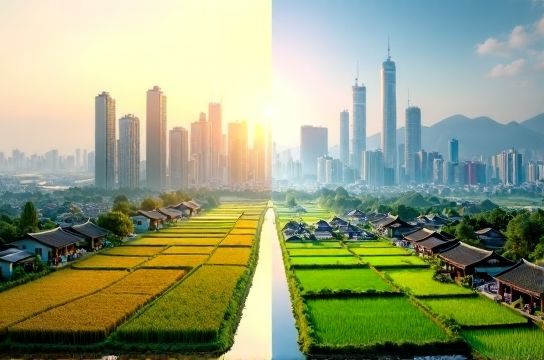
China's rapid development over the past few decades has created a striking contrast between rural and urban lifestyles. While cities like Beijing, Shanghai, and Shenzhen pulse with neon lights and sky-high skyscrapers, vast stretches of the countryside maintain a rhythm rooted in tradition, agriculture, and close-knit communities. But what’s life really like on either side of this great divide? Let’s dive into the heart of modern China to compare daily rhythms, economic realities, and cultural vibes—with real data to back it up.
The Daily Grind: City Hustle vs. Country Calm
In urban China, time is money. The average city dweller wakes up at 6:30 AM, battles rush-hour crowds on subways (some lines carry over 1 million riders daily), and clocks in 9-to-9 workdays—yes, that’s 12 hours, six days a week in many tech firms. Contrast that with rural areas, where sunrise marks the start of farm work and roosters often replace alarms. Life moves slower, but no less meaningfully.
Money Talks: Income & Cost of Living
Let’s talk numbers. According to China’s National Bureau of Statistics (2023), the average annual disposable income tells a clear story:
| Region | Avg. Annual Income (CNY) | Monthly Rent (1-Bed Apartment) | Main Occupation |
|---|---|---|---|
| Urban | 58,000 | 3,500 | Services, Tech, Manufacturing |
| Rural | 20,700 | 600 | Agriculture, Small Trade |
While city salaries are nearly three times higher, so are living costs. A meal at a street stall costs 15 CNY in Shanghai versus 8 CNY in rural Henan. Yet, many villagers own land and homes outright—cutting housing costs dramatically.
Digital Divide? Not Anymore.
You might think rural China lags in tech—but think again. E-commerce platforms like Pinduoduo and Alibaba have brought smartphones and online shopping to even remote villages. Over 60% of rural residents now use mobile payment apps (up from 28% in 2018). Farmers livestream their harvests on Douyin (China’s TikTok) and ship fresh produce nationwide. Digital inclusion is bridging the gap faster than expected.
Culture & Community: Who’s Happier?
Sure, cities offer KTV nights, bubble tea runs, and underground music scenes. But rural life shines in community strength. Extended families often live nearby, festivals revolve around ancestral traditions, and neighbors still borrow sugar—or a tractor. Surveys by the Chinese Academy of Social Sciences suggest rural residents report slightly higher life satisfaction, despite lower incomes.
The Future: Blurring the Lines
The gap isn’t static. Government initiatives like “Rural Revitalization” are improving roads, internet access, and education in the countryside. Meanwhile, some urbanites are 'returning to the fields'—launching agritourism startups or eco-farms. The future may not be urban vs. rural, but a hybrid model where convenience meets sustainability.
In the end, both lifestyles reflect different shades of the Chinese dream. One pulses with ambition; the other breathes with balance. Whether you’re swiping your metro card in Guangzhou or tending rice paddies in Yunnan, China’s heartbeat echoes in both.