
The Curious Case of Danwei Revival: Nostalgia and Community in a Fast-Changing Society
- Date:
- Views:281
- Source:The Silk Road Echo
In today’s hyper-connected, fast-paced urban China, where skyscrapers rise overnight and digital life dominates, something unexpected is happening—people are looking back. Not just with wistful glances, but with real emotional investment. The danwei, or work unit, a relic of Mao-era social organization, is quietly making a comeback—not as a bureaucratic structure, but as a cultural symbol of community, belonging, and stability.
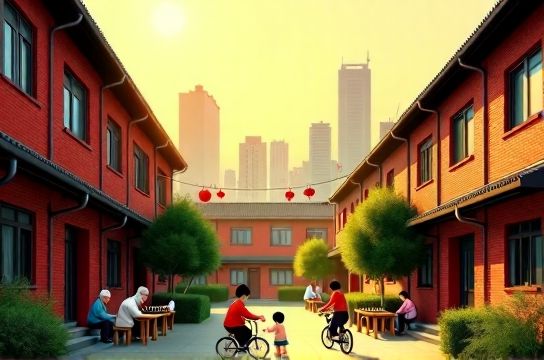
Once the backbone of socialist urban life, the danwei system provided housing, healthcare, jobs, and even social activities. By the 1990s, market reforms dismantled much of this infrastructure. Yet today, amid rising loneliness, housing pressures, and workplace alienation, many Chinese millennials and Gen Z-ers are romanticizing the danwei—not for its politics, but for its promise of community.
Social media platforms like Xiaohongshu and Douban are flooded with posts titled “I Miss a Life I’ve Never Lived” and “Could Danwei Be the Answer to Urban Loneliness?” One viral thread garnered over 50,000 likes, with users sharing imagined danwei-style apartment blocks complete with shared kitchens, communal gardens, and mandatory movie nights.
It’s not all fantasy. Cities like Chengdu and Hangzhou have launched pilot projects inspired by danwei principles—mixed-use residential complexes where coworkers live together, share amenities, and participate in group activities. These modern ‘neo-danwei’ communities report up to 40% higher resident satisfaction compared to conventional housing estates (source: 2023 Urban Living Survey, Tsinghua University).
Why the Danwei Feels So Appealing Now
The answer lies in what sociologists call social atomization. A 2022 study by Peking University found that over 67% of urban youth feel socially isolated despite constant online connectivity. Meanwhile, average rent in Tier-1 cities has skyrocketed—up 180% since 2010—making independent living unaffordable for many.
The danwei, in nostalgic memory, represents a simpler time: job security, built-in social circles, and affordable living. It wasn’t perfect—lack of privacy, political control, limited mobility—but today’s youth are reimagining it stripped of ideology, keeping only the warmth.
Danwei Then vs. Neo-Danwei Now: A Comparative Look
| Aspect | Danwei (1970s–1980s) | Neo-Danwei (2020s) |
|---|---|---|
| Housing | Assigned by employer | Rent-subsidized co-living units |
| Employment | Lifetime job security | Flexible gig + full-time hybrid |
| Social Life | Mandatory group activities | Voluntary hobby clubs & events |
| Governance | Party-led committees | Resident councils & apps |
| Autonomy | Low (state-controlled) | High (individual choice) |
This revival isn’t about returning to the past—it’s about borrowing its best ideas. As one 28-year-old tech worker in Shanghai put it: “I don’t want the state telling me how to live. But I wouldn’t mind a free badminton court and neighbors who know my name.”
Brands have taken notice. Real estate developers now market apartments with “danwei vibes”—communal laundries, rooftop farms, and coworking lounges. Even Alibaba has experimented with “campus-style” campuses that blend living and working spaces.
The danwei revival, then, is less a political movement than a cultural coping mechanism—a search for rootedness in an age of flux. In a society where everything moves too fast, sometimes the most radical idea is simply to stay.