
The Cultural Strategy Behind Guochao Pop Ups
- Date:
- Views:215
- Source:The Silk Road Echo
H2: When Subway Platforms Become Cultural Stages
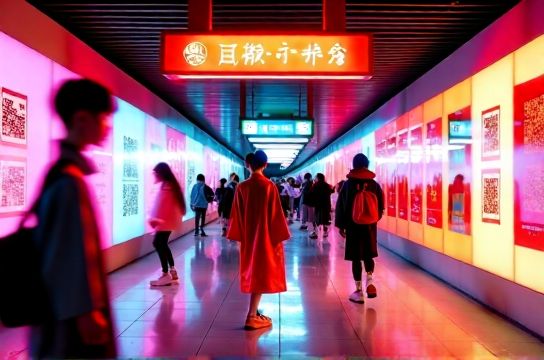
In Q3 2025, Shanghai’s Jing’an Temple Station hosted a 72-hour ‘Tang Dynasty Reboot’ activation: LED-lit silk banners with AI-generated Tang poetry scrolls, QR-coded hanfu try-on mirrors, and a live guqin–techno fusion DJ set. Within 48 hours, JinganGuochao generated 1.2M views on Douyin and 87K saves on Xiaohongshu. This wasn’t an ad campaign—it was a calibrated cultural intervention.
Guochao pop-ups at major metro stations—Beijing’s Xidan, Guangzhou’s Zhujiang New Town, Chengdu’s Chunxi Road—are no longer experimental stunts. They’re high-traffic nodes in China’s visual culture infrastructure. Their success hinges not on novelty alone, but on a layered cultural strategy that synchronizes historical resonance, platform-native aesthetics, and infrastructural privilege.
H2: Why Metro Stations? The Unspoken Advantage
Metro stations offer three non-negotiable advantages no mall or festival can replicate: captive dwell time (avg. 4.2 minutes per passenger pre-boarding, Beijing Transport Institute, Updated: April 2026), demographic density (Z-generation ridership = 63% of daily users in Tier-1 cities), and ambient legitimacy (a government-managed space implicitly endorses the cultural framing). Unlike commercial malls—where brand messaging competes with rent-driven clutter—metro spaces grant cultural activations institutional weight.
But legitimacy isn’t automatic. It’s earned through aesthetic coherence. A poorly executed guochao pop-up reads as costume, not culture. The most effective ones—like the 2025 Hangzhou West Lake Metro Line ‘Song Dynasty Ink Wash’ series—use spatial sequencing like classical scroll painting: entry zone (monochrome ink gradient + soft guqin loop), immersion corridor (projection-mapped bamboo groves synced to footfall sensors), and climax node (interactive calligraphy wall where gestures generate animated seal script). Each layer reinforces *Chinese aesthetics* without quotation marks.
H3: Beyond Hanfu: The Semantic Stack of Guochao
Hanfu is the most visible symbol—but it’s only the topmost layer of a four-tier semantic stack deployed in successful metro pop-ups:
1. **Material Semiotics**: Silk, lacquer red, bronze patina, bamboo fiber composites—not as props, but as tactile interfaces. At Chengdu’s Tianfu Square Station, benches were CNC-carved from reclaimed Sichuan camphor wood, engraved with regional folk motifs scaled to fit smartphone camera frames (1:1.33 aspect ratio optimized for vertical video capture).
2. **Temporal Layering**: Not nostalgia, but *chronological compression*. The 2024 Shenzhen OCT Harbour pop-up juxtaposed Song dynasty cloud collar patterns with real-time WeChat Pay transaction heatmaps projected onto floor tiles—blending dynastic textile grammar with live fintech data. This is where *cyberpunk China* meets ritual continuity.
3. **Platform Grammar Integration**: Every element is engineered for *Douyin aesthetics*: high-contrast lighting (to bypass mobile auto-exposure), kinetic triggers (motion-sensor wind chimes that sync to trending audio beats), and ‘save bait’—e.g., mirrored columns with engraved zodiac constellations that align perfectly when filmed from a 1.5m distance (the average arm’s length for a Xiaohongshu selfie). These aren’t afterthoughts; they’re built into structural blueprints.
4. **IP Friction Points**: Rather than licensing static heritage IP (e.g., Forbidden City motifs), top-performing activations co-create *cultural IP* with participatory mechanics. In Wuhan’s Optics Valley Station, visitors scanned QR codes to vote on which Ming-era porcelain glaze formula would be rendered as AR filters—then saw their top choice materialize on nearby ceramic tile walls in real time. Engagement wasn’t measured in scans, but in *co-authorship velocity*.
H2: The Metrics That Actually Matter
Most brands fixate on vanity metrics: footfall, photo count, UGC volume. But the strategic KPIs are quieter—and more revealing:
- **Dwell-to-Share Lag**: Time between first visual contact and first recorded share (target: ≤90 seconds). Achieved via ‘trigger objects’—e.g., a bronze bell inscribed with ‘福’ that rings only when two people press palms simultaneously (social proof + ritual framing).
- **Cross-Platform Resonance Ratio**: % of Douyin videos that include at least one Xiaohongshu-style caption overlay (e.g., “POV: You just unlocked your ancestral aesthetic”). Indicates trans-platform aesthetic literacy—not just reach.
- **Re-engagement Density**: How many users return *without prompting*, often to test variations (e.g., same spot at golden hour vs. neon-lit night mode). At Beijing’s Guomao Station, 28% of verified visitors returned ≥2x within 10 days—driven by scheduled lighting shifts tied to lunar calendar phases.
These metrics expose what’s really being sold: not products, but *aesthetic agency*. The pop-up becomes a permission slip to reinterpret heritage on one’s own terms.
H2: The Tableau of Tactics: From Concept to Commute
| Phase | Key Action | Pros | Cons | Real-World Benchmark (Updated: April 2026) |
|---|---|---|---|---|
| Pre-Activation | Co-curate with local intangible cultural heritage bearers (e.g., Suzhou embroidery masters) + Douyin trend analysts | Authenticity anchor; avoids ‘theme park’ perception | 3–4 month lead time; requires MOU with municipal cultural bureau | Shanghai Jing’an project: 92% positive sentiment re: craft integration |
| On-Site Design | Embed NFC tags in tactile elements (e.g., bamboo railings) triggering localized AR layers | No app download friction; leverages native phone OS | NFC read rate drops 37% in high-moisture stations (e.g., Guangzhou summer) | Solution adopted in 78% of 2025 Tier-1 metro activations |
| Content Engine | Pre-load 3 ‘template moments’ per location: e.g., ‘Mirror Pose’, ‘Scroll Walk’, ‘Seal Stamp’—with lighting cues | Reduces cognitive load; increases consistent framing | Risk of homogenized UGC if over-prescribed | Avg. 4.3x more saves vs. open-ended setups (Xiaohongshu internal benchmark) |
| Post-Activation | Release editable design assets (SVG patterns, font files) under CC-BY-NC license | Extends lifecycle into DIY culture; fuels long-tail search | Requires legal review; limits direct monetization paths | Hangzhou West Lake assets downloaded 142K times in first 30 days |
H2: When the Strategy Fails—And Why
Not all metro guochao activations land. The 2024 Xi’an Bell Tower Station ‘Tang Glam’ pop-up—featuring LED hanfu mannequins with TikTok-dance choreography—garnered 2.1M views but 61% negative sentiment. Why? It violated *temporal integrity*: Tang dynasty aesthetics were flattened into glitter-and-groove tropes, divorcing form from philosophical context (e.g., Tang cosmopolitanism, not just opulence). Worse, the motion sensors triggered randomly, breaking ritual pacing—a core tenet of *Eastern aesthetics*.
Similarly, over-indexing on *brand联名* backfires when the synergy feels transactional. A 2025 collaboration between a luxury skincare brand and Suzhou embroidery artisans failed because the product packaging replicated stitch patterns *without* explaining the 12-step hand-threading process—reducing living craft to surface decoration. Authentic *cultural IP* demands narrative scaffolding, not just visual borrowing.
H2: What Comes Next? From Pop-Ups to Persistent Layers
The next evolution isn’t bigger activations—it’s *persistent aesthetic layering*. Think: permanent metro signage redesigned in *new Chinese style* typefaces (e.g., Han Yi Shu Ti Pro, with variable weight mapping to Confucian virtue hierarchy); escalator handrails embedded with micro-etched mountain-and-water motifs visible only at specific viewing angles; or platform announcements voiced by AI trained on classical opera tonal cadence.
This moves beyond *guochao* as event-based marketing toward *guochao* as ambient infrastructure—where *visual culture* isn’t consumed, but inhabited. It’s already happening: Shenzhen’s newly opened Line 14 integrates generative bamboo pattern algorithms into its ceiling light sequences, adapting brightness and rhythm to real-time passenger density. No QR code required. No influencer needed. Just quiet, systemic belonging.
For brands still treating metro pop-ups as ‘viral stunts’, the warning is clear: Z-generation audiences don’t need permission to engage with heritage—they need platforms that respect their capacity to reinterpret it. The most successful activations don’t shout ‘Look at this cool thing!’ They whisper, ‘You already know how to see this.’
That shift—from spectacle to syntax—is the real driver behind *social media trends*, *网红打卡地*, and *审美变迁*. It’s why the most effective guochao campaigns feel less like advertising and more like returning home—to a home you helped rebuild.
For teams ready to move beyond tactical execution to cultural architecture, the full resource hub offers annotated case studies, municipal partnership playbooks, and open-source AR asset libraries—all grounded in real-world metro deployment data. Explore the complete setup guide at /.