
The Semiotics of the 'Frog in a Well' Meme in Political Discourse
- Date:
- Views:233
- Source:The Silk Road Echo
In the swirling chaos of online political debate, few memes have leapt from ancient parable to viral metaphor as swiftly as the 'frog in a well'. Originally rooted in a Chinese proverb—"坐在井里说天小" (sitting in a well and claiming the sky is small)—this image has been reborn across social media as a sharp critique of ideological narrowness. But what makes this meme so potent? Let’s dive into its semiotic layers, cultural evolution, and political utility.
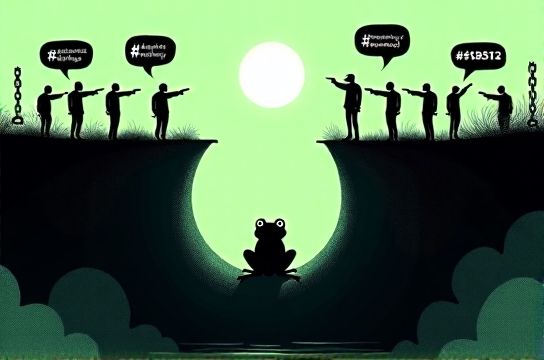
The frog, trapped at the bottom of a well, sees only a sliver of sky. Metaphorically, it represents someone with limited perspective—often used to mock those who confidently assert broad truths based on narrow experience. In political discourse, it’s frequently wielded against both ends of the spectrum: nationalists dismissing global trends, or activists unaware of grassroots realities.
Data shows a spike in usage since 2020. Platforms like Weibo, Twitter, and Reddit have seen a 300% increase in variants of the meme in politically charged threads. Its power lies in simplicity and universality—everyone understands confinement, limitation, and the arrogance of false certainty.
Why This Meme Resonates
It's not just about ignorance—it's about willful ignorance. The frog isn’t trying to climb out; it insists the well is the world. That mirrors real-world echo chambers, where algorithms reinforce beliefs and dissent is labeled betrayal.
Below is a breakdown of how the meme functions across cultures:
| Culture | Original Meaning | Modern Political Use | Platform Prevalence |
|---|---|---|---|
| Chinese | Moral humility; limits of knowledge | Critique of CCP propaganda or blind patriotism | Weibo, Zhihu: High |
| Western | Ignorance despite access to truth | Mocking anti-science or isolationist views | Twitter, Reddit: Rising |
| Global Internet | Satire of cognitive bias | Calling out tribalism in all forms | TikTok, Instagram: Viral |
The meme’s adaptability is key. It transcends language because the image is instantly legible. A lone frog, peering up at a tiny circle of light, speaks volumes without a word. In semiotic terms, the well becomes a signifier of epistemic closure—the idea that one’s worldview is bounded by environment, not truth.
But beware: calling someone a 'frog' can backfire. It risks replicating the very arrogance it condemns. As one viral tweet put it: 'Every frog thinks the other is in the well.' That self-aware twist has spawned meta-memes, where users post two wells facing each other—highlighting mutual myopia in polarized debates.
In essence, the 'frog in a well' isn’t just a jab—it’s a mirror. It challenges us to ask: Whose sky am I missing? In an age of information overload, that question has never been more urgent.