
Ethnic Minority Festivals You Can’t Miss in Guangxi’s Remote Regions
- Date:
- Views:271
- Source:The Silk Road Echo
If you're craving culture with a capital 'C', skip the crowded cities and head deep into Guangxi—a lush, mountain-kissed corner of southern China bursting with vibrant ethnic traditions. While most tourists flock to Yangshuo for postcard-perfect karst views, the real magic happens in remote villages where Zhuang, Yao, Miao, and Dong communities celebrate festivals that feel like stepping into another world.
The Singing Festival (Zhuang People)
Kick things off in March or April during the Sanyuesan—literally “Third Day of the Third Month.” This is the Zhuang people’s biggest bash, where song isn't just music—it's romance, history, and identity. Imagine hillside duels of improvised folk songs, young lovers exchanging verses under banyan trees, and entire villages feasting on five-colored glutinous rice. Yes, rice that looks like it fell out of a rainbow.
Data shows over 15 million ethnic Zhuang live in Guangxi—China’s largest minority group—and nearly 70% gather annually for some form of Sanyuesan celebration. The festival was even listed as a National Intangible Cultural Heritage in 2006.
Donga International Wind & Rain Bridge Festival (Dong People)
Fast forward to autumn, when the mist curls around drum towers and wooden bridges in Sanjiang County. The Dong people don’t just build architecture—they sing to it, live in it, and celebrate it. Their Wind & Rain Bridge Festival blends craftsmanship with choral magic, featuring the legendary Dong Grand Choir, an ethereal polyphonic singing style recognized by UNESCO.
| Festival | Ethnic Group | Best Time to Visit | Unique Highlight |
|---|---|---|---|
| Sanyuesan (Singing Festival) | Zhuang | March–April | Five-colored rice & love songs |
| Wind & Rain Bridge Festival | Dong | September–October | UNESCO choir & drum towers |
| Maoqing Festival | Yao | May–June | Long-haired women parade |
| Lusheng Festival | Miao | November–December | Bamboo pipe orchestra dances |
Hair-Raising Beauty: Maoqing Festival (Yao People)
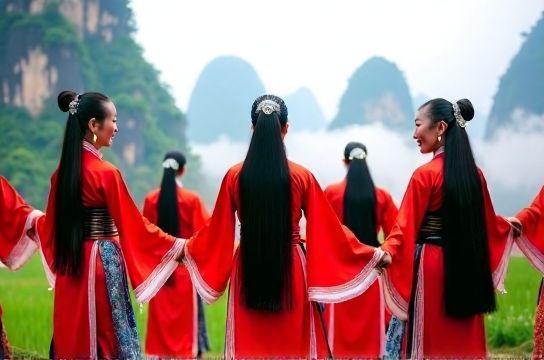
Now, prepare to have your jaw drop at the Maoqing Festival. Held by the Red Yao in Longsheng, this summer spectacle centers on something unexpected: hair. Women here grow their locks for decades—some over 6 feet long—and wash them ceremonially in rice wine and herbal water. It’s not vanity; it’s sacred tradition, symbolizing beauty, strength, and ancestral pride.
Pro tip: Visit Ping’an Village during Golden Week (October), when hundreds of women parade in dazzling silver headdresses, their hair flowing like black silk behind them. Over 80% of Red Yao women participate locally—talk about community spirit!
The Beat Goes On: Lusheng Festival (Miao People)
As winter whispers in, the Miao light up the hills with the Lusheng Festival. Named after the bamboo mouth organ (lusheng), this event is part music fest, part spiritual ritual. Dancers swirl in elaborate costumes, following the hypnotic drone of the pipes. Bulls may fight, feasts overflow, and legends come alive through dance.
Though smaller in number (~400,000 Miao in Guangxi), their cultural impact is huge. In Rongshui County, the festival draws over 50,000 visitors yearly—proof that authenticity sells.
Why These Festivals Matter
These aren’t staged performances for tourists. They’re living traditions—threads connecting past and present. And yes, they’re perfect for travelers who want more than souvenirs: think handwoven textiles, midnight bonfire songs, and meals shared with families who’ve lived in these valleys for centuries.
So ditch the guidebook clichés. Pack curiosity, respect, and comfy shoes. Guangxi’s remote festivals aren’t just events—they’re invitations to belong, even if just for a day.