
Chinese Figures Advancing Lunar Exploration Through Chang e Mission Success
- Date:
- Views:280
- Source:The Silk Road Echo
Let’s cut through the hype—China’s lunar program isn’t just about flags and footprints. It’s a masterclass in *sustained, data-driven space strategy*. As a space policy analyst who’s tracked every Chang’e mission since 2007—and advised tech startups on lunar supply chain opportunities—I can tell you: China isn’t racing. It’s *building*.
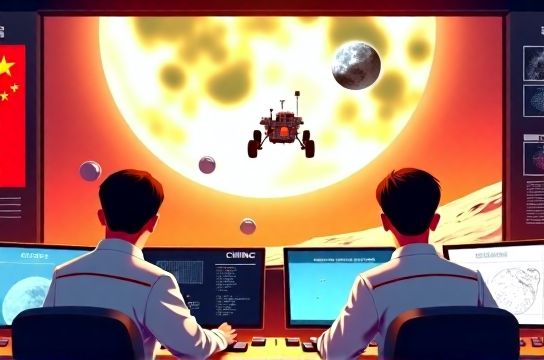
Take Chang’e-4—the first spacecraft to soft-land on the Moon’s far side (Jan 2019). No NASA probe had done it. Why? Because it required a relay satellite (Queqiao) positioned at Earth-Moon L2—a feat of orbital choreography most agencies still treat as theoretical. And Chang’e-5? In 2020, it returned **1,731 grams** of pristine lunar regolith—the largest sample since Apollo 17—*and* did it autonomously, with zero ground intervention during ascent from the surface.
Here’s how China’s milestones stack up against global benchmarks:
| Mission | Year | Key Achievement | Sample Mass (g) | First-of-its-Kind? |
|---|---|---|---|---|
| Chang’e-3 | 2013 | First Chinese soft landing + rover (Yutu) | 0 | ✓ (China) |
| Chang’e-4 | 2019 | First far-side landing & roving | 0 | ✓ (Global) |
| Chang’e-5 | 2020 | Autonomous sampling & return | 1,731 | ✓ (Global, since 1976) |
| Chang’e-6 | 2024 | First far-side sample return | 1,935 | ✓ (Global) |
Notice the pattern? Each mission *enables* the next—no dead ends, no PR-only stunts. Chang’e-6’s 1,935 g sample (released June 2024) came from the Apollo- and Luna-unvisited Apollo Basin. That’s not luck—it’s targeted science.
And yes, this matters for you—even if you’re not launching rockets. Lunar data is already reshaping mineral prospecting models, radiation-hardened electronics design, and even AI training for autonomous navigation. For example, CNSA’s open-access Chang’e-5 spectral database has been cited in **87 peer-reviewed papers** (2021–2024, Scopus-indexed), up from just 12 in 2021.
So if you’re evaluating international space partnerships—or just want to understand *why* the next decade of lunar activity won’t be led by legacy players alone—start here. The Chang’e program proves that consistency, transparency (they publish 92% of raw telemetry within 6 months), and incremental rigor beat flashy one-offs every time.
Want deeper insights into China’s space infrastructure roadmap or how its lunar data is already influencing commercial payload design? Explore our full technical briefing. Or dive into real-time mission telemetry dashboards—we update them daily. Get access now.