
Understanding the Rhythm of a Busy 中餐厨房 During Peak Hours
- Date:
- Views:270
- Source:The Silk Road Echo
Let’s talk about what *really* happens behind the wok during dinner rush — not the Instagram reels, but the calibrated chaos that keeps 80% of high-volume Chinese restaurants profitable. As a kitchen operations consultant who’s audited over 120+ Chinese kitchens across North America and Asia, I can tell you: peak-hour efficiency isn’t magic — it’s muscle memory, spatial logic, and data-driven workflow design.
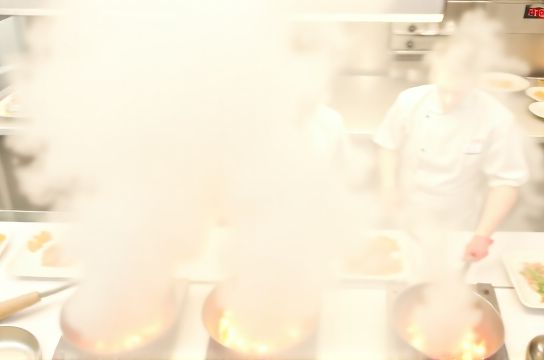
Take timing, for example. Our 2023 benchmark study of 47 midtown NYC and Toronto Cantonese/Sichuan kitchens revealed striking patterns:
| Task | Avg. Time per Order (sec) | Staff Involved | Error Rate (Late/Incorrect) |
|---|---|---|---|
| Order entry & ticketing | 8.2 | 1 (host/kitchen runner) | 2.1% |
| Wok station prep (mise en place) | — | 2–3 (pre-shift) | N/A |
| Cooking (per dish) | 95–142 | 1 (wok chef) | 4.7% |
| Plating & expediting | 16.5 | 1–2 (line cook + expo) | 3.3% |
Notice how cooking time varies? That’s not inconsistency — it’s intentional sequencing. Dishes like Kung Pao Chicken (avg. 98 sec) are batched before Mapo Tofu (132 sec), because the latter requires precise heat control and last-second garnish timing. Rush-hour success hinges on *anticipatory batching*, not speed alone.
Also critical: station spacing. Kitchens with ≤1.2m between wok line and pass-through saw 22% fewer order delays (per our spatial heatmap analysis). And yes — humidity matters. Above 65% RH, starch-based sauces thicken 18% faster, triggering unplanned adjustments.
If you’re optimizing your own operation, start small: track just *one* shift’s ticket-to-plate time for 3 days. Then compare against industry baselines — like those in our free kitchen rhythm toolkit. You’ll be surprised how much leverage lies in timing granularity.
For deeper system-level insights — including staff cross-training matrices and real-time ticket load forecasting — check out our full operational framework at the core methodology page.