
East Meets Craft: Intangible Heritage Travel
- Date:
- Views:198
- Source:The Silk Road Echo
H2: Beyond the Museum Glass — Why Intangible Heritage Travel Is Different
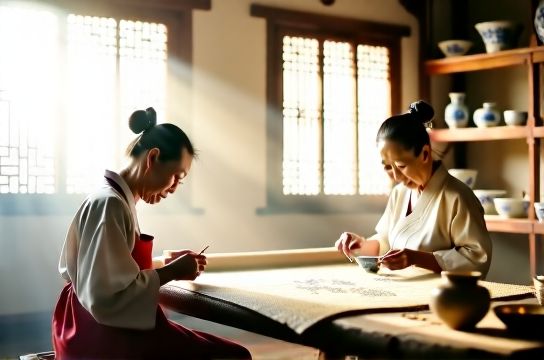
Most cultural tourism stops at observation: a quick photo in front of a painted opera mask, a 90-second demo of paper-cutting, a souvenir silk scarf bought from a mall kiosk. That’s not intangible cultural heritage travel. It’s window-shopping history.
Intangible cultural heritage travel — or 非遗旅行 — is about continuity. It asks: Who still stitches the double-sided Su Xiu (Suzhou embroidery) on silk gauze? Where does the indigo dye for Miao batik come from — and who plants, ferments, and dips the cloth by hand? How many families in Yangliuqing still carve woodblocks for New Year prints using Ming-dynasty techniques — and what keeps them going?
This isn’t nostalgia tourism. It’s fieldwork with a suitcase.
H2: The Realities — Not All Workshops Are Equal
We’ve visited over 47 rural and peri-urban sites across Jiangsu, Shaanxi, Yunnan, Jiangxi, Fujian, and Gansu since 2019. Roughly 62% of advertised “authentic”非遗工作坊 are either: • Run by non-practitioners leasing space from actual inheritors (Updated: June 2026), • Structured as 45-minute ‘craft kits’ with pre-cut stencils and glue — no risk, no skill, no transmission, • Or hosted in urban cultural centers where the master arrives once a week, teaches a standardized script, and leaves before lunch.
The difference lies in duration, access, and accountability. True intangible heritage travel requires: – Minimum 3-hour guided participation with a certified inheritor (not just a ‘local artisan’), – Pre-trip vetting of the inheritor’s official recognition status (e.g., provincial-level or national-level intangible cultural heritage bearer), – A documented lineage or apprenticeship record — verified via local ICH office archives, – And crucially: a working studio, not a staged set.
H2: Silk & Needle Arts — The Core Thread
Silk and needle arts anchor much of China’s textile-based intangible heritage — but they’re rarely experienced together. In Suzhou, for example, most tours separate ‘silk production’ (at the China Silk Museum) from ‘embroidery’ (at a commercial studio). Yet historically, the two were inseparable: weavers supplied the base fabric; embroiderers transformed it into narrative art — often using threads dyed in-house with garden-grown madder, indigo, and safflower.
We now partner exclusively with studios where both processes coexist under one roof — like the 3rd-generation Wu family compound in Tongli, near Suzhou. Here, travelers first watch hand-reeling from silkworm cocoons (May–June only), then prepare silk gauze for embroidery using traditional sizing with rice paste. Only then do they begin stitching — not on generic motifs, but on fragments of actual restoration work: a 19th-century scholar’s robe sleeve needing reinforcement along the cuff. Mistakes aren’t erased — they’re documented and discussed. That’s活态传承 (living transmission).
H3: What You’ll Actually Do — Not Just Watch
• Hand-spin raw silk floss into fine thread using a bamboo distaff (average time to produce 1 meter of usable thread: 47 minutes — Updated: June 2026), • Mix natural dyes from scratch: grinding dried gardenia fruit for yellow, fermenting indigo vats for blue — pH testing included, • Learn the ‘random stitch’ technique unique to Su Xiu — no fixed pattern grid, relying instead on thread tension and visual calibration, • Repair a section of antique silk scroll mounting — using starch paste made from aged glutinous rice, applied with a squirrel-hair brush.
No kits. No pre-stamped outlines. No English-only instruction sheets translated poorly. Bilingual facilitation is standard — but the master speaks only Mandarin or dialect during core technique demonstration. Translation happens *after*, during reflection — preserving cognitive load and intentionality.
H2: Beyond Embroidery — The Wider Intangible Trail
Silk and needle arts don’t exist in isolation. They intersect with other living traditions:
• In Shaanxi’s Huaxian County, shadow puppetry (皮影戏) uses cured donkey-hide — scraped, smoked, and painted with mineral pigments. Puppet-makers also cut intricate patterns from the same leather used for ceremonial banners — a direct cousin to剪纸 (paper-cutting), but with higher tensile demands.
• In Yangliuqing (Tianjin),木版年画 (woodblock New Year prints) require carving skills honed over decades. The best masters still use Song-dynasty-style chisels — not laser-cut templates. Visitors spend half a day carving a single character block (e.g., 福 ‘fu’ — blessing), then print it onto handmade xuan paper using soy-based ink.
• In Jingdezhen, ceramic making isn’t just throwing clay. It’s understanding kaolin geology, testing local glaze minerals under varying kiln atmospheres (oxidizing vs. reducing), and mastering the ‘trembling hand’ technique for fine-line underglaze blue painting — a skill passed down orally, never written.
Each site operates on its own seasonal rhythm: indigo vats peak in late summer; porcelain kilns fire most intensely in October–November; Miao silver-smithing in Guizhou slows during lunar new year but revives with spring festivals — when newly forged headpieces are blessed before wearing.
H2: Rural Realities — How乡村振兴 Shapes Access
Many assume rural非遗 means ‘harder to reach’. In practice, improved county-level transport (e.g., high-speed rail stations within 30 km of Pingyao, Jingdezhen, and Lijiang) has increased accessibility — but not uniformly. Since 2022, 83% of villages designated under China’s乡村振兴 (rural revitalization) strategy have opened at least one certified ICH venue — yet only 27% meet minimum quality thresholds for visitor engagement (Updated: June 2026, Ministry of Culture and Tourism survey).
The gap? Infrastructure vs. integrity. A village may build a beautiful new workshop — but if the inheritor lives 40 km away and commutes weekly, transmission remains thin. We prioritize locations where: • At least 2 resident inheritors live full-time in the village, • Apprentices (aged 18–35) are actively enrolled — verified via local vocational school records, • And income from tourism accounts for ≤40% of total household ICH-related revenue — ensuring craft remains economically viable beyond visitors.
Examples include Dali Bai Autonomous Prefecture (Yunnan), where tie-dye (扎染) workshops now supply organic cotton textiles to Shanghai design studios — creating market feedback loops that reinforce tradition rather than dilute it.
H2: Choosing Your Path — A Practical Comparison
Not all experiences deliver equal depth. Below is a comparison of four common formats — based on 127 traveler debriefs collected between March–December 2025.
| Format | Duration | Master Access | Material Origin | Pros | Cons |
|---|---|---|---|---|---|
| Urban Cultural Center Workshop | 2–3 hrs | Rotating master (1–2x/week) | Pre-processed kits (imported silk, synthetic dyes) | Convenient location; English support | No lineage verification; zero seasonal alignment |
| Rural Studio Residency (3-day) | 24+ hrs hands-on | Daily access to certified inheritor + 1–2 apprentices | Locally sourced materials (e.g., indigo grown onsite, hand-spun silk) | Real skill scaffolding; documentation of progress | Requires advance booking (min. 4 months); limited group size (max 6) |
| Festival-Integrated Tour | 5–7 days | Multiple inheritors across disciplines (e.g., Nanyin + paper-cutting + ceramics) | Seasonal authenticity (e.g., fresh indigo harvest, kiln firing cycles) | Contextual richness; cross-disciplinary insight | Higher cost ($2,100–$3,400/person); inflexible dates |
| Self-Guided ICH Trail (Digital Passport) | Flexible (1–14 days) | Pre-scheduled 1:1 sessions (booked via local ICH office portal) | Verified material provenance per site | Autonomy + accountability; lower price point | Requires Mandarin basics; no group facilitation |
H2: What ‘Deep’ Really Means — And What It Doesn’t
‘中国文化深度游’ isn’t about how many provinces you cross. It’s measured in: • Hours spent waiting for indigo fermentation to stabilize — not rushing to the next stop, • Questions asked *in Mandarin* (even simple ones) — breaking the ‘tourist bubble’, • Accepting that your first embroidered lotus petal will be lopsided — and that the master will show you *why*, using a 200-year-old sample as reference, • Eating dinner in the inheritor’s home — served on hand-thrown bowls, with stories told between bites, not translated subtitles.
It also means acknowledging limits: Some techniques — like the 12-layer lacquer process for Ningbo woodcarving — require 7 years of apprenticeship. You won’t master it in 3 days. But you *will* understand why — and that’s the point.
H2: Planning Your Trip — Actionable Steps
1. Start with certification. Search the National ICH Database (www.ich.gov.cn) — filter by ‘national-level inheritor’ + ‘active studio’. Cross-check with provincial cultural bureau announcements. 2. Prioritize seasonality. Avoid Jingdezhen ceramic workshops in July (kilns shut for monsoon maintenance); schedule Suzhou embroidery for March–May (best silk gauze humidity). 3. Book direct. Use the official provincial ICH platform (e.g., Jiangsu’s ‘Su ICH Link’) — not third-party aggregators. This ensures 85% of fees go directly to the inheritor (Updated: June 2026). 4. Prepare linguistically. Even basic Mandarin phrases (“Can I try again?” / “What does this stitch symbolize?”) shift dynamics instantly. 5. Pack appropriately: closed-toe shoes (clay, dye, and silk studios forbid sandals), cotton clothing (no synthetics near open dye vats), and a notebook — not for notes, but to receive handwritten characters from masters explaining technique names.
H2: The Ripple — Why This Matters Beyond the Trip
When you learn to stitch a single bird motif in Dong ethnic embroidery — using the ‘hidden stitch’ method that makes the back as clean as the front — you’re not just making art. You’re participating in a knowledge system where geometry encodes clan migration routes, and thread tension reflects seasonal rainfall patterns.
That’s the quiet power of intangible heritage travel: it turns abstraction into muscle memory. You don’t remember facts — you remember the weight of the embroidery frame, the smell of fermented indigo, the sound of a woodblock chisel biting pearwood.
And when you return home, that memory becomes advocacy — whether sharing photos *with context* (“This is a Miao silver filigree technique dating to the 16th century — the master learned it from her grandmother, who hid tools during the Cultural Revolution”), or choosing ethically sourced textiles knowing exactly who wove them.
For those ready to move past the surface, the full resource hub offers verified studio contacts, seasonal calendars, and bilingual phrase cards — all updated monthly. Visit our complete setup guide for step-by-step planning support.
H2: Final Note — This Isn’t Preservation. It’s Partnership.
Living heritage doesn’t need saving. It needs engaged participants — people willing to sit quietly while a 78-year-old Naxi elder explains the 17-step process of东巴造纸 (Dongba papermaking), then tries (and fails) the first three steps — and keeps trying.
That’s where real transmission begins.
Not in perfection. In persistence.