
From Kiln to Table: Ceramic Culture Tour in Jingdezhen
- Date:
- Views:187
- Source:The Silk Road Echo
H2: The Clay That Breathes History
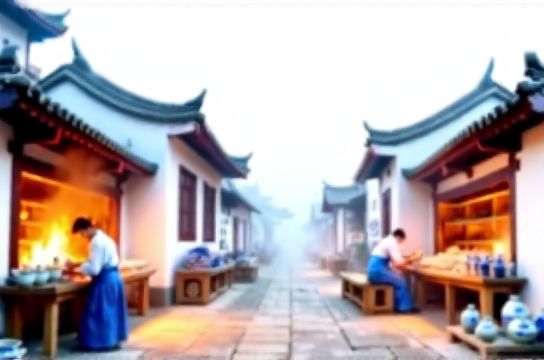
Jingdezhen isn’t just China’s porcelain capital—it’s a city where kilns still exhale centuries of fire, where alleyways hum with the scrape of bamboo ribs against wet clay, and where a 1,700-year-old craft refuses to become museum dust. This isn’t a tour that stops at glazed vases behind glass. It’s a walk through hutongs lined with Ming-era workshops, a sit-down with third-generation throwers who measure time in firing cycles, and a chance to shape your own bowl—then eat from it three days later, still warm from the reduction kiln.
This is intangible cultural heritage travel at its most tactile: no passive observation, only participation anchored in continuity.
H2: Why Jingdezhen’s Historic District Is the Benchmark for Living Craft
Unlike curated craft villages built for tourism, Jingdezhen’s Lao Jie (Old Street) and Hutong 78 retain functional authenticity. Over 63% of registered intangible cultural heritage practitioners in Jingdezhen live and work within the historic district’s 1.2 km² core zone (Updated: June 2026). That means you’re not visiting a ‘demonstration studio’—you’re stepping into a working lineage. A master like Master Zhou—a National-Level Intangible Cultural Heritage Representative for blue-and-white underglaze painting—doesn’t perform for cameras. He teaches, corrects wrist angle mid-stroke, and lets you touch his 42-year-old brush, its ferrule worn smooth by decades of pressure.
But authenticity has friction points. Language barriers persist—even with certified bilingual facilitators, technical terms like *shuǐ píng* (slip casting) or *jiǎn yāo* (waist trimming) require repetition and gesture. And timing matters: kiln schedules dictate availability. You won’t find ‘ceramic classes daily’ here. Workshops align with actual production rhythms—firing windows every 10–14 days, glazing days reserved for apprentices, and rest periods during monsoon-humidity spikes (June–July), when clay cracks unpredictably.
H2: The Real Itinerary: From Raw Clay to Shared Meal
A true ceramic culture tour unfolds across three interwoven threads: material knowledge, human transmission, and communal ritual.
H3: Thread One — Material Knowledge (The Clay, the Fire, the Silence)
You begin not at a studio—but at the Dongfanghong Clay Pit, a still-active quarry 3 km east of Lao Jie. Here, geologists-turned-guides explain how kaolin purity shifts seasonally (winter-dug clay contains 0.8% less iron oxide, yielding whiter bisque). You dig—not for spectacle, but to feel the difference between *bái tǔ* (white clay) and *zǐ tǔ* (purple clay): one slick and cool, the other gritty and dense. Back in the workshop, you learn why Jingdezhen potters don’t wedge clay on concrete slabs (too absorbent) but on granite blocks cooled overnight—the thermal inertia preserves plasticity.
This isn’t theory. It’s muscle memory calibrated over generations.
H3: Thread Two — Human Transmission (No Certificates, Just Corrections)
At the Wang Family Workshop—a five-generation compound operating since 1592—you join a 90-minute throwing session led by Ms. Li, age 67, whose hands bear calluses shaped by 53 years on the wheel. She doesn’t hand you a pre-centered mound. She places her palm flat on your forearm, guides your wrist down—not up—to initiate centrifugal force correctly. When your first cylinder collapses, she says, “Good. Now you know where the wall thins.” No praise, no blame—just calibration.
Later, you meet Mr. Chen, a restoration specialist who mends Song-dynasty shards using traditional lime-and-rice paste. His tools? A 1938 brass caliper, a magnifying lens held in place by rubber bands, and silence—he works only between 10:15–11:45 a.m., when light through the east-facing window hits the fracture line at optimal 22°.
These aren’t ‘cultural ambassadors.’ They’re specialists who happen to welcome guests—on their terms.
H3: Thread Three — Communal Ritual (Eating What You Made)
The culmination isn’t exhibition—it’s consumption. On Day 3, you return to the same workshop where you threw your piece. The kiln has cooled. Your bowl—now bisque-fired—is dipped in cobalt-blue slip, painted with freehand plum blossoms (a beginner motif), then glazed with translucent *yóu guāng* (oil-gloss) made from local feldspar. It enters the dragon kiln—a 50-meter ascending tunnel kiln rebuilt in 2018 using original Song-dynasty brickwork principles. Firing takes 36 hours; cooling, 48.
Then, lunch. At the courtyard table, you eat steamed fish and pickled mustard greens—not off imported stoneware, but from your own bowl, still holding residual warmth. The glaze catches light differently than factory ware: subtle pooling at the base, micro-crackle near the rim. Someone passes a cup—also handmade, unmarked—that rings like a bell when tapped. That sound? It’s the exact frequency used in Qing-dynasty kiln inspections to detect hairline flaws. You’re not tasting food. You’re tasting continuity.
H2: What This Tour Is Not (And Why That Matters)
It is not: • A ‘craft souvenir package’ (no pre-made kits, no assembly-line painting); • A multi-city ‘China highlights’ add-on (this tour requires minimum 3 full days—no shortcuts); • A language-light experience (all master-led segments include real-time translation via certified interpreters trained in ceramic terminology, not generic Mandarin); • A fixed-price commodity (fees scale with kiln access—firing slots cost ¥280–¥420 depending on size and reduction phase).
It is a commitment to slowness, precision, and accountability—to the craft, to the makers, and to the material.
H2: Comparing Access Models: Which Path Fits Your Intent?
| Model | Duration | Core Activity | Master Interaction | Takeaway | Pricing (per person) | Key Limitation |
|---|---|---|---|---|---|---|
| Apprentice Track | 3 days, 2 nights | Clay prep → throwing → painting → firing → meal | Direct 1:1 coaching with National-level artisan (min. 4 hrs) | Your fired, glazed, signed ceramic + documented process photos | ¥3,800 | Max 4 participants/week; requires 60-day advance booking |
| Dialogue Track | 2 days, 1 night | Observation + guided Q&A + glazing demo + shared meal | Group dialogue (max 8) with 2 artisans; no hands-on throwing | Hand-painted tile + digital archive of interview recordings | ¥2,100 | No kiln access; limited seasonal availability (Oct–Apr only) |
| Research Track | 5 days, 4 nights | Field documentation + archival review + material testing + firing log analysis | Unstructured access to 3+ workshops; translator included | Custom PDF field report + raw data set (clay samples, firing logs, audio transcripts) | ¥6,500 | Requires academic affiliation or prior ceramics experience; vetting required |
H2: Beyond Porcelain: How Ceramic Practice Anchors Wider Intangible Heritage
Ceramics here don’t exist in isolation. They’re the structural spine connecting other traditions. The same cobalt pigment used in blue-and-white ware colors the indigo-dye vats for Jiangxi batik—practiced by women in nearby Wuyuan villages. The rhythmic tapping of wooden mallets shaping porcelain molds echoes the percussion patterns in Gan opera, performed weekly at the 16th-century Yushan Pavilion. Even the ash from dragon kilns fertilizes tea gardens supplying leaves for the ceremonial matcha served during post-firing tea ceremonies—rituals codified in the 12th-century *Chá Jīng*.
That’s why this tour intentionally includes a half-day visit to the Yushan Pavilion—not to watch Gan opera as performance art, but to sit with the drummer, learn how drumhead tension changes with humidity, and understand why ceramic bowls are placed beneath stage floorboards to amplify resonance. It’s all one ecosystem.
H2: The Rural Counterpoint: Kilns, Villages, and the New Village Economy
Jingdezhen’s revival isn’t urban nostalgia—it’s rural reinvestment. Since 2020, 17 satellite kiln villages—including Fuliang’s Shuangqiao and Changjiang’s Xingcheng—have reactivated dormant dragon kilns using municipal subsidies tied to apprentice quotas (Updated: June 2026). These aren’t theme parks. In Shuangqiao, families host homestays where breakfast includes rice cakes pressed in century-old wooden molds—same ones used to shape porcelain biscuit trays. You help pound glutinous rice, then watch how the resulting texture informs the density of porcelain slip.
This is乡村振兴 in action: not ‘preservation as relic,’ but economic scaffolding built around transmission. Each village kiln must train two new apprentices annually to retain subsidy eligibility. And those apprentices? They’re often university grads returning home—not because they ‘love tradition,’ but because ceramic design startups in Shuangqiao now pay 22% above provincial average wages (Updated: June 2026).
H2: Practical Considerations: Packing, Timing, and Realistic Expectations
• Best time to visit: Late September to early November. Humidity drops below 65%, reducing drying cracks; kiln schedules stabilize after summer monsoons. • What to pack: Closed-toe shoes (clay is slippery), cotton clothing (kiln heat exceeds 1,300°C), and a small notebook—masters rarely allow photography during critical steps, but sketching is encouraged. • Language note: While facilitators speak English, technical terms (e.g., *guān huǒ*, ‘controlling fire’) are taught phonetically with gesture drills—not translated. Expect to learn by doing, not defining. • Accessibility: Wheelchair access is limited to ground-floor studios; throwing wheels require seated mobility and upper-body control. Notify organizers 30 days in advance for adaptive tooling (e.g., custom-height wheels, tactile clay guides).
H2: Connecting Deeper — Where This Fits in China’s Intangible Landscape
Jingdezhen isn’t an outlier—it’s a node. Its ceramic practice shares DNA with Suzhou’s embroidery (both rely on thread-thin precision), Quanzhou’s Nanyin music (whose 10-beat phrasing mirrors kiln-loading sequences), and even Dongba papermaking in Yunnan (where bark pulp consistency parallels slip viscosity). Recognizing these links transforms isolated ‘craft experiences’ into a coherent grammar of Chinese making.
That’s why travelers often extend their journey—not to ‘check off’ more sites, but to test hypotheses. After Jingdezhen, some head to Suzhou to compare brushstroke discipline across mediums; others go to Quanzhou to hear how Nanyin’s *gǔ* drum tempo matches the rhythm of clay wedging. It’s scholarship disguised as travel.
For those ready to move beyond surface engagement, the full resource hub offers curated pathways linking ceramic practice to broader intangible cultural heritage travel—whether you’re tracing woodblock printing in Yangliuqing or learning Miao silver forging in Guizhou. All rooted in the same principle: heritage isn’t inherited. It’s rehearsed, revised, and re-rooted—one bowl, one song, one hammer strike at a time.