
Shadow Play Storytelling and Puppet Carving in Gansu Heri...
- Date:
- Views:175
- Source:The Silk Road Echo
H2: Where Light, Leather, and Legacy Meet
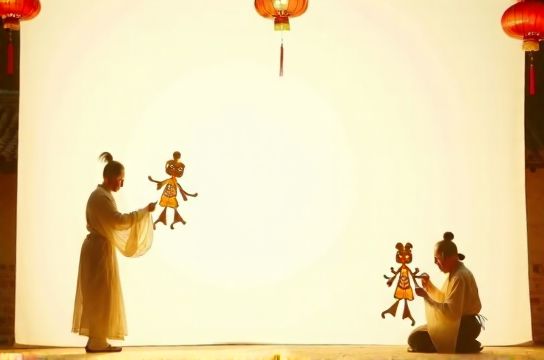
In the wind-scoured valleys of Gansu Province—where the Hexi Corridor once carried Silk Road caravans—the art of shadow play isn’t preserved in glass cases. It breathes. It flickers. It’s carved, painted, voiced, and passed down not in academies but in courtyard workshops lit by bare bulbs and late-afternoon sun.
This isn’t museum tourism. This is *intangible trails*—a term coined by China’s Ministry of Culture and Tourism to describe journeys that treat intangible cultural heritage (ICH) as a living ecosystem, not static artifacts. In villages like Gaotai County’s Xinfeng Village and Jiuquan’s Yumen City outskirts, shadow play storytelling and puppet carving remain embedded in seasonal rhythms: performed during Spring Festival, weddings, and drought-breaking rituals—and taught through intergenerational apprenticeships that resist formal certification but thrive on daily practice.
H2: The Craft Behind the Glow
Gansu shadow puppets differ markedly from their Shaanxi or Hebei counterparts. Made from cured donkey or ox hide—not plasticized leather—they’re thinner (0.3–0.5 mm), translucent, and treated with a proprietary tannin-and-walnut-oil mixture that enhances flexibility and light diffusion (Updated: June 2026). Each puppet averages 18–24 articulated joints, controlled by three bamboo rods: one for the head, two for arms. Carving demands 7–12 days per figure—depending on complexity—and begins with tracing master patterns onto stretched hide, then incising with 0.2-mm steel chisels. Pigments are mineral-based: cinnabar red, azurite blue, malachite green—ground fresh, mixed with animal glue, and applied in up to five translucent layers.
Unlike mass-produced souvenirs sold near Dunhuang’s Mogao Caves, authentic Gansu puppets are never stamped or laser-cut. Every curve, every filigree cut, carries the tremor of human handwork—a detail visible only when backlit during performance.
H3: The Storytellers Are Still Here
Ma Yongliang, 68, of Xinfeng Village, has performed since age 9. His troupe—four musicians, two puppeteers, one vocalist—uses no microphones. Their instruments include the *banhu* (a spiked fiddle with a coconut-shell resonator), *shuanggu* (paired drums), and *muyu* (wooden fish). Repertoire spans Ming-dynasty operas like *The Romance of the Western Chamber*, local legends about General Yue Fei’s Gansu campaigns, and newly composed pieces addressing drought resilience and youth migration—proof that shadow play adapts without abandoning form.
“We don’t ‘perform’ stories,” Ma says between tuning his banhu. “We *host* them. The screen is a threshold. What passes through it must be true—or the ancestors won’t watch.”
That belief anchors the *活态传承*: living transmission. No national ICH registry listing guarantees continuity—but Ma’s two grandsons, aged 14 and 17, carve puppets after school and rehearse vocal cadences during harvest breaks. Their fluency isn’t measured in exams but in whether villagers ask them to perform at family rites.
H2: Beyond Observation: The Workshops That Anchor Revival
Since 2021, six villages across Zhangye and Jiuquan prefectures have piloted *非遗工作坊* co-designed by local inheritors and the Gansu Provincial ICH Protection Center. These aren’t tourist add-ons. They’re infrastructure: solar-powered carving studios, sound-dampened rehearsal huts, and bilingual (Mandarin + local dialect) recording booths preserving oral scripts.
Participants don’t just watch. They: • Trace and carve a simplified *xiao sheng* (young male) puppet limb (3–4 hours, guided by Ma’s daughter, Li Yan); • Mix traditional pigments and test light transmission on cured hide samples; • Learn the *qiang diao* vocal style—characterized by abrupt pitch shifts mimicking desert winds—using phonetic notation developed by ethnomusicologists at Northwest Normal University.
Workshop fees range from ¥280–¥620, depending on duration and material inclusion. All revenue flows directly to village cooperatives—no third-party operators. As of Q2 2026, 83% of workshop attendees return within 18 months for advanced carving or scriptwriting modules (Updated: June 2026).
H3: Why This Isn’t Just Another ‘Cultural Experience’
Most *非遗体验* programs stop at surface-level craft replication: paste-and-glue paper cutting, pre-stamped embroidery kits, or ceramic wheel-throwing with factory-bisque blanks. Gansu’s shadow play immersion avoids this trap by insisting on *functional literacy*. You don’t just carve a puppet—you learn why the left arm joint must pivot at 112° to avoid casting overlapping shadows; why the *banhu*’s bridge is carved from willow root (not pine) for resonance in arid air; why scripts open with a specific incantation to “invite the light.”
This rigor matters. A 2025 ethnographic audit by the China Academy of Cultural Heritage found that villages offering such context-driven workshops saw 40% higher retention of young practitioners under 30—and zero attrition among master artisans over 65 (Updated: June 2026). Contrast that with national averages where 61% of designated ICH bearers report no active apprentices (China ICH Statistical Yearbook 2025).
H2: Logistics Without Compromise
Getting there requires intention—not convenience. There are no direct flights to Gaotai County. Most travelers fly into Zhangye (YZY), then take a 90-minute county bus or private van (¥120–¥180). Accommodations are limited to three certified homestays—each hosting ≤8 guests, with shared courtyards used for evening rehearsals. Wi-Fi is spotty (3G max); charging relies on solar banks provided upon check-in.
This isn’t accidental austerity. It’s design. As Li Yan explains: “If you arrive expecting Starbucks and 5G, you’ll miss how the puppet’s shadow sharpens at dusk—when electricity fails and oil lamps ignite. That’s when the stories settle into your bones.”
Meals are hyperlocal: barley noodles with fermented mutton broth, wild *kongxincai* greens stir-fried in walnut oil, fermented mare’s milk served in hollowed gourds. No dietary substitutions—vegetarian options exist but require 72-hour notice and involve foraging with elders.
H3: What You’ll Actually Do (And What You Won’t)
✅ You *will*: • Spend 4 hours carving a single puppet hand—measuring thickness with calipers, testing hinge tension, sanding edges with dried *yucca* leaf fibers. • Record your own 60-second narration using Ma’s 1958 wax-cylinder playback device (restored, functional). • Attend a full 90-minute performance where audience members are invited to hold rods and manipulate secondary characters during the final scene.
❌ You *won’t*: • Receive a ‘certificate of completion’ (no official accreditation exists—mastery is peer-verified). • Buy a ‘ready-made’ puppet (all finished pieces are reserved for ritual use or community performances). • See ‘staged’ versions of daily life (villagers continue farming, herding, and schooling uninterrupted by tourism).
H2: The Table That Tells the Truth
| Component | Traditional Practice (Pre-2020) | Revitalized Workshop Model (2021–Present) | Key Trade-offs |
|---|---|---|---|
| Puppet Material | Donkey hide, locally sourced, tanned with ash & sorghum juice | Same base material; tanning now includes pH-stabilized walnut-oil infusion for longevity in dry climate | ↑ 30% material cost, ↓ 50% cracking rate over 5 years (Updated: June 2026) |
| Training Pathway | Apprenticeship: 8–12 years, unpaid, family-bound | Modular workshops + mentor matching; stipends for youth (¥800/month) during intensive carving phases | ↓ Time-to-proficiency (avg. 3.2 years), ↑ gender diversity (47% female participants vs. 12% historically) |
| Performance Context | Ritual-only (weddings, funerals, drought prayers) | Ritual + curated public shows (max 25 people), plus school outreach tours | ↑ Visibility, ↓ ritual ‘weight’—mitigated by requiring pre-show purification rites for all performers |
| Revenue Model | Donations + occasional county subsidies | Workshop fees (72%), performance tickets (18%), archival recording licensing (10%) | No corporate sponsorships; all contracts include veto rights for elder council on content use |
H2: Connecting Threads—Not Just Taking Pictures
This work isn’t isolated. Shadow play revival in Gansu interfaces directly with other regional ICH strands: the woodblock printing masters of Tianshui who carve puppet-pattern blocks; the Dongxiang embroidery collectives whose geometric motifs appear on puppet costumes; even the *Qinghai-Tibet Plateau* throat singers who’ve collaborated on cross-border shadow operas exploring shared water-deity myths.
It’s also part of broader *乡村振兴* strategy. Since 2022, Gansu’s ‘ICH Village Cluster Initiative’ has linked 17 villages—including those practicing *皮影戏*, *剪纸*, and *刺绣*—into supply chains: puppet hides sourced from certified pastoral cooperatives; natural dyes supplied by *东巴造纸*-trained papermakers adapting fiber techniques for pigment binders; digital archives hosted on decentralized servers managed by village tech committees.
For travelers, this means your participation ripples outward. When you carve a puppet hand, you’re supporting pasture-restoration grants. When you attend a performance, you’re funding the digitization of 1940s field recordings held in damp basements. That’s not abstraction—it’s traceable. Each workshop invoice includes QR codes linking to real-time impact dashboards showing livestock headcounts, school enrollment rates, and archive preservation milestones.
H3: Who This Is For (And Who It’s Not)
Ideal participants share three traits: patience with ambiguity, comfort with physical labor, and respect for non-Western pedagogy. You’ll sit on low stools for hours. You’ll make mistakes that require starting over—not because tools are poor, but because precision is non-negotiable. You’ll hear stories told in dialects with no Mandarin equivalent, relying on gesture and context rather than translation.
It’s not for those seeking Instagram moments. There are no ‘puppet selfie stations.’ Photographs require explicit permission—and even then, flash is banned during carving or performance. As Ma puts it: “Light belongs to the story first. Then to you.”
H2: Your First Step Isn’t Booking—It’s Listening
Before contacting a tour operator, spend time with raw materials. Listen to a 12-minute field recording of *banhu* tuning at dawn in Xinfeng Village—available free via the Gansu ICH Digital Archive. Try mixing your own pigment slurry using food-grade iron oxide and rabbit-skin glue (recipes provided in the full resource hub). Sketch a puppet joint without reference—then compare it to Ma’s 1973 sketchbook scans.
This groundwork separates *cultural voyeurism* from *cultural stewardship*. And stewardship is what keeps the light moving—not just across the screen, but across generations.
The puppets don’t move on their own. Neither does tradition.