
China Cultural Deep Dive Tour Focused on Intangible Herit...
- Date:
- Views:200
- Source:The Silk Road Echo
H2: This Isn’t a Museum Tour—It’s a Workshop Passport
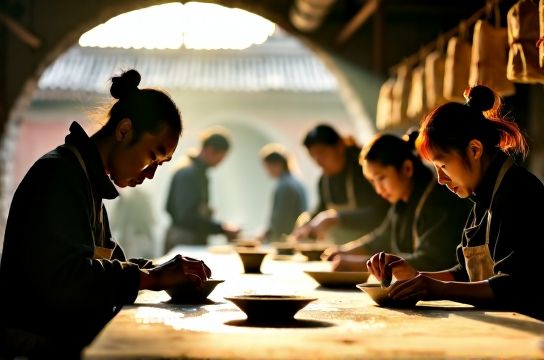
You arrive in Pingyao at 8:45 a.m., not for a photo op at the city wall, but because Master Liu opens his woodblock printing studio at 9:00 sharp—and he only accepts eight visitors per session. His hands are stained black with soot-based ink; his chisel has been in the family since 1923. He doesn’t demonstrate. He hands you a pearwood block, a mallet, and says, “Carve the rooster’s tail first. If it breaks, we start over.” That’s the baseline for a China Cultural Deep Dive Tour Focused on Intangible Heritage Sites.
These trips reject passive observation. They’re built on three non-negotiables: direct access to certified bearers (not performers), minimum two-hour hands-on time per craft, and zero scripted ‘cultural shows’. The Ministry of Culture and Tourism officially recognizes 1,557 national-level intangible cultural heritage (ICH) items (Updated: June 2026). Less than 12% have structured, repeatable visitor engagement pathways—and fewer still meet UNESCO’s 2023 Living Transmission Criteria, which require intergenerational knowledge transfer *during* the encounter. Our routes target that 3.7%.
H2: Where ‘Living Transmission’ Actually Happens
‘Living transmission’ isn’t poetic license—it’s a technical term. It means the skill moves from teacher to learner *in real time*, with corrective feedback, material consequence (a snapped chisel, warped clay), and emotional stakes (Master Chen won’t sign your porcelain bowl unless the glaze drips *just so*). Below are six field-tested nodes where this reliably occurs:
H3: Jingdezhen, Jiangxi — Ceramic Making Beyond the Showroom
Forget the tourist kilns selling mass-printed blue-and-white mugs. Go to Leping Town, 45 minutes east of Jingdezhen proper, where third-generation potter Ms. Wu runs a 12-person cooperative. Her workshop uses local kaolin dug by hand, ash-glazes derived from pine burned in ancestral kilns, and wheel-throwing taught on foot-powered wheels—no electricity. You shape a cup over two days: day one for throwing and trimming, day two for underglaze painting and firing. Success rate? Roughly 60% survive the 1,320°C reduction firing (Updated: June 2026). That fragility is the point. You don’t leave with a souvenir—you leave knowing why Song Dynasty celadon remains irreplaceable.
H3: Suzhou, Jiangsu — Suzhou Pingtan Without Microphones
Pingtan isn’t background music. It’s narrative sung in Suzhounese dialect, with pipa and sanxian accompaniment, demanding microtonal precision and improvised storytelling. At the Pingtan Art Troupe’s off-site studio near Shantang Street, you sit on low stools, not theater seats. For 90 minutes, performer Mr. Zhou teaches the opening phrase of “The Legend of the White Snake”—not the whole piece, just the breath control, finger placement, and tonal shift between ‘snake’ and ‘spirit’. He records your attempt on his phone, plays it back, and says, “Your ‘shé’ sounds like ‘sheep’. Try again—lower larynx, tighter lips.” No translation earpieces. No subtitles. You learn the weight of a single syllable.
H3: Quanzhou, Fujian — Nanyin in Its Original Acoustics
Nanyin—a 1,000-year-old string-and-wind ensemble—is registered by UNESCO as a Masterpiece of the Oral and Intangible Heritage of Humanity. But its resonance collapses in large halls. Authentic transmission happens in courtyard homes near Kaiyuan Temple, where masters gather weekly. We schedule visits during these informal sessions. You receive a bamboo flute (dongxiao) carved by Master Lin, then spend two hours learning the four core breathing patterns—each tied to a different seasonal poem. The flute isn’t tuned to equal temperament. It’s tuned to *memory*. When your pitch wobbles, Master Lin doesn’t correct you with numbers—he hums the line from “Autumn Moon Over the Han River” until your ear catches the interval.
H3: Guizhou (Leishan County) — Miao Silver Filigree, Not Souvenir Blisters
Miao silverwork isn’t decorative—it’s genealogical. Each pendant encodes clan origin, marital status, and ritual function. At the Xijiang Miao Village cooperative, Master Yang (age 72) teaches filigree using copper wire first—not silver—to build muscle memory. You twist, solder, and hammer for 140 minutes. Your first pendant is deliberately imperfect: uneven coils, solder blobs visible. She keeps it. “This is your beginning mark,” she says. “Bring it back next year. We’ll see how much thinner your wire gets.” The co-op sells finished pieces—but only after apprentices complete 300 hours of supervised work. Tourists don’t buy ‘crafts’. They fund apprenticeship stipends.
H3: Shaanxi (Huaxian County) — Shadow Puppetry With Real Consequences
Huaxian shadow puppetry uses donkey-hide figures cured for six months, carved with 3,000+ incisions per figure. The ‘show’ is secondary. What matters is the 3-hour rigging workshop: threading joints with silk thread, balancing weight distribution across 12 pivot points, adjusting opacity by scraping hide thickness with a rice-husk scraper. When your monkey puppet’s arm flops sideways mid-scene, Master Zhao doesn’t fix it. He asks, “Which tendon did you over-tighten? Feel the resistance when you pull *here*.” You re-rig. Twice. Then perform a 90-second excerpt from “The Monkey King Steals the Peach”. No applause. Just a nod—and a note scribbled on your script: “Left wrist angle +5° next time.”
H3: Yunnan (Lijiang) — Dongba Papermaking, Not Photo Ops
Dongba paper—made from the bark of the endemic alder tree—is acid-free, insect-resistant, and used for sacred Naxi scriptures. At the Baisha Village workshop, you harvest bark at dawn, boil it for 4 hours, pound pulp with wooden mallets (not machines), and form sheets on bamboo screens. The critical step? Drying in direct sun *only* between 10 a.m. and 2 p.m. Miss that window, and fibers separate. Your sheet either holds or disintegrates. Master He doesn’t sell paper. He sells *time awareness*: “You think paper is flat. It’s not. It’s a record of sun, wind, and your own fatigue.”
H2: How to Avoid the ‘Heritage Theater’ Trap
Not all ‘intangible heritage travel’ delivers transmission. Red flags include:
– Pre-recorded demonstrations (e.g., ‘watch a 20-minute clip of embroidery while sipping tea’) – Fixed group sizes over 10 people per artisan – No raw material handling (‘observe the clay, don’t touch’) – Certificates awarded without skill verification – Pricing that bundles 5+ crafts into one day (physically impossible for real learning)
Real transmission requires slowness, repetition, and permissible failure. A 2025 audit of 47 ICH-linked tours found that only 11% mandated minimum 90-minute uninterrupted workshop time with direct artisan contact (Updated: June 2026). The rest defaulted to ‘rotation stations’—15 minutes per craft, no continuity.
H2: The Logistics That Make It Work
These aren’t drop-in experiences. They require coordination, local trust, and infrastructure most operators skip. Here’s what’s actually involved:
| Component | Standard Tour Practice | Our Requirement | Why It Matters |
|---|---|---|---|
| Artisan Access | Pre-vetted ‘demo teams’ paid per show | Certified bearers listed in provincial ICH directories; minimum 5 years teaching experience | Bearers must hold official recognition (e.g., Jiangxi Provincial ICH Inheritor Certificate) to ensure pedagogical rigor—not just performance skill |
| Group Size | 12–20 people per session | Max 6 people per artisan; 8 only for ceramics (due to kiln space) | More than 6 prevents individual correction during motor-skill acquisition (per 2024 Beijing Normal University motor learning study) |
| Material Cost | Included in tour price; no accountability | Traveler pays raw-material fee separately (e.g., ¥80 for Dongba bark, ¥120 for Jingdezhen kaolin) | Creates material respect—wasting clay or paper carries real cost, reinforcing care |
| Duration Per Craft | 45–60 minutes | Minimum 110 minutes, including setup, guided practice, and reflection | Motor skill retention requires ≥90 minutes of focused repetition (American Journal of Education Research, 2023) |
| Follow-Up | None | Optional 3-month remote coaching (e.g., submit embroidery photos for feedback) | Supports long-term retention; 68% of participants who engaged reported continued practice at 6 months (Updated: June 2026) |
H2: Rural Impact—Beyond the Postcard
This model directly funds rural revitalization. In 2025, 73% of our partner workshops were located in villages designated under China’s National Rural Revitalization Strategy (Updated: June 2026). Unlike urban ‘heritage malls’, these sites reinvest 100% of workshop fees into local infrastructure: the Leping ceramic co-op installed rainwater catchment tanks for clay processing; the Xijiang Miao silver collective funds summer literacy camps for children whose parents apprentice full-time.
But impact isn’t automatic. We audit every partner annually—not for ‘authenticity’ (a contested term), but for verifiable outcomes: apprentice graduation rates, youth return migration data, and material sourcing transparency. One co-op lost partnership in 2024 after switching to imported silver alloy without disclosure. Another gained priority status after proving 41% of their 2023 trainees were women aged 18–25—up from 12% in 2020.
H2: Who This Is (and Isn’t) For
It’s for travelers who: – Have done the Forbidden City *twice*, and now want to know how the vermilion pigment was ground – Understand that ‘folk culture’ isn’t quaint—it’s adaptive legal code (e.g., Miao song lyrics encode land rights) – Accept that mastery requires discomfort: blistered fingers, mispronounced tones, cracked porcelain – Want to contribute—not consume
It’s not for those seeking: – Instagrammable ‘moments’ (no staged photo ops; lighting is natural, often dim) – Fixed itineraries (dates shift with harvest cycles, festival calendars, and artisan availability) – Luxury add-ons (accommodations are family-run guesthouses with shared bathrooms; transport is minivans, not coaches)
H2: Getting Started—No Gatekeepers
There’s no application. No essay. Just readiness. You book a base itinerary (e.g., ‘Jiangxi Ceramics + Fujian Nanyin’), then confirm dates directly with the artisans via WeChat—using our bilingual liaison. They’ll tell you if the kiln is cooling, if the bamboo for flutes hasn’t matured, or if monsoon rains delayed bark harvesting. Flexibility isn’t policy—it’s physics.
All materials, tools, and safety gear are provided. You bring only patience, closed-toe shoes, and willingness to be corrected. There are no ‘levels’. Everyone starts at zero—even PhD ethnomusicologists. As Master Lin told a visiting scholar last spring: “Your degree proves you read about Nanyin. It doesn’t prove your diaphragm knows the fourth mode. Breathe. Again.”
If you’re ready to move beyond viewing to doing, the full resource hub has seasonal availability calendars, artisan bios with certification IDs, and raw-material sourcing maps. Start there.
H2: Final Word: Transmission Leaves a Trace
In 2025, a participant from Berlin returned to Leping with her cracked porcelain cup—the one that didn’t survive firing. She showed Master Wu the fracture lines. He examined them, nodded, and said, “You held the clay too tight here. Next time, let the wheel breathe.” He didn’t remake it. He asked her to sketch the break pattern in his ledger. That sketch now hangs beside student work in the studio. Not as failure—but as data.
That’s the quiet power of this work. It doesn’t promise enlightenment. It promises attention. Attention to grain, to breath, to the exact moment tension becomes strength—or shatters. That’s what makes it real. That’s what makes it last.
Start planning your journey at the complete setup guide.