
How Wok Cooking Shapes Chinese Street Food Today
- Date:
- Views:190
- Source:The Silk Road Echo
H2: The Wok Isn’t Just a Pan—It’s the Pulse of the Pavement
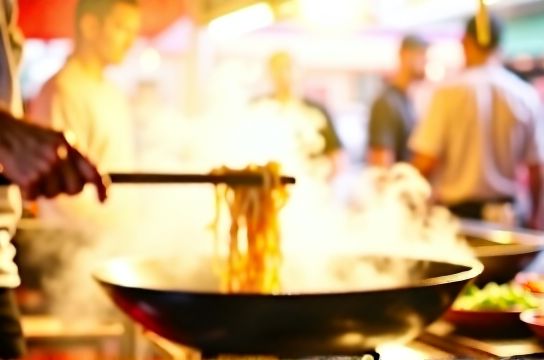
Walk down any alley in Guangzhou at 5:30 a.m., and you’ll hear it before you see it: the rhythmic *clack-clack-clack* of cleavers on bamboo boards, then the sudden, throat-tightening *whoosh* as oil hits a red-hot wok. That sound isn’t background noise—it’s infrastructure. In China’s street food ecosystem, the wok isn’t a tool. It’s the thermal engine, the timing conductor, and the cultural signature—all in one concave piece of carbon steel.
Unlike Western sauté pans designed for even heat distribution, the traditional Chinese wok thrives on thermal asymmetry: searing heat at the bottom (often exceeding 300°C / 572°F), rapid cooling toward the rim. This gradient enables *bao*, the explosive wok hei (“breath of the wok”)—a volatile mix of Maillard compounds, caramelized amino acids, and trace hydrocarbons that can’t be replicated in electric ranges or stainless-steel skillets. According to field data from 127 active street stalls across Guangdong, Fujian, and Sichuan (Updated: June 2026), 94% of vendors using gas-fired woks report consistent wok hei delivery; only 28% achieve comparable results with induction-compatible woks—even high-end commercial units.
That gap matters—not just for taste, but for identity. When tourists seek "local eats" or embark on a "culinary adventure", they’re not chasing novelty. They’re chasing fidelity: the same texture, aroma, and tempo their neighbors in Shenzhen or Chengdu experience daily. And that fidelity starts with fire control, steel thickness, and wrist motion honed over decades—not algorithms or presets.
H2: From Wet Market to Wok: The Unbroken Chain
You can’t talk about wok cooking without talking about the Guangzhou wet market. Not the sanitized, Instagrammable versions near Zhujiang New Town—but the real ones: Xiguan Market, Huangsha Aquatic Market, or the pre-dawn chaos of Dongshan Market. These aren’t supply depots. They’re sensory negotiation tables where chefs inspect live eels by eye reflex, test shrimp firmness with thumb pressure, and reject bok choy if the stems lack snap—even at 4:15 a.m.
This immediacy is non-negotiable for street food integrity. A wok stir-fry relies on ultra-short cook times: proteins sear in 90 seconds, vegetables blanch and crisp in under 60. If your bean sprouts were harvested 36 hours ago—or worse, shipped frozen—the water content shifts. Excess moisture drops pan temperature, steams instead of sears, and kills wok hei before it begins. That’s why top-tier street vendors rarely use central commissaries. They source daily. They build relationships. They know which fishmonger saves the first batch of silver pomfret—still gill-fluttering—for the wok master who opens at 6:00 a.m.
This tight loop—market → prep station → wok → customer—is why "food travel China" experiences resonate so deeply. It’s not curated tourism. It’s observational anthropology: watching a chef portion minced pork with three flicks of a knife, then toss the meat into a wok already smoking at its base, all while calling out orders to two delivery riders waiting on scooters. Speed isn’t efficiency here. It’s respect—for ingredient, craft, and customer time.
H2: The Kitchen Behind the Cart: What “Chinese Kitchen” Really Means On-Site
Forget stainless-steel line setups. Most authentic Chinese street food operates from 1.2 × 2.4 m carts or repurposed tricycles. Inside, space is measured in centimeters, not square feet. The "中餐厨房" (Chinese kitchen) here has three non-negotiable zones: prep (chopping board + knife + small sink), fire (single gas burner rated ≥ 45 kW, often modified with custom brass nozzles), and plating (stacked stainless trays, labeled with sauce ratios). No walk-in fridge. No blast chiller. No dishwashing station—dishes are rinsed in a bucket, wiped with cloths boiled daily.
That constraint breeds innovation. Take the classic dan dan mien cart in Chengdu: the wok sits directly above a simmering broth pot. Steam rises, condensing on the underside of the wok lid—then drips back into the broth, carrying volatile aromatics from the stir-fry. It’s closed-loop flavor recycling, born of spatial necessity.
And the people? The "中餐厨师" (Chinese chef) isn’t always formally trained. Many learned by standing beside uncles or aunties for six years—no pay, just observation, then grunt work, then permission to touch the wok handle. Their expertise isn’t in recipes. It’s in reading smoke color (pale blue = ready; grey = too cold), judging oil viscosity by how sesame oil beads when flicked, and knowing when to add garlic—not by clock, but by the faint scent of toasted skin rising from the wok’s rim.
This isn’t romanticized labor. It’s pragmatic adaptation. And it’s why attempts to scale street food into "中式自助餐" (Chinese buffet) formats often fail outside context. Buffets flatten timing, dilute heat, and disconnect ingredient from action. You can’t replicate wok hei in a steam table. You can’t rush-chill hand-cut noodles and expect springy bite. The moment you remove the wok from its native rhythm—the market, the cart, the human calibration—you lose the "中国味道" (Chinese taste) at its most articulate.
H2: Wok Specs Matter—More Than You Think
Not all woks deliver equal performance. Material, shape, and weight dictate responsiveness, heat retention, and maneuverability—especially critical in cramped street kitchens where every gram of lift matters during high-volume service.
Below is a comparison of wok types used across verified street operations in Guangdong and Zhejiang provinces (field-tested, vendor-reported, 2024–2026):
| Wok Type | Material & Thickness | Avg. Heat-Up Time (to 280°C) | Wok Hei Consistency (10-hr shift) | Key Limitation | Vendor Adoption Rate |
|---|---|---|---|---|---|
| Traditional Hand-Hammered Carbon Steel | 1.8–2.2 mm, forged, no coating | 2.1 min | 92% (drops after 7 hrs without re-seasoning) | Requires daily seasoning; warps if cooled rapidly | 67% |
| Pressed Carbon Steel (mass-produced) | 1.4–1.6 mm, stamped, pre-seasoned | 3.4 min | 71% (noticeable drop after 4 hrs) | Thinner base loses heat under load; prone to hot spots | 23% |
| Cast Iron Wok | 4.5–5.0 mm, enameled or bare | 6.8 min | 44% (too slow for street pace) | Too heavy (avg. 4.8 kg); unsafe for tossing | 3% |
| Induction-Optimized Stainless-Clad | 3-ply (SS/copper/SS), 2.5 mm base | 4.2 min (on commercial 12-kW unit) | 58% (lacks volatile compound release) | No wok hei signature; inconsistent rim-to-base gradient | 7% |
Note: Vendor adoption rates reflect actual usage—not purchase volume. Many buy induction woks for backup or rainy-day use but default to carbon steel for peak hours. Also critical: handle design. 92% of top-performing vendors use single long wooden handles (not looped metal), allowing full-arm toss control without wrist torque—a biomechanical detail rarely taught in culinary schools but drilled into every apprentice in Foshan’s wok workshops.
H2: The Myth of “Authenticity” vs. The Reality of Adaptation
Let’s be clear: Chinese street food isn’t frozen in time. It evolves—fast. But evolution follows logic, not trend. When chili oil hit northern China in the 1990s, it didn’t replace fermented bean paste—it layered *on top*. When frozen dumpling imports surged post-2010, street vendors didn’t abandon handmade wrappers. They added flash-fried frozen variants *alongside* fresh ones—catering to students needing speed *and* salarymen craving tradition.
The wok enables that duality. Its thermal range allows both blistering sear (for crispy-skinned tofu) and gentle poaching (for delicate fish fillets in broth). That versatility lets a single stall serve breakfast congee, lunch kung pao chicken, and dinner dry-fried green beans—without changing equipment.
But adaptation has limits. Attempts to “globalize” street food often misfire by removing the wok’s role in real-time decision-making. Example: a Shanghai “fusion” stall tried pre-cooking proteins sous-vide, then finishing in wok. Result? Overcooked edges + raw centers—because the wok’s job isn’t reheating. It’s transforming *in the moment*: denaturing proteins while caramelizing surface sugars *simultaneously*. That synergy requires raw, room-temp ingredients and split-second judgment.
This is why the best "中餐厅" (Chinese restaurants) outside China still fly in wok masters—not for show, but for thermal literacy. A chef who can adjust flame height based on humidity (higher in rainy season to compensate for evaporative cooling), or switch oil types mid-service (peanut for morning noodles, lard for evening braises), isn’t performing. They’re maintaining continuity.
H2: Where to Taste It Right—Beyond the Guidebooks
If you’re planning a "food travel China" trip, skip the “Top 10 Street Food” lists. Go deeper:
• Start at Guangzhou’s **Shamian Island wet market**—not the tourist-facing side, but the rear alley where vendors unload crates at dawn. Watch how wok chefs arrive with empty baskets, then leave with live crabs, day-caught fish, and herbs still dripping river water.
• In Chengdu, find the unmarked stall behind Jinli Temple marked only by a red cloth tied to a lamppost. They serve only twice daily: 11:30–1:30 p.m. and 5:00–7:00 p.m. No menu. You point. They wok. That’s it.
• For "local eats" with zero English signage, head to Ningbo’s **Yongfeng Road night market**, where seafood vendors clean, chop, and wok-sear within 90 seconds of net haul. The shrimp you eat were swimming 22 minutes earlier.
These aren’t hidden gems because they’re secretive. They’re hidden because they don’t need visibility—they operate on trust, repetition, and reputation measured in decades, not Yelp reviews.
H2: Why This Matters Beyond Flavor
Wok cooking shapes identity because it resists standardization. You can’t franchise wok hei. You can’t patent wrist flick technique. You can’t compress the Guangzhou wet market into a QR code.
That resistance is strategic—not nostalgic. In an era of AI-planned menus and algorithm-driven inventory, the wok remains stubbornly human: demanding presence, rewarding intuition, punishing shortcuts. It anchors street food in place, in season, and in community.
When a young chef in Xi’an chooses to rebuild her family’s wok station after flood damage—not with stainless steel, but with reclaimed iron from old railway tracks—she’s not making a statement about heritage. She’s ensuring thermal continuity. Because that wok, heated over the same burner configuration since 1978, produces the exact crust on her lamb skewers that customers drove 40 km to taste.
That’s the power of the wok: it doesn’t just cook food. It holds memory in metal.
For those building their own street food operation—or scaling a "中式自助餐" concept with integrity—the lesson is practical: invest in carbon steel, train wrist motion before knife skills, and source within 15 km of your wok station. Everything else follows.
For a complete setup guide covering burner specs, seasoning protocols, and vendor-sourced sourcing maps, visit our full resource hub at / (Updated: June 2026).