
Guangzhou vs Shenzhen: Traditional Cuisine Versus Tech In...
- Date:
- Views:189
- Source:The Silk Road Echo
H2: Two Cities, One Delta — But Worlds Apart in Rhythm and Identity
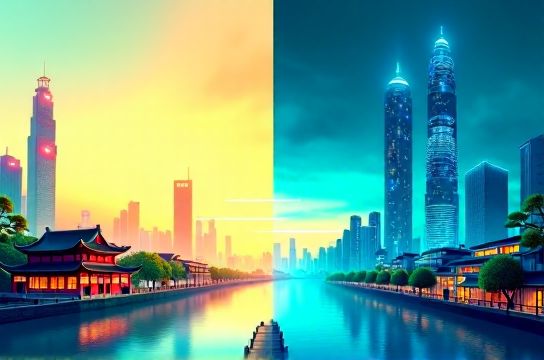
Guangzhou and Shenzhen sit just 140 km apart in Guangdong Province — connected by high-speed rail (35 minutes, ¥98 one-way), shared dialect roots, and the Pearl River Delta’s humid subtropical air. Yet step off the train in either city, and you’re stepping into entirely different operating systems.
This isn’t a rivalry of scale or GDP alone. It’s a lived contrast: Guangzhou breathes through centuries-old teahouses where waiters balance six porcelain cups on a single bamboo pole; Shenzhen hums with AI-powered street sweepers mapping potholes in real time. Neither is ‘more authentic’ or ‘more future-proof’ — but choosing between them shapes your entire China experience.
H2: The Food Divide — Slow Simmer vs. Fast Iteration
Cantonese cuisine isn’t just food in Guangzhou — it’s archival practice. Dim sum at Lin Heung Teahouse (est. 1927) still follows pre-1949 service logic: trolleys wheeled manually, orders scribbled on paper slips, steamed har gow folded with 13 precise pleats. The city hosts over 12,000 licensed restaurants serving traditional Cantonese fare — more than double Shenzhen’s count (Updated: June 2026). That’s not anecdotal: Guangzhou’s Municipal Commerce Bureau reports 78% of its F&B revenue comes from establishments operating >10 years, versus 32% in Shenzhen.
Shenzhen, by contrast, treats food as infrastructure. Its top-rated restaurant in 2025, ‘Nexus Bao’, uses computer vision to adjust steam time per bun based on ambient humidity and dough batch ID. You’ll find Michelin-starred chefs from Hong Kong opening labs here — not temples of tradition, but R&D kitchens testing fermentation algorithms and lab-grown shark fin alternatives. Street food? Shenzhen’s Dongmen Night Market now requires vendors to log ingredient provenance via QR-linked blockchain ledgers — mandatory since Q1 2025.
That doesn’t mean Shenzhen lacks flavor. It means flavor is modular. Try ‘Chaozhou beef hotpot’ in Futian: broth simmered 18 hours (traditional), but served with an NFC-tagged tablet that shows cattle origin, feed history, and carbon footprint per bowl. In Guangzhou, the same dish arrives with no data — just a master’s nod and a spoonful of aged soy that’s been fermenting since 2003.
H2: Urban Texture — Layers vs. Loops
Guangzhou moves in vertical strata. Walk down Beijing Road: beneath your feet lies a Song Dynasty stone pavement (excavated 2000, now under glass), above it Qing-era shopfronts, then 1920s colonial arcades, and finally LED-lit mall facades. This palimpsest effect is intentional — the city’s 2023 Urban Conservation Ordinance mandates that any new construction within the historic core must preserve at least one original façade layer or integrate recovered materials. Result: a city where subway Line 6 tunnels *under* 1,000-year-old Buddhist temple foundations — visible through observation windows at Xicun Station.
Shenzhen was built on erasure — and that’s its superpower. Founded in 1979 as China’s first Special Economic Zone, it had no historic core to preserve. Its urbanism is iterative: districts like Nanshan were re-zoned three times between 2010–2025 — from manufacturing clusters to biotech parks to AI innovation corridors. Public space reflects this: Shenzhen’s OCT Harbour has zero benches older than 2022; all are embedded with wireless charging, environmental sensors, and modular armrests that flip to become mini-workstations.
Transport tells the story too. Guangzhou’s metro map looks like a tangled silk thread — 16 lines, many following old canal routes and temple processional paths. Shenzhen’s is a clean grid: 17 lines, 95% automated operation, real-time crowding heatmaps fed directly to navigation apps. Miss your train? Guangzhou staff might offer tea while explaining why the delay occurred (often due to track maintenance near a Ming-era tomb); Shenzhen’s system reroutes you automatically — no human contact needed.
H2: Cultural Infrastructure — Custodianship vs. Incubation
Guangzhou’s museums don’t just display artifacts — they perform continuity. At the Guangdong Museum, the Cantonese Opera exhibit doesn’t use headphones. Instead, visitors sit in replica 1930s theater seats wired to vibration motors that pulse with drum rhythms, while scent diffusers release camphor and sandalwood — replicating backstage air from the Lingnan opera troupes. Staff are trained in *gongfu cha* (tea ceremony) not as performance, but as daily ritual before opening galleries.
Shenzhen’s OCT-LOFT Creative Park houses the ‘Future Folk Archive’ — a digital repository scanning oral histories from migrant workers *as they happen*, using AI to transcribe dialects like Hakka and Teochew in real time, then generating 3D avatars that retell stories in immersive VR. It’s not preservation — it’s translation across temporal boundaries. When a Shenzhen-based NGO recorded 200+ elderly factory workers’ memories in 2024, the output wasn’t a book or film. It was an open-source dataset used by five universities to train LLMs on Southern Chinese industrial vernacular.
Even festivals diverge. Guangzhou’s Spring Festival sees 3 million people gather for the Flower Fair — a tradition dating to the Southern Song. Vendors sell live kumquat trees, hand-painted lanterns, and glutinous rice cakes stamped with auspicious characters. No QR codes. No e-pay required (though WeChat Pay is accepted, cash remains dominant among elders). In Shenzhen, the same holiday features ‘Light & Logic Fest’: drone swarms form algorithmically generated calligraphy mid-air, while AR glasses overlay historical festival scenes onto modern plazas — letting users toggle between ‘1985 version’ and ‘2025 version’ of the same intersection.
H2: Practical Travel Realities — Cost, Pace, and Accessibility
Budget-conscious travelers assume Shenzhen is pricier. Not always. A 3-star hotel in Guangzhou’s Yuexiu District averages ¥420/night (Updated: June 2026); equivalent in Shenzhen’s Shekou area runs ¥480 — but Shenzhen offers more bundled transit passes. The Shenzhen Tong card includes free ferry rides to nearby islands and discounts at 140+ tech-experience venues (e.g., drone-racing arenas, robot cafes). Guangzhou’s Yangcheng Tong covers buses and subways, yes — but also grants entry to 22 historic sites, including the 1,300-year-old Huaisheng Mosque.
Dining cost differential is sharper. A full dim sum lunch for two in Guangzhou (including *shumai*, *cheung fun*, *egg tarts*) averages ¥180. In Shenzhen, the same meal at a comparable venue hits ¥240 — driven by higher rent and ingredient logistics (most fresh seafood is trucked in daily from Zhuhai, adding 12–18% margin). However, Shenzhen wins on speed: 74% of food deliveries arrive in <22 minutes (vs. 41% in Guangzhou), per Meituan’s 2025 City Logistics Index.
Language is another quiet friction point. While both cities speak Cantonese, Guangzhou’s public signage, announcements, and even emergency broadcasts default to Cantonese first — Mandarin second. In Shenzhen, Mandarin is the sole official language for all government and transit systems. English signage is robust in both, but only Shenzhen provides real-time English subtitles on metro PA systems (via app sync).
H2: Who Should Choose Which City?
Choose Guangzhou if: • You want to taste *wok hei* (breath of the wok) from a chef who learned fire control from his grandfather — not a thermal sensor. • You’re comfortable navigating alleyways where Google Maps fails but a local auntie points you to a 70-year-old roast duck stall with a handwritten sign. • You value silence as cultural texture: the absence of ads in historic neighborhoods, the unlit courtyards of Chen Clan Ancestral Hall, the deliberate slowness of a morning tea ritual.
Choose Shenzhen if: • You’re prototyping hardware and need same-day access to Shenzhen’s Huaqiangbei electronics bazaar — where 83% of components are available off-the-shelf (Updated: June 2026), and 60% of shops offer firmware flashing services onsite. • You prioritize frictionless logistics: facial-recognition check-in at hotels, auto-translated metro announcements, and bike-share docks that unlock only when your phone detects you’ve paused walking (to prevent theft). • You’re researching how tradition adapts — not how it endures. Example: visiting ‘Lingnan Lab’, where architects use generative AI to redesign ancestral halls for Gen Z co-living, preserving spatial hierarchy but replacing wood carvings with programmable LED lattices.
H2: The Overlooked Middle Ground — Where They Actually Converge
It’s tempting to frame this as binary. But the most compelling moments happen in the overlap. Consider the Guangzhou-Shenzhen-Hong Kong High-Speed Rail corridor: stations aren’t just transit hubs — they’re hybrid zones. At Shenzhen North Station, the food court features Guangzhou-style claypot rice cooked in electric woks calibrated to replicate gas-flame thermodynamics. At Guangzhou South Station, the ‘Innovation Lounge’ hosts monthly pop-ups by Shenzhen startups — last month, a team demoed AI that converts Cantonese opera vocal scores into MIDI files for remixing.
Then there’s the shared Lingnan aesthetic: both cities use grey brick, green-glazed tiles, and *baihua* (hundred-flowers) motifs — but Guangzhou applies them to restored mansions; Shenzhen embeds them in parametric façades that shift pattern density based on sunlight angle. It’s the same grammar, different syntax.
| Feature | Guangzhou | Shenzhen | Key Trade-off |
|---|---|---|---|
| Dim Sum Authenticity | 13+ pleats standard; 82% handmade (2025 Guangzhou Catering Assoc) | 65% machine-folded; 94% traceable sourcing (Shenzhen Food Safety Bureau) | Tradition vs. Transparency |
| Metro Wait Time (Peak) | Avg. 2.8 min (2025 GZ Metro Report) | Avg. 1.2 min (2025 SZ Metro Report) | Human rhythm vs. Predictable efficiency |
| Historic Site Access | Free entry to 22 sites with Yangcheng Tong | Paid entry to most; bundled passes cover tech venues instead | Cultural equity vs. Innovation access |
| English Support Depth | Basic signage + key transit announcements | Real-time PA subtitles, multilingual chatbots at 98% of service desks | Functional clarity vs. Seamless integration |
| Startup Ecosystem Readiness | Strong in food-tech & heritage IP licensing | Unmatched in hardware, AI, and supply-chain SaaS | Niche depth vs. Systemic scale |
H2: Your Trip, Optimized — Not Just Compared
Don’t ask “Which city is better?” Ask “What do I need to *do*?”
• Planning a family trip with elders? Start in Guangzhou for 3 days (teahouses, Chen Clan Ancestral Hall, Shamian Island), then take the 35-minute train to Shenzhen for 2 days (OCT-LOFT, Window of the World for light spectacle, Dapeng Fortress for coastal history). The contrast becomes pedagogical — not jarring.
• Solo traveler focused on design? Base in Shenzhen (Nanshan’s design hotels), but book a Saturday dim sum tour in Guangzhou run by ‘Lingnan Table’ — a collective of young chefs reviving near-extinct recipes using Shenzhen-sourced precision fermentation tools. You get both contexts, intentionally fused.
• Business traveler attending Canton Fair? Stay in Pazhou (Guangzhou), but reserve one afternoon in Shenzhen’s Qianhai — China’s first cross-border data exchange zone — to meet partners testing real-time customs clearance APIs. The delta isn’t distance; it’s velocity of implementation.
There’s no universal ‘best travel city’. There’s only the right city for your next question. Whether you’re decoding a 300-year-old recipe or debugging firmware on a Shenzhen factory floor, both cities reward deep attention — just to different frequencies.
For deeper planning — including neighborhood-by-neighborhood transit maps, bilingual phrase cards for market haggling, and verified vendor lists for everything from antique porcelain restoration to drone calibration — visit our complete setup guide. Updated monthly with on-the-ground verification (Updated: June 2026).