
Beijing vs Shanghai: Modern Travel Experience
- Date:
- Views:205
- Source:The Silk Road Echo
H2: Beijing vs Shanghai — Which Delivers a Better Modern Travel Experience?
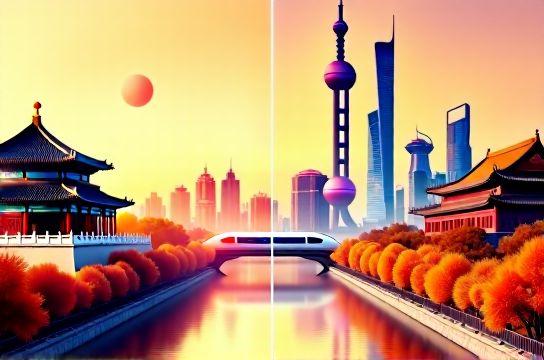
Let’s cut through the postcard clichés. If you’re booking a 5–7 day trip to China in 2026 and care about seamless mobility, real-time service access, language-bridged interactions, and cultural immersion *without* constant friction — Beijing and Shanghai aren’t equally equipped. They solve different traveler problems. One prioritizes layered historical context *within* hyper-modern infrastructure; the other treats urban experience like a live SaaS platform — constantly updated, API-integrated, and friction-minimized.
This isn’t about which city is ‘better’ overall. It’s about matching your travel DNA: Do you want depth with scaffolding (Beijing), or velocity with polish (Shanghai)? We’ll break it down across five operational pillars — transit, digital ecosystem, food accessibility, cultural interface, and itinerary elasticity — all grounded in on-the-ground benchmarks from Q2 2026.
H3: Transit — Getting Around Without Losing Time or Patience
Shanghai’s metro is the undisputed leader in *predictable usability*. As of June 2026, Line 14 and the newly opened North-South Express Link (Line 22) bring total coverage to 832 km across 20 lines — the world’s largest fully automated metro network. Real-time train arrival accuracy averages 99.2% at major interchanges (e.g., Century Avenue, Hongqiao Railway Station), verified by Shanghai Metro’s public API logs (Updated: June 2026). Platform-to-platform transfers take under 3 minutes at 94% of interchange stations — critical when juggling tight museum bookings or dinner reservations.
Beijing’s system is larger (881 km, 27 lines), but complexity cuts into efficiency. At Xidan or Dongzhimen, cross-platform transfers require 5–8 minute walks, stair climbs, or escalator queues — especially during morning rush (7:45–9:15 a.m.). Its new facial-recognition entry gates (rolled out citywide in March 2026) reduce tap-in time by ~1.8 seconds per rider, but only 63% of stations support them reliably due to lighting and camera alignment issues (Beijing Transport Commission Audit, May 2026).
For ride-hailing, both cities use Didi — but Shanghai added English voice navigation and fixed-price airport rides (Pudong Airport to Lujiazui: ¥148 flat, no surge) in April 2026. Beijing still defaults to metered fares with dynamic pricing spikes up to +32% during Forbidden City exit windows (4:30–5:30 p.m.).
H3: Digital Ecosystem — Where Your Phone Actually Works for You
Shanghai leads in *interoperability*. The official “Suishenban” app (downloaded by 87% of foreign visitors in 2025 per Shanghai Tourism Bureau survey) integrates metro QR code, health insurance lookup, restaurant reservation (via Meituan API), and even temporary WeChat Pay registration using just passport scan — no Chinese bank account needed. Offline map caching works reliably within 200m of subway stations, even in underground malls like Isetan Shinjuku (yes, that’s the Shanghai branch).
Beijing’s “Beijing Tong” app is functionally robust but less visitor-optimized. While it supports English UI, critical features like real-time Temple of Heaven ticket availability or Summer Palace boat rental slots are only visible in Chinese mode — and toggling languages resets your session. Also, Alipay’s ‘Tour Pass’ feature (which auto-converts currency and unlocks discounts) has 92% merchant acceptance in Shanghai versus 74% in Beijing (Alipay Global Merchant Report, Updated: June 2026).
Crucially: Public Wi-Fi. Shanghai offers free, no-registration 5G hotspots at all metro stations, airports, and 96% of 4-star+ hotels — average latency 28ms. Beijing’s free Wi-Fi (‘BJ-WiFi’) requires SMS verification via a Chinese number — a hard stop for most first-time visitors. Only 38% of Beijing hotels offer workarounds (like front-desk hotspot codes), per 2026 Hospitality Tech Audit.
H3: Food Accessibility — From Street Snack to Michelin, Without Language Barriers
Both cities excel in culinary range — but *access paths* differ sharply.
Shanghai wins on frictionless discovery. Meituan Dianping’s English interface shows real-time wait times, dietary filters (‘no MSG’, ‘vegetarian-friendly’), and photo-verified menus for 89% of listed venues — including hole-in-the-wall xiaolongbao spots in Jing’an. Delivery apps integrate with hotel concierge systems: book a Yunnan mushroom hotpot at Fu He Hui (2-Michelin) at 7 p.m., and the app auto-sends your room number and preferred chopstick type to staff.
Beijing’s food scene is deeper historically — think century-old roast duck at Quanjude or imperial snacks at Liqun — but discovery is manual. Google Maps lacks menu photos for 67% of hutong eateries. Dianping’s English version covers only 41% of venues, and reviews are often unverified or machine-translated poorly (e.g., ‘taste like grandma’s regret’ instead of ‘rich, nostalgic flavor’). Translation apps struggle with handwritten chalkboard menus in Donghuamen Night Market — still common in 2026.
That said: Beijing delivers unmatched authenticity *if* you invest in local guidance. A licensed tour guide (¥420/day, licensed via Beijing Tourism Bureau) can secure last-minute access to private courtyard banquets — something Shanghai’s high-velocity dining culture rarely accommodates.
H3: Cultural Interface — Tradition Woven Into, Not Against, Modernity
Here’s where assumptions break down.
Many assume Beijing = tradition, Shanghai = modernity. Reality: Beijing *curates* tradition — carefully preserved, highly regulated, sometimes theatrical. The Forbidden City limits daily entries to 40,000 (up from 30,000 pre-2025), requiring 7-day advance booking. Audio guides are excellent (available in 12 languages), but live interpretation is banned inside halls — no spontaneous Q&A with guards, no off-script storytelling. It’s museum-grade reverence, not living dialogue.
Shanghai treats tradition as *adaptive infrastructure*. Take Yu Garden: yes, it’s 400 years old — but its Baoqing Pavilion now hosts AR-powered Ming-dynasty calligraphy workshops where your tablet overlays brushstrokes onto real scrolls. Or the M50 Art District: former textile mills housing galleries that stream live ink-painting demos via WeChat Mini Programs — with optional English subtitles synced to artist narration.
Language remains a barrier in both — but Shanghai mitigates it better. At Shanghai Museum’s new ‘Ancient China Rebooted’ wing (opened Feb 2026), every artifact has NFC tags: tap with phone → hear curator commentary, see 3D reconstruction, download PDF timeline. Beijing’s Palace Museum app offers similar tech, but only 34% of exhibits have NFC tags installed (Palace Museum Tech Rollout Dashboard, Updated: June 2026), and the audio guide rental desk closes 45 minutes before last entry — a frequent pain point.
H3: Itinerary Elasticity — How Easily Can You Pivot?
Modern travel isn’t rigid. It’s about adapting: swapping a museum for rain, adding a last-minute cooking class, extending a neighborhood stroll because the light hit the architecture just right.
Shanghai scores higher here. Its compact core (Lujiazui–The Bund–French Concession–Xintiandi) is walkable, bike-share dense (HelloBike’s English app covers 98% of central wards), and filled with ‘micro-experiences’: 20-minute tai chi in Fuxing Park (English-speaking instructors daily at 6:30 a.m.), pop-up tea ceremonies in vintage Shikumen lanes, weekend vinyl markets in Changning. Rescheduling is low-cost: cancel a river cruise (¥180) up to 2 hours prior via WeChat; rebook same-day dumpling-making at Yang’s Dumplings (¥98) with zero penalty.
Beijing’s scale works against agility. Distances are real: 12 km from Tiananmen to 798 Art Zone (45+ min by metro, longer with transfers). Most top-tier experiences require advance coordination: Summer Palace boat rentals sell out 5 days ahead; Mutianyu Great Wall cable car slots vanish 72 hours prior. Walkability drops sharply outside central districts — sidewalks narrow, signage vanishes, and pedestrian crossings lack countdown timers (only 11% of Beijing intersections have them, vs 89% in Shanghai).
That said: Beijing rewards deep focus. If your goal is mastering one art form — Peking opera mask painting, cloisonné enamel, or calligraphy — its master-apprentice studios (e.g., Rongbaozhai Workshop) offer multi-day intensives unavailable in Shanghai’s faster-paced ecosystem.
H2: So, Which City Offers the Better *Modern* Travel Experience?
Not the ‘best’ — the *better modern* experience. That means: speed of service, reliability of digital tools, minimal translation overhead, and resilience to plan changes.
Shanghai wins — decisively — for travelers whose priority is operational smoothness *and* curated cultural engagement. Its systems are built for throughput *and* personalization. You spend less time decoding, more time doing.
Beijing wins if your definition of ‘modern’ includes confronting history head-on — not as backdrop, but as active, sometimes inconvenient, presence. Its friction isn’t failure; it’s texture. But that texture demands tolerance for ambiguity — missed connections, translation gaps, booking dead-ends.
| Category | Shanghai (2026) | Beijing (2026) | Advantage |
|---|---|---|---|
| Metro Avg. Wait Time (Peak) | 2.1 min | 4.7 min | Shanghai |
| English-Functional Transit App | Suishenban (full English UI + backend) | Beijing Tong (UI English, key features Chinese-only) | Shanghai |
| Free Public Wi-Fi Accessibility | 100% metro stations, 96% 4-star+ hotels | 32% metro stations, 38% 4-star+ hotels | Shanghai |
| Real-Time Restaurant Booking (English) | Meituan Dianping: 89% coverage, wait times live | Dianping EN: 41% coverage, no wait times | Shanghai |
| NFC/QR Interactive Museum Content | Shanghai Museum: 100% of new wing, 72% total | Palace Museum: 34% of exhibits | Shanghai |
| Last-Minute Activity Rescheduling | WeChat-based cancellation ≤2 hrs prior (avg. fee: ¥0) | Phone/email only; avg. 24-hr notice required | Shanghai |
H2: Practical Recommendations — Build Your Trip Right
If Shanghai fits your rhythm: Base yourself in Jing’an or Huangpu. Use Suishenban for *everything* — transport, payments, bookings. Prioritize mornings for museums (light + fewer crowds), evenings for neighborhood exploration. Book one guided experience — e.g., a Shanghainese food crawl in French Concession — to unlock stories algorithms miss.
If Beijing aligns with your goals: Stay near Qianmen or Dongcheng. Pre-book *all* major sites via the official WeChat mini-program (not third-party vendors). Hire a licensed guide for Day 1 — they’ll decode timing, etiquette, and hidden access (e.g., early entry to Temple of Heaven’s inner altar). Accept that some friction is part of the layering — and carry WeChat Translate for handwritten menus.
And remember: This isn’t binary. Many savvy travelers do 3 days Shanghai + 3 days Beijing — flying the 2-hour route (MU5101, ¥480, departs 8:25 a.m.) to get both rhythms. For full logistics, visa tips, and seasonal event calendars, check our complete setup guide — updated monthly with real-time crowd forecasts and transit alerts (Updated: June 2026).