
Shaoxing vs Jinhua Shaoxing Wine Versus Dongyang Woodcarving in Zhejiang Culture
- Date:
- Views:235
- Source:The Silk Road Echo
Let’s cut through the noise: when people talk about Zhejiang’s intangible cultural treasures, two names consistently rise to the top—Shaoxing yellow wine and Dongyang woodcarving. But here’s what most overlook: they’re not just regional crafts—they’re UNESCO-recognized traditions with measurable economic and cultural footprints.
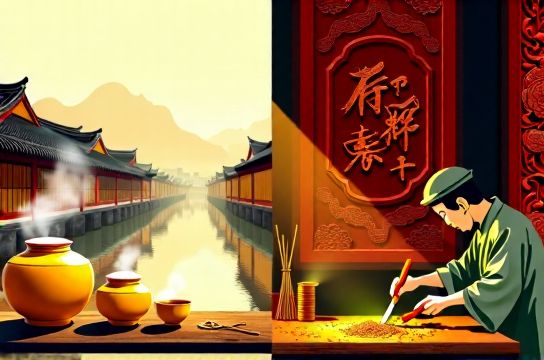
Shaoxing wine isn’t ‘just rice wine.’ It’s aged using a 2,500-year-old method, fermented in clay jars buried underground during winter. In 2023, Shaoxing produced over 187,000 kiloliters—nearly 70% of China’s total yellow wine output (Zhejiang Bureau of Statistics). Meanwhile, Dongyang woodcarving—designated a National Intangible Cultural Heritage in 2006—supports over 12,000 artisans across 320 workshops, generating ¥1.42 billion in annual revenue (Dongyang Culture & Tourism Bureau, 2024).
Here’s how they compare head-to-head:
| Dimension | Shaoxing Wine | Dongyang Woodcarving |
|---|---|---|
| UNESCO Status | Part of ‘Traditional Chinese Yellow Wine Brewing’ (ICH 2020) | National ICH (2006); submitted for UNESCO review (2025 cycle) |
| Average Craft Mastery Timeline | 12–15 years (master brewer certification) | 10–18 years (‘Three Carving Masters’ title requires ≥3 major commissions) |
| Export Reach (2023) | 58 countries; top 3: Japan, South Korea, USA | 41 countries; top 3: Singapore, Canada, Germany |
What ties them together? Both rely on hyper-local inputs—Shaoxing’s Jianshui spring water and glutinous rice from Yuyao—and Dongyang’s native nanmu and huanghuali hardwoods. Neither scales via automation: each Shaoxing jar is hand-sealed; each woodcarving panel undergoes ≥7 hand-chiseling stages.
So which matters more? Neither. They’re complementary expressions of Zhejiang’s philosophy: *‘Wen yi zai dao’* (culture embodies the Way). One nourishes the body and ritual; the other shapes space and memory.
If you’re exploring authentic Zhejiang heritage—whether for research, sourcing, or cultural travel—I recommend starting with hands-on experiences: a guided tasting at Guyue Longshan Brewery or an apprentice-led carving demo in Hengdian. And if you’re serious about preserving such traditions, support starts with understanding—not just consumption.
For deeper insights into how these crafts shape regional identity and sustainable livelihoods, explore our full analysis on Zhejiang’s living heritage ecosystem.