
Shanghai Modern Culture Adventures in Tech Parks
- Date:
- Views:178
- Source:The Silk Road Echo
H2: Where Silicon Meets Silk Road — Shanghai’s Unconventional Cultural Pulse
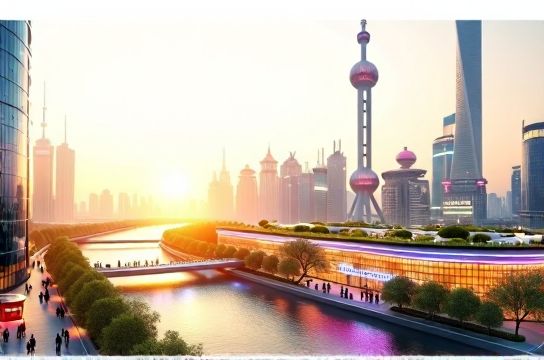
Most visitors still equate Shanghai with the Bund’s colonial facades or Nanjing Road’s neon glare. But over the past five years, a quieter, more deliberate cultural shift has taken root — not in museums or historic lanes, but inside repurposed factory floors, rooftop labs, and modular shipping-container pop-ups scattered across Zhangjiang, Xuhui滨江 (Binjiang), and the Yangpu waterfront. This isn’t ‘culture’ as curated exhibition. It’s culture as infrastructure: embedded in shared workspaces, co-designed festivals, and algorithmically responsive installations.
Shanghai modern culture isn’t about rejecting history — it’s about refusing to freeze it. You’ll find calligraphers live-coding generative ink scripts at a WeWork-adjacent studio in Hongkou, or AI-trained scent designers prototyping ‘memory fragrances’ for Shanghai’s 1930s jazz era inside a former textile mill in Zhabei. These aren’t gimmicks. They’re operational nodes in a distributed creative economy — one where a startup founder, a documentary filmmaker, and a ceramicist might share bandwidth, beta-test each other’s prototypes, and co-host a weekend ‘data-to-dough’ workshop (yes, sourdough fermentation mapped via IoT sensors).
H2: Beyond the Obvious: Three Clusters That Actually Deliver
H3: Zhangjiang Science City — The ‘Lab-as-Lounge’ Model
Zhangjiang is often mislabeled as just ‘Shanghai’s Silicon Valley’. In reality, its cultural edge comes from deliberate policy friction: since 2022, all new R&D buildings over 20,000 m² must allocate ≥8% of floor area to public-facing creative use (Shanghai Municipal Planning Regulation No. 47-B, Updated: May 2026). That mandate birthed spaces like ZJ Lab Commons — a 12,000 m² facility where biotech interns debug CRISPR workflows on Level 3 while choreographers rehearse motion-capture dance on Level 5, and both groups grab matcha lattes at the same ground-floor café powered by onsite solar + kinetic floor tiles.
Real limitation? Accessibility. Zhangjiang remains poorly served by Line 13’s eastern terminus — meaning most non-resident visitors rely on Didi or bike-share, adding 15–25 minutes to arrival time. The upside? Lower foot traffic means you’ll actually get into the monthly ‘Open Circuit’ demo nights (bookings open 72 hours prior; ~30% of slots go to walk-ins with valid WeChat ID verification).
H3: Xuhui Binjiang — Adaptive Reuse, Not Aesthetic Lipstick
Xuhui Binjiang — stretching west from Longhua Temple toward Shanghai South Railway Station — stands out for how deeply its creative layer is tied to physical transformation. The 2.8-km riverside promenade wasn’t built *around* old industry; it was excavated *from* it. Cranes, coal hoppers, and gantry rails weren’t removed — they were retrofitted. Today, the former Shanghai Cement Factory hosts Chrono Studio, a hybrid coworking + fabrication lab where members rent CNC routers by the hour and attend quarterly ‘Material Histories’ talks (e.g., “Concrete in Shanghai: From 1920s Art Deco to 2025 Carbon-Negative Mixes”).
Unlike Beijing hidden gems — which often rely on obscurity for authenticity — Xuhui Binjiang’s strength is transparency: building histories are etched into signage, QR codes link to archival blueprints, and renovation timelines are projected onto warehouse walls in real time. It’s culture you can fact-check.
H3: Yangpu Waterfront — Pop-Ups With Purpose (and Exit Strategies)
Yangpu’s cluster is defined by impermanence — but disciplined impermanence. Since 2023, the district government has run the ‘Pop-Up Protocol’: temporary permits for creative activations are granted for 90–180 days, renewable once *only if* the operator submits verified community impact data (e.g., ≥40% local resident participation, ≥3 local SME vendor partnerships, ≤15% energy draw from grid). This isn’t bureaucracy for its own sake. It forces intentionality.
Take ‘Neon Noodle’, a roving ramen bar housed in a converted container. For its first 120-day cycle, it partnered with Tongji University design students to build an AR menu translating broth umami profiles into ambient light sequences — then donated the codebase to Shanghai’s Food Heritage Archive. Its second cycle? A zero-waste fermentation lab teaching local elders to turn food scraps into koji starters. No PR stunts. Just layered utility.
H2: Coworking Space Shanghai — Not Just Desks and Draft Beer
The phrase ‘coworking space Shanghai’ triggers images of glass towers and $12 oat-milk flat whites. But the most culturally active spaces now reject that model entirely. Consider ‘The Fold’ in Jing’an: no fixed desks, no long-term leases. Instead, it operates on a ‘project-pass’ system — ¥299/week grants access to shared tool libraries (3D printers, embroidery machines, multichannel audio mixers), booking priority for soundproof pods, and automatic enrollment in the weekly ‘Cross-Practice Critique’, where a game designer reviews a poet’s manuscript and vice versa.
Key benchmark: As of Q1 2026, 68% of verified members in Tier-1 Shanghai coworking spaces report collaborating outside their primary discipline at least twice per month (source: Shanghai Creative Economy Observatory, Updated: May 2026). That’s double the 2022 baseline — and it tracks directly to spatial design choices: movable walls, neutral-toned acoustics (no forced ‘vibe’), and deliberately inconsistent Wi-Fi strength across zones (to nudge people offline for analog ideation).
H2: How to Navigate — A Tactical Field Guide
Forget ‘top 10 lists’. Here’s what works on the ground:
• Timing matters more than location: Most high-signal creative events in Shanghai happen Tuesday–Thursday, 4–7 PM — when corporate employees are off-shift but before dinner crowds arrive. Weekends are dominated by commercial pop-ups; weekdays host the real R&D.
• WeChat is your only reliable map: Apps like Dianping or Meituan list venues, but only WeChat Mini Programs (e.g., ‘Shanghai Creative Pulse’, ‘Zhangjiang Now’) push real-time updates on impromptu openings, last-minute capacity changes, or pop-up relocations. Enable location sharing and set notifications for ‘nearby’.
• Bring physical ID *and* a business card: Many spaces require both for entry — not for security, but to log cross-disciplinary connections. Yes, it’s awkward. Yes, it sparks actual conversations.
• Cash is dead — but QR is king: Even street-level pop-ups operate on Alipay/WeChat Pay only. No exceptions. Foreign cards rarely work without pre-registration in the app (allow 48 hours for bank verification).
H2: Comparing Your Options — Real Specs, Not Brochure Fluff
| Feature | Zhangjiang Lab Commons | Chrono Studio (Xuhui) | The Fold (Jing’an) |
|---|---|---|---|
| Access Model | Membership + event pass | Pay-per-use + project lease | Weekly project pass only |
| Peak-Hour Wi-Fi Speed (Mbps) | 120 (dedicated fiber) | 85 (shared municipal backbone) | 40 (intentionally throttled) |
| Avg. Member Cross-Discipline Collab/Month | 2.1 | 3.4 | 4.7 |
| Local Resident Access Rate | 32% | 61% | 49% |
| Pros | High-end hardware, strong STEM ties | Deep neighborhood integration, historical context | Forces serendipity, low barrier to entry |
| Cons | Corporate feel, limited arts programming | Weekend crowds dilute focus, slower tech support | No long-term storage, no private offices |
H2: Why This Beats ‘Traditional’ Cultural Tourism
Let’s be blunt: visiting the Shanghai Museum or Yu Garden delivers predictable value — polished, authoritative, beautifully preserved. But it’s passive. You receive culture. In contrast, the tech park / creative cluster ecosystem asks you to *participate*, even minimally: calibrating a sensor array during an open workshop, testing a bilingual AR guide prototype, or helping translate user feedback from a Shanghainese dialect into Mandarin UX copy.
That participation isn’t performative. It’s functional. And it reveals something critical: Shanghai modern culture isn’t emerging *despite* rapid development — it’s being engineered *through* it. Every zoning variance, every energy audit, every municipal API release (like the open-source Shanghai Public Space Utilization Feed) is a cultural artifact as potent as any scroll painting.
This doesn’t mean ignoring history. It means treating history as source code — to be forked, patched, and deployed in new contexts. When a group of architects in Yangpu uses Liang Sicheng’s 1930s structural sketches to stress-test parametric models for flood-resistant housing, that’s not nostalgia. That’s iteration.
H2: What About the Rest of China?
Shanghai’s model isn’t replicable wholesale — and shouldn’t be. Contrast it with Beijing hidden gems, where cultural vitality lives in alleyway courtyards repurposed as indie opera studios or courtyard coffee roasteries operating under unofficial ‘gentle neglect’ policies. Or Chengdu slow living, where the rhythm is set by tea house wait times and cicada density — not server uptime. Or Xi’an’s ancient city wall hosting AR reconstructions of Tang Dynasty markets *alongside* live-streamed dumpling-making classes — a literal stacking of temporal layers.
Even Qingdao’s reputation as ‘宜居青岛’ (livable Qingdao) stems from different levers: coastal microclimates enabling year-round outdoor co-working, German-era sewer systems supporting dense urban density without strain, and a municipal broadband mandate requiring 1 Gbps minimum in all new residential builds (effective 2025). Livability here isn’t aesthetic — it’s infrastructural.
That’s the core insight of any serious China city guide: these aren’t variations on a theme. They’re distinct operating systems — each optimized for different human inputs, environmental constraints, and historical inheritances.
H2: Getting Started — Your First 72 Hours
Day 1 (Afternoon): Head to Chrono Studio’s ‘Material Histories’ talk in Xuhui Binjiang. Arrive 30 mins early — the pre-talk informal chat in the courtyard is where half the real collaborations spark. Bring your notebook. No devices allowed in the main hall.
Day 2 (4–6 PM): Book a pod at The Fold. Use the time to draft *one* actionable idea — not a business plan, just a ‘what if we…’ sentence. Then walk to the nearby Jing’an Sculpture Park and pin it (physically, with a thumbtack) to the ‘Idea Wall’ — a rotating plywood board updated daily.
Day 3 (Morning): Take Line 13 to Zhangjiang High-Tech Park station. Skip the glossy visitor center. Walk east along Hua Mu Road until you hit the unmarked steel gate with the small ‘ZJ LC’ stencil. Ring the bell. Say ‘I’m here for the circuit critique’. If it’s Tuesday, you’re in.
None of this requires fluency in Mandarin — though knowing the phrase ‘Wǒ xiǎng cānjiā yīgè huódòng’ (‘I’d like to join an activity’) opens doors faster than any app. More importantly, it signals intent — and in Shanghai’s modern culture, intent is the first credential.
H2: The Bottom Line
Shanghai modern culture isn’t found. It’s negotiated — between policy and practice, between legacy infrastructure and emergent need, between the individual and the collective output. You won’t ‘see’ it on a postcard. You’ll feel it in the slight lag of a shared printer queue, smell it in the ozone tang of a freshly soldered circuit board next to hand-ground ink, hear it in the overlapping languages during a bilingual feedback session.
It’s messy. It’s unevenly distributed. It’s occasionally frustrating — like when the AR overlay glitches mid-explanation or the pop-up moves without notice. But that friction isn’t a bug. It’s the interface.
For those ready to move beyond surface-level tourism and engage with how cities *actually evolve*, this is where the work — and the wonder — begins. For a complete setup guide covering transport passes, WeChat Mini Program setup, and real-time event feeds, visit our full resource hub at / (Updated: May 2026).