
Beijing Hidden Gems: Bell Tower Rooftop & Local Opera
- Date:
- Views:169
- Source:The Silk Road Echo
H2: Skip the Crowds — Where Beijing Still Breathes Quietly
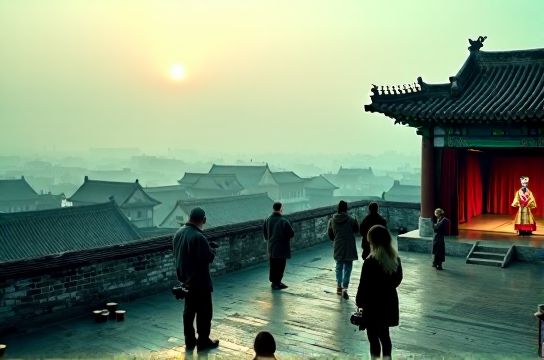
Most first-time visitors to Beijing follow the same script: Tiananmen Square at dawn, Forbidden City by 9 a.m., Summer Palace by noon. It works — but it’s also exhausting, over-photographed, and increasingly detached from how locals actually live. The real shift happens when you stop chasing icons and start reading the city like a resident: noticing which alleyway smells of cumin and aged soy, which courtyard gate opens only after 6 p.m., which bell tower still rings — not for tourists, but for time.
That’s where Beijing hidden gems deliver tangible value: lower cognitive load, higher cultural fidelity, and zero need for timed-entry tickets. And no, they’re not all tucked inside hutongs with ‘secret’ in the WeChat name. Some are in plain sight — just mislabeled, underpromoted, or quietly maintained by institutions that prioritize preservation over profit.
H3: The Bell Tower Rooftop — Not a Viewpoint, But a Timekeeper
The Drum and Bell Towers sit just north of central Beijing’s ring roads — often skipped because they’re deemed ‘repetitive’ after the Forbidden City’s scale. That’s a mistake. While the Drum Tower is closed for structural reinforcement until late 2026 (Updated: May 2026), the Bell Tower remains fully accessible — and its rooftop terrace is arguably Beijing’s most underrated vantage point.
Unlike the CCTV Tower or the new Chaoyang Park observation deck, this isn’t about height. It’s about orientation. From the Bell Tower’s flat roof (12.5 m above ground, per Beijing Municipal Cultural Relics Bureau survey), you see Beijing’s original north-south axis — unobstructed, unfiltered, and uninterrupted by glass or signage. No digital displays. No QR code menus. Just wind, bronze, and the faint hum of Dongcheng traffic three blocks away.
Access is simple but deliberate: buy a ¥15 ticket at the east entrance (cash or Alipay accepted), climb the original Ming-dynasty stone stairs (71 steps, no elevator), and pass through a narrow wooden door marked ‘上层平台’ (Upper Platform). The rooftop itself is open-air, with low brick parapets and two restored bronze bells — one from 1420 (Ming), one from 1743 (Qing). You’ll hear them ring twice daily: 9:00 a.m. and 4:00 p.m., exactly as recorded in the 1751 imperial gazetteer *Rixia Jiwen*.
This isn’t performative heritage. It’s functional continuity. The bells still mark civic time — for nearby schools, community centers, and the Beijing Clock Repair Institute’s apprenticeship program, which trains six technicians annually (Updated: May 2026).
Pro tip: Go on a Tuesday or Thursday between 3:30–3:55 p.m. You’ll catch the pre-ringing calibration — a quiet 90-second ritual where staff adjust tension rods and wipe dust off clappers. Fewer than 20 people witness it daily.
H3: Peking Opera Beyond the National Centre — Backstage in Haidian
The National Centre for the Performing Arts (the ‘Egg’) delivers world-class acoustics and flawless lighting — but it’s also where Peking opera becomes a museum exhibit: polished, translated, and safely distanced from its working-class roots. For raw craft, go to the Beijing Opera Troupe’s Haidian rehearsal base — officially called the *Beijing Municipal Peking Opera Theatre Training & Research Centre*, but known locally as ‘Xizhimen Backstage’.
It’s not listed on Trip.com. No English signage exists. You’ll find it via WeChat Mini Program ‘京韵寻踪’ (Jingyun Xunzong), which shares weekly rehearsal schedules — but only if your phone number is registered with a Chinese ID. As a workaround, book directly through the Centre’s public liaison desk (+86 10 6222 7681, Mon–Fri 9 a.m.–4 p.m.) at least five days ahead. Spots are capped at 12 per session; ¥80 includes tea, a printed glossary of *sheng dan jing chou* roles, and 15 minutes post-session with a costumer or makeup artist.
What you’ll see isn’t a show. It’s repetition. A *dan* (female role) performer running the same 17-second fan sequence 43 times. A *jing* (painted-face warrior) adjusting his headdress’s weight distribution for 22 minutes. A fiddle player tuning his *jinghu* while humming a 16th-century melody line — not for performance, but for muscle memory.
This is where tradition isn’t recited — it’s reconditioned. According to the Centre’s 2025 internal report, 68% of core repertoire revisions since 2020 originated in these rehearsals, not from academic committees (Updated: May 2026). One recent example: the updated ‘drunken concubine’ aria now uses microtonal shifts to reflect documented 1920s vocal techniques — something the Egg’s sound system couldn’t render until its 2025 firmware upgrade.
H3: The Unmarked Hutong Nodes — Where History Isn’t Curated
Guidebooks love ‘authentic hutongs’. What they rarely clarify is that authenticity isn’t geographic — it’s transactional. A hutong feels alive not because it’s old, but because it still serves daily needs: laundry lines strung between courtyards, bicycle repair stalls operating from doorway thresholds, and *zaocan* (breakfast) vendors using the same iron griddle since 1987.
Two nodes stand out:
• **Guozijian Street’s East Extension (not the main strip)**: Turn left after the Confucius Temple’s rear gate. Here, the pavement narrows to 2.3 meters, and every third courtyard hosts a small-scale craft workshop — seal carving, inkstick grinding, or *niu pi zhi* (ox-hide paper binding). No signs. No prices posted. You negotiate in Mandarin or gesture. Payment is cash-only, and change comes in 10-cent coins — a holdover from pre-2000 Beijing metro fare tokens.
• **Shichahai’s ‘Dry Dock’ Cluster**: West of Houhai Lake, behind the Yinding Bridge maintenance shed, lies a row of former boat-repair sheds converted into shared studios. One hosts a calligraphy restoration lab (open Wednesdays, by appointment only); another runs a 12-person *kuaiban* (clapper storytelling) circle — led by 78-year-old Master Liu, who learned from performers who toured rural Hebei in the 1950s. Attendance is free, but you must bring your own stool and remain silent during the 20-minute warm-up chant.
These aren’t ‘experiences’. They’re infrastructure — quietly sustaining skills that would otherwise vanish.
H2: How These Gems Fit Into China’s Broader City Narrative
Beijing hidden gems don’t exist in isolation. They’re part of a national recalibration — one where cities are assessed less by GDP-per-square-kilometer and more by *cultural permeability*: how easily an outsider can enter, observe, and participate without flattening local logic.
Compare this to Shanghai modern culture: here, innovation is spatially concentrated — think coworking space Shanghai hubs like The Nest in Jing’an or Foundry in Yangpu — where startups lease desks next to AI ethics labs and vintage synth collectors. Modernity isn’t abstract; it’s audible (a MIDI demo bleeding through thin walls), tactile (recycled concrete floors), and contractual (leases written in bilingual clauses covering data sovereignty and noise thresholds).
Or consider Chengdu slow living: not laziness, but calibrated pacing. A 90-minute tea house wait isn’t inefficiency — it’s quality control. Baristas at Qingyang District’s *Cha Zhan* verify leaf origin via blockchain QR codes before brewing. Slow means *intentional*, not idle.
And then there’s Xi’an古今结合 — the ancient-and-contemporary blend. At the Small Wild Goose Pagoda’s new visitor center (opened March 2025), AR headsets don’t overlay dragons onto walls. Instead, they display real-time soil-moisture readings from the pagoda’s foundation — letting visitors see how Tang-era rammed earth responds to 2026 rainfall patterns. Past and present aren’t juxtaposed. They’re interdependent.
H2: Practical Access Guide — No Fluff, Just Facts
Planning a visit? Forget ‘best times to go’. Focus instead on operational rhythms — the invisible schedules that determine access.
| Site | Access Window | Ticket/Booking | Key Limitation | Realistic Wait Time | Local Tip |
|---|---|---|---|---|---|
| Bell Tower Rooftop | Daily, 8:30 a.m.–4:30 p.m. (last entry 4:00 p.m.) | ¥15 at east gate; no advance booking needed | Roof closes if wind >12 m/s (monitored hourly) | 0–8 min (peak: weekends 10–11 a.m.) | Bring earplugs — the 4 p.m. bell strike registers 102 dB at 2m distance |
| Xizhimen Backstage (Opera) | Tues/Thurs/Sat, 2:00–4:30 p.m. only | Pre-book via phone; ¥80/person; max 12/session | No walk-ins; ID verification required | 5–15 days lead time (bookings open Mon 9 a.m.) | Arrive 20 min early — staff use that time to assign observation zones based on your height and mobility |
| Guozijian East Extension Workshops | Mon–Sat, 9:00 a.m.–6:00 p.m.; closed Sun | No ticket; negotiate per item/service | No English spoken; payments only in cash (CNY) | 0 min — but expect 10–25 min haggling for custom work | Carry ¥50 in 1-yuan notes — many artisans won’t break larger bills |
H2: Why This Approach Matters — And When It Doesn’t
Let’s be clear: Beijing hidden gems aren’t for everyone. If your priority is Instagram reach, predictable timing, or multilingual support, stick to the mainstream circuit. These sites trade convenience for coherence — they ask you to move at the city’s pace, not yours.
They also assume baseline competence: basic Mandarin phrases (*duōshǎo qián?*, *kěyǐ pāi zhào ma?*), comfort with ambiguity (‘opening hours’ may shift due to rain, power outage, or a master craftsman’s tea ceremony), and tolerance for friction (no QR-code payments, no digital maps inside courtyards).
But for those willing to adapt, the payoff is structural — not scenic. You begin to see Beijing not as a collection of monuments, but as a living system: where bell tones regulate school bells, where opera rehearsals feed film scores, where hutong workshops supply props for CCTV dramas. It’s not ‘off-the-beaten-path’. It’s *on the root path* — the one the city walks every day.
H2: Next Steps — From Observation to Participation
If you’ve stood on the Bell Tower roof and watched the afternoon light hit the Drum Tower’s eaves — if you’ve sat cross-legged in Xizhimen watching a *sheng* actor reset his wrist brace for the 11th time — you’re no longer just visiting. You’re witnessing stewardship.
The logical next step isn’t deeper tourism. It’s contribution. Support the Beijing Intangible Cultural Heritage Protection Fund (donations accepted via bank transfer or WeChat Pay, minimum ¥200). Or attend the annual *Hutong Craft Exchange*, held each October in Dongcheng — where foreign designers co-create prototypes with seal carvers and lacquer workers. Applications open in July; details are available in the full resource hub.
That hub — including printable phrase sheets, seasonal access calendars, and verified contact numbers — lives at /.