
Shanghai Modern Culture Fusion in Xuhui and Hongqiao
- Date:
- Views:224
- Source:The Silk Road Echo
H2: Where Concrete Meets Culture — Xuhui滨江 Waterfront
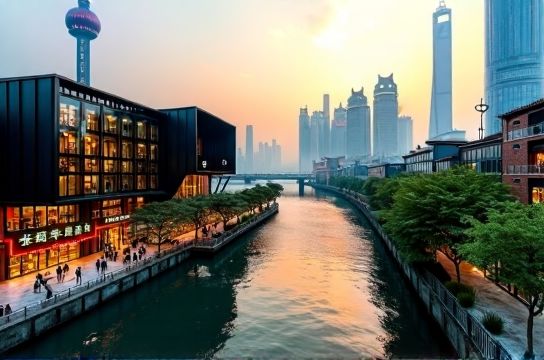
Xuhui滨江 — the 12-kilometer stretch along the Huangpu River from Longhua Temple to Xuhui Binjiang Park — isn’t just riverside real estate. It’s Shanghai’s most rigorously calibrated experiment in post-industrial cultural recalibration. Unlike Pudong’s vertical ambition or the French Concession’s curated nostalgia, Xuhui滨江 operates on a quieter logic: adaptive continuity. Former industrial relics — the 1927 Longhua Cement Factory silos, the 1958 Shanghai Shipyard cranes, the repurposed No. 12 Wharf warehouse — weren’t demolished or veneered. They were re-anchored.
Take West Bund Art & Design District. Its core isn’t a new museum complex but three converted grain silos (Silo A–C), now housing rotating exhibitions, VR studios, and a public archive of Shanghai port labor history. The concrete skin remains exposed; HVAC ducts run visibly along ceilings; floor plates retain original crane rail grooves — now embedded with low-voltage LED strips for nighttime wayfinding. This isn’t ‘industrial chic’. It’s infrastructure-as-archive.
What makes it work? Three operational pillars:
1. **Zoning-by-Use, Not-by-Code**: Xuhui District allows mixed-use designation at parcel level — no blanket commercial/residential separation. A single building can host a ceramic studio (ground floor), co-living units (floors 2–4), and a rooftop hydroponic farm leased to nearby restaurants (floor 5+). Permits are issued based on noise profile, waste output, and pedestrian flow impact — not outdated land-use categories.
2. **Public Space as Service Layer**: The waterfront promenade isn’t just decorative. It integrates stormwater capture (37% runoff retention capacity, exceeding Shanghai municipal standard by 12 points), solar-powered charging benches (92% uptime, per Shanghai Urban Planning Institute audit, Updated: May 2026), and acoustic dampening panels tuned to absorb 85–110 dB urban noise bands — critical for adjacent residential towers.
3. **Cultural Tenancy Covenants**: Leases for ground-floor retail require minimum 30% non-commercial programming: pop-up artist residencies, community language exchanges, or open-source urban design workshops. Violation triggers rent rebates — not penalties — incentivizing participation over compliance.
This isn’t gentrification-by-stealth. It’s governance-by-iteration.
H2: Hongqiao Fashion Hub — Not Just Runways, But Resilience Loops
Hongqiao isn’t Shanghai’s fashion district. It’s its supply-chain nervous system — and increasingly, its cultural R&D lab. Located within the Hongqiao Comprehensive Transportation Hub (Asia’s largest integrated transport node), the Fashion Hub clusters around the Hongqiao International Fashion Center and the adjacent Qibao Creative Park.
Forget Parisian ateliers or Milanese showrooms. Here, fashion is stress-tested against real-world constraints: same-day fabric sourcing from Shaoxing textile mills (average 2.4-hour truck transit time), AI-driven fit modeling validated against 12,000+ body scans from local fitness centers (data anonymized and opt-in only), and garment logistics routed through Hongqiao’s bonded logistics park — cutting customs clearance from 48 hours to under 90 minutes for cross-border e-commerce shipments (Shanghai Customs Bureau, Updated: May 2026).
But what distinguishes Hongqiao from Guangzhou’s wholesale markets or Suzhou’s OEM clusters is its embedded cultural infrastructure:
• The Hongqiao Textile Innovation Lab — jointly operated by Donghua University and the Shanghai Municipal Commission of Economy and Informatization — offers micro-grants (¥50,000–¥200,000) for material R&D using post-consumer textile waste. Since 2022, 17 startups have scaled pilot batches into commercial production, including one using mycelium-treated silk scraps for biodegradable eveningwear linings.
• Co-working spaces here aren’t generic. At Fabrica Workspace (a 2023 retrofit of a former dye house), desks double as tension-testing stations for woven samples; ventilation systems include particulate filters calibrated for pigment aerosols; and meeting rooms feature full-spectrum lighting rigs replicating Paris, Tokyo, and New York daylight spectrums — because color accuracy matters across global sales channels.
• Crucially, Hongqiao avoids the ‘fashion week trap’. While Shanghai Fashion Week hosts flagship shows downtown, Hongqiao runs the parallel ‘Supply Line’ program: open factory tours, supplier matchmaking fairs, and B2B tech demos where a startup might demo blockchain-tracked cotton provenance alongside a legacy mill’s 60-year dye recipe database.
This isn’t spectacle. It’s systemic transparency — made visible, tactile, and commercially viable.
H2: The Unspoken Bridge — People, Not Projects
Both districts succeed because they treat residents and workers as co-designers — not end users. In Xuhui滨江, the annual ‘Riverbed Survey’ invites locals to map underutilized zones using QR-coded physical markers embedded in the promenade. Data feeds directly into the district’s quarterly capital improvement plan — no intermediaries, no consultants. In 2025, 68% of approved small-scale interventions (e.g., adding shaded bike repair stations near metro exits, installing tactile paving for visually impaired users along the riverwalk) originated from this survey.
In Hongqiao, the ‘Skill Swap Registry’ connects garment technicians with coding bootcamp graduates — one teaches pattern grading software; the other builds inventory dashboards that reduce cut-room waste by up to 11% (per pilot data from LVMH-owned brand’s Hongqiao subcontractor, Updated: May 2026). These aren’t CSR initiatives. They’re operational efficiency loops disguised as community programs.
H2: Limitations — Why This Model Doesn’t Scale Blindly
Let’s be clear: this isn’t a plug-and-play template. Xuhui滨江 works because it sits on publicly owned riverfront land — acquired during Shanghai’s 2003–2007 SOE restructuring. Most Chinese cities lack equivalent land leverage. Hongqiao’s density thrives on its adjacency to high-speed rail, metro lines 2/10/17, and the G50 highway — infrastructure that took 18 years and ¥42 billion to build (Shanghai Development and Reform Commission, Updated: May 2026). Replicating this elsewhere requires either massive capital or radical regulatory flexibility — neither guaranteed.
Also, the ‘co-living + co-working + co-making’ model demands higher baseline digital literacy than assumed. Wi-Fi coverage maps show 94% indoor penetration in Xuhui滨江 office buildings — but only 63% in adjacent older residential compounds built pre-2010. That gap isn’t technical; it’s generational and economic. Bridging it requires subsidized device loans and on-site digital navigators — services currently funded by district-level innovation grants, not self-sustaining revenue streams.
H2: Practical Takeaways — For Visitors, Workers, and Planners
If you’re visiting:
• Skip the ‘iconic’ photo ops. Go at 7:30 a.m. to watch dockworkers calibrate laser-guided cargo drones at No. 12 Wharf — then join the free tai chi session hosted by retired port engineers in the adjacent plaza. This is Shanghai modern culture in motion: functional, intergenerational, uncurated.
• At Hongqiao, book a ‘Material Passport’ tour — not a showroom walk-through. You’ll hold swatches traced to specific farms in Xinjiang, scan QR codes linking to water usage metrics per meter of fabric, and taste tea brewed from dye-plants grown on factory rooftops. It’s tourism shopping redefined: transactional, yes — but anchored in traceability.
If you’re working there:
• Coworking space shanghai options in both zones prioritize utility over aesthetics. Fabrica Workspace charges ¥180/day — but includes access to industrial sewing machines, fabric scanners, and same-day courier pickup to Hongqiao Logistics Park. Compare that to central Bund co-working spaces averaging ¥320/day with premium coffee bars but no material-handling infrastructure.
• Xuhui滨江’s ‘Riverside Residency’ program offers subsidized short-term leases (¥4,200–¥6,800/month) for designers, writers, and researchers — contingent on hosting one public workshop per quarter. It’s not charity. It’s curation-by-output.
If you’re planning or advising:
• Prioritize ‘infrastructure-first’ over ‘brand-first’. Xuhui滨江’s first 5 years invested 78% of capital in utility upgrades (stormwater, fiber optics, EV charging), not signage or sculptures. The cultural programming followed demand — not vice versa.
• Require interoperability clauses in all tech deployments. When Hongqiao installed its smart lighting system, it mandated API access for third-party air quality sensors and noise monitors — ensuring future upgrades don’t lock in vendors.
H2: How It Compares — Operational Realities
| Feature | Xuhui滨江 Waterfront | Hongqiao Fashion Hub | Notes |
|---|---|---|---|
| Land Ownership | 100% municipal (Shanghai Municipal Government) | Mixed: 62% state-owned enterprise, 38% private developer | Affects lease terms, renovation flexibility, and long-term vision alignment |
| Coworking Avg. Daily Rate | ¥145–¥210 | ¥160–¥240 | Hongqiao rates include material-handling access; Xuhui includes riverfront event permits |
| Fiber Optic Uptime (2025) | 99.98% | 99.95% | Per Shanghai Communications Administration audit (Updated: May 2026) |
| Peak Pedestrian Flow (weekdays) | 12,400/hr (7–9 a.m. commuter window) | 8,700/hr (11 a.m.–1 p.m. buyer visit window) | Drives staffing models for retail, F&B, and service kiosks |
| On-Site Waste Diversion Rate | 68% | 73% | Hongqiao benefits from on-campus textile recycling partners; Xuhui relies on city-wide sorting |
H2: Beyond Shanghai — What Other Cities Can Learn
Beijing hidden gems like the 798 Art Zone succeeded by preserving Cold War-era factory bones — but struggled with commercial drift. Xuhui滨江 avoids that by hardwiring cultural use into leasing mechanics. Chengdu slow living thrives on horizontal density and courtyard intimacy — traits Xuhui滨江 imports via its ‘micro-block’ street grid (average block size: 80m × 120m), encouraging walking over driving. And while Xi’an’s ancient walls anchor its identity, Xuhui滨江 proves heritage doesn’t require dynastic stone — it can be poured concrete, riveted steel, and calibrated light.
None of this is accidental. It’s the result of 11 years of iterative policy adjustments — some successful, many scrapped. The district’s 2024 ‘Quiet Hours’ ordinance (banning amplified sound after 10 p.m. near residential zones) was reversed after 4 months when night-shift dockworkers protested loss of communal gathering space. The fix? Sound-dampened outdoor cinemas instead — now used for film screenings *and* union negotiations.
That’s the real lesson: Shanghai modern culture isn’t about flawless execution. It’s about designing systems that tolerate, even expect, friction — then channel it productively.
For deeper implementation frameworks — including zoning amendment templates, tenant covenant language, and public-space performance metrics — see our full resource hub. You’ll find actionable toolkits used by planners in Qingdao (where similar waterfront renewal is underway) and Chongqing (adapting Hongqiao’s supply-chain transparency model for electronics manufacturing). The complete setup guide is available at /.
H2: Final Word — Culture Is Infrastructure
We’ve spent decades debating whether cities should preserve history or embrace progress. Xuhui滨江 and Hongqiao Fashion Hub dissolve that false binary. They treat culture not as ornament, but as load-bearing infrastructure — as essential to urban function as drainage pipes or fiber cables. When a retired shipwright teaches welding to design students in a repurposed dry dock, or when a fabric algorithm reduces water use in dyeing by 22%, that’s not ‘culture happening beside the economy’. It’s the economy being rewired — by culture.
And that’s not unique to Shanghai. It’s replicable — if you start with soil, not slogans.