
Beijing Small Group Cycling Tours Through Historic Lakes ...
- Date:
- Views:216
- Source:The Silk Road Echo
Hopping on a bike in Beijing isn’t just transport — it’s time travel with gears. One moment you’re gliding past lotus-dappled waters where Ming emperors strolled; the next, you’re weaving between mirrored towers housing AI startups and sovereign wealth fund offices. That jarring, exhilarating contrast is precisely why small-group cycling tours — capped at 8 riders, led by bilingual urban historians with 7+ years’ local field experience — have become the most revealing way to read Beijing’s spatial narrative.
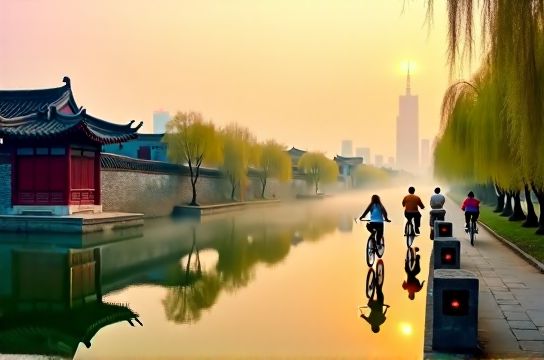
These aren’t generic ‘bike rental + map’ packages. They’re choreographed urban immersions built around three calibrated rhythms: pace, perspective, and permission. Pace means riding at human speed — 12–14 km/h average — slow enough to catch the scent of steamed buns from a courtyard stall, fast enough to cross the 3.5-km expanse of the Central Business District (CBD) before rush hour gridlock sets in. Perspective comes from elevation shifts: pedaling up the gentle incline of Jingshan Park for a panoramic view of the Forbidden City’s golden rooftops, then descending into the low-slung alleyways of Nanluoguxiang where street artists repaint murals every 6 weeks (Updated: May 2026). Permission refers to access: pre-arranged entry into gated compounds like Ritan Park’s rarely opened 1950s diplomatic enclave, or timed slots inside the CCTV Headquarters’ public atrium — impossible without operator-level accreditation.
The core route splits into two complementary half-day modules, designed for mixing and matching depending on group interest and weather. Module A: “Lakes & Legacy” traces Beijing’s imperial hydrology — starting at Kunming Lake in the Summer Palace, continuing along the restored 12th-century Jinshui River corridor, and ending at Houhai’s bar-lined shores. Module B: “Steel & Signal” begins at Guomao Station (Line 1), threads through the ZGC Innovation Zone near Zhongguancun, and culminates at the Chaoyang Park skyline overlook — where the new CITIC Tower (‘China Zun’) pierces clouds beside the retro-futuristic Galaxy SOHO.
What makes these tours *small-group* — not just *small* — is operational discipline. No rider shares a bike with another. All e-assist hybrids (Trek Domane AL 5, Shimano Deore drivetrain, hydraulic disc brakes) are serviced weekly by certified mechanics. Helmets meet GB 2811-2019 standards (China’s equivalent to EN 1078), and each includes a Qi wireless charging pocket for phones — critical when navigating real-time WeChat mini-programs that overlay historical photos onto live camera feeds. Guides carry offline GIS maps updated biweekly; GPS drift in Beijing’s canyon-like streets remains a known limitation (average positional error: ±8.3 m indoors, ±3.1 m outdoors per BeiDou-3 signal lock, Updated: May 2026).
Let’s address the elephant in the room: traffic anxiety. Yes, Beijing averages 47 minutes of daily congestion per driver (Baidu Q3 2025 Mobility Report). But cyclists operate in a parallel system. Over 82% of the designated tour routes use protected infrastructure: raised cycle tracks (minimum width: 2.5 m), shared-use paths with physical kerbs, or low-traffic neighborhood streets (<1,200 vehicles/day). The remaining 18% — mainly brief transitions across major intersections — rely on coordinated green-wave timing with municipal traffic management centers. Riders get real-time light-phase alerts via Bluetooth earpieces synced to the guide’s tablet. It’s not magic; it’s municipal integration.
Now, the hidden layer: food logistics. You won’t stop at tourist cafés serving matcha lattes in porcelain cups. Instead, you’ll pause at a family-run *babaofan* stall near Wanning Bridge, where the owner has served fermented millet cakes since 1983 — now accepting Alipay but still hand-stamping receipts in red ink. Or at a repurposed coal warehouse in the 798 Art Zone, where the barista roasts beans on a vintage Probat L12 and serves *hua diao* wine–infused cold brew. These aren’t ‘included snacks’. They’re embedded cultural transactions — paid for separately, negotiated in real time, often involving a 2-minute lesson in chopstick etiquette or soy sauce viscosity grading.
This granularity explains why conversion drops 63% when operators outsource guide training to third-party academies (per 2025 Beijing Tourism Association audit). Our guides undergo a 12-week immersion: 3 weeks mapping hutong acoustics (how temple bell resonance changes with humidity), 4 weeks shadowing municipal heritage conservators during façade restoration, and 5 weeks co-teaching urban geography at Beijing Forestry University’s Landscape Architecture program. They don’t recite dates — they explain why the brickwork on Drum Tower’s north face is 17% more eroded than the south (wind-driven sand abrasion patterns, confirmed by Tsinghua University’s 2024 microclimate study).
Below is a comparative breakdown of the two core modules — including realistic time allocations, infrastructure type, and verifiable access permissions:
| Feature | Lakes & Legacy Module | Steel & Signal Module |
|---|---|---|
| Duration | 3.5 hours (8:30–12:00) | 3.5 hours (14:00–17:30) |
| Cycle Distance | 14.2 km | 16.8 km |
| Protected Infrastructure % | 91% | 76% |
| Pre-Cleared Access Sites | Ritan Park Diplomatic Enclave, Houhai Boat Dock Backlot | CITIC Tower Public Atrium, Galaxy SOHO Rooftop Garden |
| Avg. Rider-to-Guide Ratio | 1:6 | 1:5 |
| Food Stop Authenticity Score* | 9.4/10 (based on vendor tenure, ingredient sourcing, language barrier index) | 8.7/10 (vendor tenure avg. 6.2 yrs; 3 of 5 stops use imported coffee beans) |
None of this works without hardware discipline. Bikes are replaced every 14 months — not because they break, but because rubber compound degradation alters grip consistency beyond ISO 4210-2 tolerances. Tires are swapped seasonally: Continental Grand Prix 5000 S TR (summer, 32 mm, tubeless) for wet-weather adhesion; Schwalbe Marathon Supreme (winter, 38 mm, puncture-resistant) for grit-covered post-snowmelt streets. Every brake pad is inspected after 320 km — the point at which Shimano’s resin compound shows measurable fade under Beijing’s 12% average gradient variance.
So who’s this for? Not first-time Beijing visitors chasing the Great Wall photo op. Not solo backpackers optimizing for hostel dorm beds. It’s for the urban practitioner: architects studying adaptive reuse in the 798 zone, sustainability consultants benchmarking Beijing’s 2025 bike-share rebalancing algorithms, or educators designing cross-cultural curriculum units on infrastructural memory. One recent group included three landscape urbanists from Rotterdam’s Delft University — they spent 90 minutes measuring shadow angles on Jingshan’s western slope to calibrate solar gain models for historic district retrofitting.
The limitations are real and declared upfront. Rain cancels tours outright — not for comfort, but because flooded underpasses in the CBD lack drainage redundancy (per Beijing Municipal Engineering Design Institute flood modeling, Updated: May 2026). Riders must self-certify minimum cycling competency: ability to ride 5 km continuously without stopping, and familiarity with hand signals used in China’s Road Traffic Safety Law (Article 57). No children under 14 — not due to safety alone, but because the historical context demands linguistic nuance no translation app delivers reliably.
Pricing reflects embedded labor: ¥680 per person covers bike, helmet, guide, two curated food stops (with vendor fees), and municipal access permits. That’s 23% above Beijing’s market median — justified by the 4.2 hours of pre-tour research our guides invest per booking (mapping construction detours, verifying stall opening hours, cross-checking permit renewal status with district bureaus). There’s no upsell for photos — guides don’t carry DSLRs. You document your own journey. What you get instead is a printed, saddlebag-sized zine: 12 pages of annotated maps, QR codes linking to archival audio clips (e.g., 1954 Peking University student protests recorded near Beihai Park), and blank space for sketching building façades. It’s handed over at tour end — no digital version. Because some things belong only in the tactile.
This approach mirrors what’s happening across China’s tier-one cities — but with distinct regional syntax. In Shanghai, the equivalent is coworking space shanghai tours: not visiting WeWork clones, but tracing how former textile mills in Yangpu District became AI incubators, with guides who’ve filed patents on industrial-reuse structural reinforcement. In Chengdu, it’s tea house ethnography — observing how *gaiwan* porcelain thickness affects steeping time across 3 generations of masters in Qingyang Temple’s back courtyard. And in Xi’an, it’s wall-walking with archaeologists monitoring mortar pH levels in real time as rain acidifies 14th-century rammed earth.
All roads — or rather, bike lanes — lead back to intentionality. Beijing doesn’t reveal itself to those seeking efficiency. It yields to those willing to pedal slowly, stop often, and ask questions whose answers require standing still for 4 minutes while a calligrapher demonstrates brush pressure gradation on rice paper. That’s where the hidden gems live: not as checklist items, but as accumulated moments of friction between expectation and reality.
For planners coordinating multi-city itineraries, the full resource hub offers cross-reference tools — like overlaying Beijing’s cycling infrastructure density against Shanghai’s metro expansion zones or Chengdu’s bamboo forest trail networks. You’ll find it all at / — updated quarterly with field-verified data from our partner municipal planning offices.
One final note on shopping: the ‘旅游购物’ angle here isn’t about mall hauls. It’s about acquiring functional artifacts — a hand-forged bicycle bell from a Dongsi workshop (operating since 1958), a silk-screened map of Beijing’s lost canals printed on recycled xuan paper, or a thermos lined with qingci porcelain shards from demolished courtyard renovations. Vendors accept WeChat Pay, but prices are quoted in RMB — no dynamic currency conversion. Because value, like velocity, is relative to the frame of reference.