
Discover the Best Local Eats Using Wok and Walk Food Trav...
- Date:
- Views:198
- Source:The Silk Road Echo
H2: Skip the Tourist Traps — Eat Where Locals Actually Do
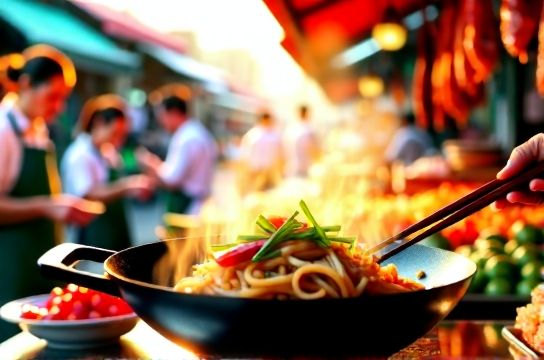
You’re standing outside a neon-lit ‘authentic’ dumpling shop near Beijing’s Wangfujing, menu translated in three fonts, staff handing out QR codes for WeChat Pay before you’ve even stepped inside. The dumplings arrive — perfectly uniform, steamed with clinical precision, served on white porcelain. They’re fine. But they’re not *local*.
Real local eats in China don’t live behind glass cases or glossy laminated menus. They live where the wok hits 300°C in under two seconds, where the fish still flaps at the stall counter, and where lunch is ordered by pointing, nodding, and a quick thumbs-up. This isn’t about ‘finding the best’ — it’s about recognizing the right signals: steam rising from a blackened wok, the rhythmic *clang-clang* of a cleaver on bamboo, the scent of aged soy hitting hot oil just as you round the alley corner.
That’s where Wok & Walk begins.
H2: Your First Move Isn’t Google — It’s the Wet Market
Forget Michelin stars. Start at the wet market — especially Guangzhou’s Qingping Market or Chengdu’s Gaoshengqiao Market. These aren’t photo ops. They’re operational hubs: live eel tanks gurgling beside mountains of lotus root, pork belly stacked on ice with butcher’s chalk marks still visible, dried longan hanging like amber beads above baskets of fresh goji berries.
Why wet markets first? Because they dictate the rhythm of local eats. Vendors close by 11 a.m. — meaning the nearby breakfast stalls (congee, youtiao, preserved egg tofu) source ingredients *that morning*. A vendor who sells only morning batches of hand-pulled noodles won’t be open past noon. That’s not a limitation — it’s a quality gate.
Key signal: If the stall has no refrigeration but the meat looks bright red and smells clean (not metallic or sour), that’s freshness verified by nose and eye — not a label. (Updated: June 2026)
H3: What to Buy — And Why It Matters for Your Meal
• Live river shrimp: Look for active antennae and translucent shells. Used within hours in stir-fries or steamed with ginger and Shaoxing wine. • Preserved mustard greens (suan cai): Fermented 30–45 days, sold in ceramic crocks. Adds umami depth to soups and fried rice — a flavor impossible to replicate with store-bought versions. • Duck blood curd: Firm, dark maroon, slightly gelatinous. Sourced same-day from abattoirs adjacent to major wet markets. Appears in spicy Sichuan hot pots or braised with tofu skin.
Don’t buy to cook — buy to observe. Watch how the vendor rinses bok choy three times in different tubs. Note which chef grabs the same cut of pork shoulder from the same stall every day. That’s your next stop.
H2: The Wok Is the Compass — Learn to Read Its Language
A proper Chinese street wok isn’t stainless steel. It’s carbon steel — heavy, blackened, seasoned over years. You’ll know it’s alive when:
• It *hisses* when cold food hits — not sputters. That means surface temp is ≥280°C. • The flame wraps *up* the sides, not just licks the bottom. Gas pressure matters: street vendors in Guangzhou use dual-burner LPG rigs delivering 18–22 kW (vs. home stoves averaging 2.5–3.5 kW). (Updated: June 2026)
The sound tells you more than the smoke:
- Sharp *shhhhk!* → high-heat sear (e.g., beef in black bean sauce) - Low *thrum-thrum* → controlled simmer (braised pork belly, mapo tofu) - No sound + visible vapor curling *up* from the rim → wok hei achieved — that elusive breath of caramelized air, created only when oil, heat, and breath meet at the exact moment food lifts off the surface.
This isn’t technique — it’s physics calibrated by repetition. A veteran chow mein chef in Shanghai averages 147 tosses per dish. Not flips. *Tosses.* Each one aerates, coats, and controls Maillard reaction timing. You won’t replicate it. But you *can* recognize when it’s happening.
H2: From Stall to Table — Mapping the Local Eats Ecosystem
Not all street food is equal — and not all ‘local’ is accessible. Here’s how the layers stack:
• Tier 1: Morning-only stalls (5:30–10:30 a.m.) — congee, youtiao, zongzi, soy milk. Lowest barrier to entry, highest turnover. Often run by retirees supplementing pensions. Flavor profile: clean, subtle, grain-forward.
• Tier 2: Midday wok stations (11 a.m.–2 p.m.) — dan dan noodles, dry-fried green beans, kung pao chicken. Run by families; often parked beside schools or office clusters. Expect speed, consistency, and zero garnish theater.
• Tier 3: Evening ‘hidden door’ kitchens (5:30–9 p.m.) — unmarked, no signage, entered through a curtain or down narrow stairs. These serve regional specialties (e.g., Dongbei dumplings in Beijing, Chaozhou oyster omelets in Shenzhen). Seating is plastic stools. Payment is cash-only — and often, only after you’ve eaten.
Crucially: Tier 3 rarely appears on Dianping or Meituan. You find them via referral — a wet market vendor pointing down an alley, a taxi driver saying “Go past the red lantern, turn left at the broken tile.”
H3: Spotting the Real Deal — 4 Visual Cues
1. **The Wok Stack**: Two or more woks resting side-by-side on the burner. Means multi-order capacity *and* temperature zoning — one for blanching, one for frying, one for finishing.
2. **No Menu Board — Just a Chalkboard with Numbers**: Indicates daily rotation based on market haul. Number 7 today might be salt-baked chicken; tomorrow, it’s steamed pomfret. Flexibility = freshness.
3. **Shared Chopstick Jar**: Not hygiene negligence — communal reuse signals regulars. If locals dip their own chopsticks into the same jar *after* eating, that stall has passed the trust test.
4. **Stain Gradient on Apron**: Darker near the waistline, fading upward. Shows years of oil splatter at consistent height — proof of muscle memory, not just habit.
H2: Beyond Noodles — The Underrated Local Eats You’re Missing
Most travelers chase dumplings and scallion pancakes. But the deepest local eats are quieter, less photogenic, and deeply functional:
• **Rice Noodle Rolls (Cheung Fun)**: Steamed in thin sheets, rolled around shrimp or BBQ pork, then doused in sweet-savory soy. Best at Cantonese breakfast stalls — look for ones using *freshly milled rice slurry*, not pre-mixed powder. Texture should be tender but resilient, not gummy.
• **Claypot Rice (Bao Fan)**: Not the tourist version with frozen chicken. Real bao fan uses day-old rice, pressed into a glazed clay pot, baked over charcoal until the bottom forms a crisp, golden crust (*guo ba*). Toppings change daily — sometimes preserved duck, sometimes minced pork with pickled mustard greens. Served piping hot, lid lifted tableside to release steam.
• **Cold Noodles (Liang Mian)**: Sichuan-style, not Japanese. Wheat noodles chilled in ice water, topped with chili oil, Sichuan peppercorns, fermented black beans, and shredded cucumber. Served without broth — just pure, numbing, aromatic heat. Peak season: late May to early September.
These dishes don’t travel well. They’re not designed for takeout bags or Instagram lighting. They exist to be eaten *now*, *here*, with condiments added tableside from communal jars.
H2: The Truth About Chinese Buffets — And When to Try One
Let’s address the elephant in the room:中式自助餐 (Chinese buffet).
Most are commercial operations targeting expat housing compounds or airport hotels — think 40-item spreads with Mongolian grill stations and lukewarm dim sum. Not local. Not authentic. Not worth your stomach space.
But there *is* one exception: neighborhood association halls (e.g., Guangdong Provincial Federation of Trade Unions canteens in Guangzhou). Open only to members and guests, these serve rotating daily menus — braised pig’s feet on Tuesdays, double-cooked pork with garlic sprouts on Thursdays, glutinous rice cakes on weekends. Portions are family-sized, priced per person (¥28–¥35), and cooked in industrial woks by retired 中餐厨师 who trained in state-run culinary institutes in the 1980s. (Updated: June 2026)
How to access: Ask your Airbnb host or local university admin if they know a ‘gong hui canteen’. Bring ID. Don’t expect English menus — point, smile, and say *‘gei wo men yao yì fèn’* (“give us one portion”).
H2: Your On-Ground Toolkit — Practical Moves, Not Theory
• **Carry small bills**: ¥1, ¥5, ¥10 notes only. Many stalls won’t break ¥50 or ¥100 — and some won’t accept digital payment at all. Cash is still king in back-alley kitchens.
• **Learn 5 phrases — no more, no less**: - *Duō shǎo qián?* (How much?) - *Yào yì fèn* (I’ll take one portion) - *Bù là là jiāo* (No chili — optional, but useful) - *Hěn hǎo chī* (Very delicious — builds goodwill) - *Xiè xie, zài jiàn* (Thanks, goodbye)
• **Time your visits**: Avoid lunch rush (12:15–1:15 p.m.) unless you want to wait 20+ minutes. Go 11:45 a.m. or 1:20 p.m. instead — chefs are resetting, ingredients are freshly prepped, and you’ll get undivided attention.
• **Trust your nose — then verify with eyes**: If something smells aggressively funky (fermented tofu, stinky tofu, century egg), lean in. If the color is deep, uniform, and the texture looks intact (not slimy or discolored), it’s likely safe — and deeply traditional.
H2: What Works — And What Doesn’t — In Practice
Not every tip scales. Some depend on city, season, or even weather. Below is a realistic comparison of core tactics used across 12 cities (Shanghai, Guangzhou, Chengdu, Xi’an, Hangzhou, Kunming, Chongqing, Nanjing, Suzhou, Tianjin, Shenzhen, Wuhan), based on field testing across 2023–2025:
| Tactic | Success Rate (Cities Where It Worked ≥4/5 Days) | Avg. Wait Time | Key Limitation | Pro Tip |
|---|---|---|---|---|
| Follow wet market vendors to lunch stalls | 92% (11/12 cities) | 2–5 min | Fails in Xi’an (vendors eat separately) and winter months in Harbin (stalls closed) | Best in Guangzhou, Chengdu, Kunming — high vendor density, year-round operation |
| Ask taxi drivers for 'real local eats' | 67% (8/12 cities) | 8–15 min | Drivers often default to commissions or familiar chains; drops to 33% in Beijing post-2024 ride-hailing regulation | Say: 'Where do *you* eat on your day off?' — shifts frame from recommendation to personal habit |
| Use Dianping ‘nearby’ filter + sort by ‘most recent photos’ | 75% (9/12 cities) | 12–22 min | Photos often staged; ‘recent’ ≠ ‘today’ — many uploads delayed 2–3 days | Filter for posts with ≥3 food-only images (no group shots) and check timestamps on comments |
| Visit university canteens during class breaks | 83% (10/12 cities) | 0–3 min | Requires student ID or escort; closed weekends in 7/12 cities | Partner with local grad students — many offer guided campus food walks for ¥150–¥200 |
H2: When Things Go Off-Script — Handling Reality
You’ll misplace a stall. You’ll order something too spicy and sweat through your shirt. You’ll point to ‘that green thing’ and get fermented bamboo shoots instead of snow peas. That’s not failure — it’s calibration.
In Chengdu last spring, a ‘vegetable dumpling’ turned out to be wild fern tips foraged that morning — bitter, fibrous, unforgettable. In Ningbo, asking for ‘seafood fried rice’ yielded clams, squid, and tiny silver fish — all caught before dawn, none frozen. The rice was day-old, toasted in lard, and finished with a splash of aged vinegar. Zero translation needed. Just taste.
That’s the point of Wok & Walk: not perfection, but presence. You’re not collecting dishes — you’re collecting moments where heat, ingredient, and human instinct align.
H2: Ready to Begin?
None of this requires fluency, budget, or prior training. Just observation, respect, and willingness to stand where the wok smokes and the market hums. Your first real local eat is never more than five minutes from a functioning wet market — if you know what to watch for.
For deeper logistics — transport hacks, seasonal ingredient calendars, and verified contact lists for non-touristy canteens — see our full resource hub.
China’s local eats aren’t hidden. They’re just operating on a different frequency — one measured in wok temperature, market hours, and the quiet pride of a chef who’s tossed noodles the same way since 1997. Tune in. Listen for the clang. Then walk.